 Historical Figure MBTI
4 min read
#112 · 3-13-26 · The Medieval Mediterranean
Michael Scot
Scholar, translator, astrologer, and interpreter of hidden knowledge across worlds.
c. 1175 — c. 1232
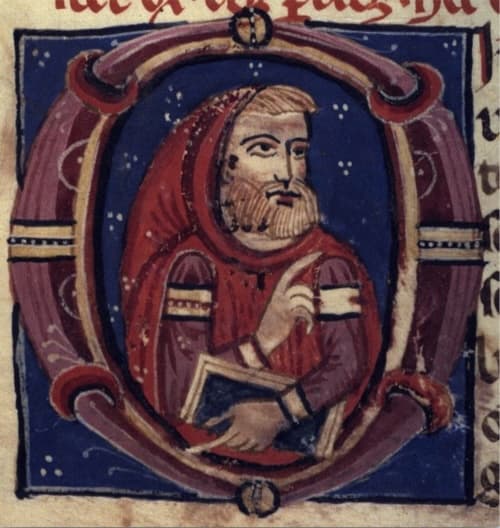
Portrait of Michael Scot.
The Interpreter of Hidden Order
Born in the late 12th century, Michael Scot emerged as one of the most enigmatic intellectual figures of the High Middle Ages. A Scottish scholar who traveled across Europe — from Paris to Toledo to the court of Frederick II, Holy Roman Emperor — Scot became a key bridge between intellectual worlds, translating Aristotle and Arabic philosophy into Latin and helping reshape medieval thought.
But Scot was not merely a translator of texts. Across his works — from Liber introductorius to Liber physiognomiae — he consistently operated under a singular assumption: that reality is structured, symbolic, and ultimately interpretable. The stars, the body, the hand, the dream — all were expressions of a deeper order waiting to be read.
That's the INFJ signature: Ni synthesis paired with Fe purpose — he was not merely a translator of texts. He was a translator of meaning.
Michael Scot is best understood as INFJ — a type defined by the search for underlying patterns, symbolic meaning, and the interpretation of unseen structures shaping the visible world. His work is not driven by experimentation for its own sake, nor by the open-ended generation of ideas, but by a persistent effort to unify disparate phenomena into a coherent vision of reality.
Ni — Dominant
Scot's entire intellectual project is rooted in the belief that surface reality reflects deeper truth — reflecting dominant Ni.
In Liber physiognomiae, the human body becomes a symbolic map of inner character. In his astrological and alchemical writings, celestial and material forms become expressions of universal principles. Even his engagement with Arabic and Aristotelian thought reflects a desire not simply to collect knowledge, but to synthesize it into a unified understanding. He does not explore endlessly. He converges.
Fe — Auxiliary
Scot's system is not neutral — it is applied to human judgment and relational discernment — reflecting auxiliary Fe.
His physiognomy is explicitly framed as a way to distinguish virtue from vice, and trustworthiness from deceit. His work, dedicated to Frederick II, was meant to aid in evaluating people — advisors, allies, even potential partners. This reveals a consistent orientation toward understanding people in order to navigate human relationships. Ni vision in service of Fe purpose: knowledge that helps us live better together.
Ti — Tertiary
While symbolic and intuitive at its core, Scot's work is carefully structured — reflecting tertiary Ti.
He builds multi-factor systems, refines interpretive rules — such as the caution not to judge from one trait alone — and organizes knowledge into layered frameworks. This reflects Ti not as the driver, but as a supporting tool — giving internal coherence to insights derived from intuition.
Se — Inferior
Scot engages heavily with physical observation — faces, bodies, hands, natural phenomena — but these are never treated empirically, reflecting inferior Se.
Instead, they are interpreted as signs — surface manifestations of deeper truths. Se is present, but always in service of Ni. The physical world is not a domain of direct experience but a readable text, meaningful only insofar as it points beyond itself.
Why INFJ Over ENFP
Why not ENFP?
ENFP is the closest alternative and explains Scot's cross-cultural movement, intellectual curiosity, and engagement with diverse ideas. However, the core difference lies in direction. ENFP explores outward, generating possibilities and embracing multiplicity. Scot does not remain in open-ended exploration. Instead, he repeatedly moves toward integration and synthesis, building systems that attempt to explain reality as a whole. More importantly, ENFPs tend to resist reducing individuals to fixed categories, prioritizing personal nuance. Scot, by contrast, constructs generalized interpretive frameworks that map external features to inner character. He is not saying “each person is uniquely felt” — he is saying “each person can be understood through a deeper pattern.” That is Ni, not Ne.
Connected Figures
Further Reading
- Michael Scot — Lynn ThorndikeThe foundational modern monograph on Scot's life, translations, and works on astrology and natural philosophy (1965).
- The Introduction of Arabic Learning into England — Charles BurnettExplores the broader translation movement of which Scot was a central figure, tracing Arabic science into Latin Europe.
- Frederick II: A Medieval Emperor — David AbulafiaThe definitive biography of Scot's imperial patron; gives essential context for the Palermo court where Scot worked.
