 Historical Figure MBTI
3 min read
#111 · 3-13-26 · The Medieval Mediterranean
Pope Gregory IX
Head of the Catholic Church, codifier of canon law, and defender of orthodoxy.
1170 — 1241
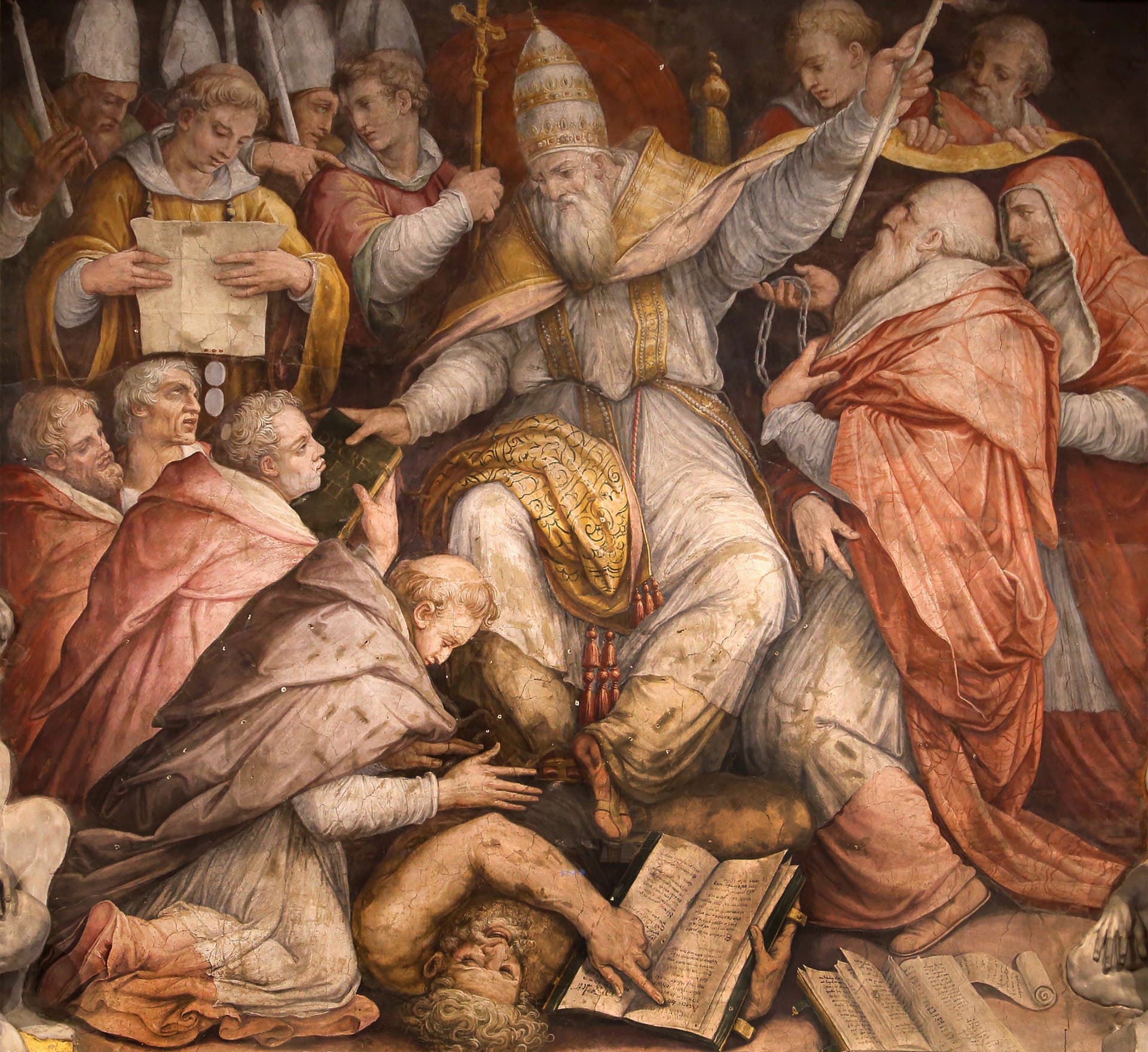
Portrait of Pope Gregory IX.
The Guardian of Order
Born around 1170 into a powerful Roman noble family, Pope Gregory IX (Ugolino dei Conti) was raised within the very structures he would later defend. As the nephew of Pope Innocent III, he grew up close to the center of papal authority, absorbing both its responsibilities and its worldview from an early age.
Educated in theology and canon law, Gregory developed a mindset grounded in doctrine, precedent, and institutional continuity. Unlike figures who rise by reshaping systems, Gregory's life reflects deep alignment with an existing structure — one he believed must be preserved and upheld.
That's the ISTJ signature: Si tradition paired with Te enforcement — when he became pope in 1227, he did not seek to redefine the Church. He sought to defend it.
Pope Gregory IX is best understood as ISTJ — a personality defined by adherence to established order, internalized standards, and structured enforcement. He did not approach leadership as an opportunity to innovate or explore. He approached it as a responsibility to maintain what was already known to be correct.
Si — Dominant
Gregory's worldview was rooted in tradition, precedent, and continuity — reflecting dominant Si.
Having been raised within the Church's highest circles, he internalized its doctrines and authority structures deeply. He did not question the system. He embodied it. This is evident in his unwavering commitment to orthodoxy and his sensitivity to deviation. Actions were judged not by whether they worked, but by whether they aligned with what had been established as correct.
Te — Auxiliary
Gregory enforced his standards decisively — reflecting auxiliary Te.
He excommunicated rulers who defied the Church, asserted papal authority over secular leaders, and acted quickly and firmly in response to perceived violations. His leadership was not exploratory but executory — applying structure, issuing judgments, and maintaining order through clear action. His compilation of canon law — the Decretals — exemplifies this: a systematic codification of established precedent, not an innovation, but a structure made permanent.
Fi — Tertiary
Gregory's decisions appear anchored in a strong internal sense of moral correctness — reflecting tertiary Fi.
His actions were not merely procedural, but driven by conviction. This is visible in his repeated conflicts with Frederick II, Holy Roman Emperor, where even successful outcomes were rejected if they did not align with proper form. For Gregory, correctness outweighed effectiveness. That is not a strategic calculation. It is a deeply held personal standard.
Ne — Inferior
Gregory showed little interest in exploring alternative approaches or entertaining new possibilities — reflecting inferior Ne.
He did not engage in open-ended intellectual exchange or philosophical experimentation. Deviation from established structure was not seen as an opportunity, but as a threat. Where Frederick II gathered scholars to debate freely, Gregory saw such openness as dangerous.
Why ISTJ Over ESTJ
Why not ESTJ?
While Gregory exercised authority, his behavior does not reflect the outwardly directive, system-optimizing nature of Te-dominant leadership. He did not seek to reorganize or expand the system for efficiency. Instead, his actions consistently reflect preservation and enforcement of what already existed. His compilation of canon law was not an innovation, but a codification of established precedent, aligning more with Si dominance than Te dominance.
Connected Figures
Further Reading
- The Papal Monarchy: The Western Church from 1050 to 1250 — Colin MorrisEssential survey of the medieval papacy at its height, covering Gregory IX's place in the tradition of Gregorian reform.
- Pope and Emperor in the Middle Ages — Brian TierneyExamines the constitutional conflict between papal and imperial authority — the framework for Gregory's war with Frederick II.
- The Wonder of the World: A Novel of Frederick II — Henry BenrathHistorical fiction, but grounded — useful for understanding the Frederick–Gregory dynamic from the imperial side.
- Canon Law and the Letters of Pope Gregory IX — Kenneth PenningtonScholarly study of the Decretals and their role in systematizing medieval canon law.
