 Historical Figure MBTI
4 min read
#110 · 3-13-26 · The Medieval Mediterranean
Pope Innocent III
Head of the Catholic Church, architect of papal supremacy.
1160 — 1216
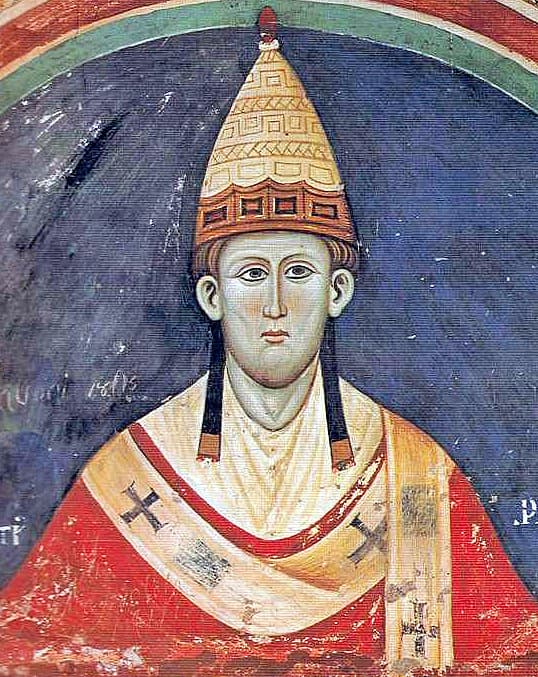
Portrait of Pope Innocent III.
The Architect of Order
Born in 1160 into a noble Roman family, Pope Innocent III was shaped not by battlefield ambition or courtly charisma, but by study. Raised within the structures of Roman aristocracy and educated in theology at Paris and canon law at Bologna, he developed a rare combination of abstract reasoning and institutional understanding.
Unlike many medieval figures who rose through visibility or influence, Innocent's ascent appears rooted in intellectual credibility. He was not known for flamboyance or social magnetism, but for discipline, seriousness, and competence. When he was elected pope in 1198 at the age of thirty-seven, he did not arrive as a charismatic leader — he arrived as someone already prepared. What followed was not improvisation. It was implementation.
Pope Innocent III is sometimes interpreted as an ENTJ due to his authority and political impact. However, his personality is more accurately understood as INTJ — defined not by ambition for power itself, but by the execution of a coherent vision of order.
That's the INTJ signature: Ni vision paired with Te execution — he did not rise in order to gain power. He gained power and then aligned the world to what he believed it should be.
Ni — Dominant
Innocent's leadership was guided by a singular, internally consistent vision — reflecting dominant Ni.
He saw the Church not as one institution among many, but as the central structure through which all earthly power should be ordered. This vision was not reactive or opportunistic. It was applied consistently across kings, emperors, and institutions, reflecting Ni's tendency to compress complexity into a unified model of reality. His worldview was not exploratory — it was definitive.
Te — Auxiliary
Once in power, Innocent acted decisively to implement his vision — reflecting auxiliary Te.
He excommunicated rulers who defied the Church, placed kingdoms under interdict, intervened in imperial succession, and asserted the pope's authority over secular governance. These actions were not driven by expansion for its own sake, but by the enforcement of a system. His use of power was structured, consistent, and purposeful — reflecting Te in service of Ni.
Fi — Tertiary
Innocent's authority appears grounded in a deep internal conviction about moral and spiritual order — reflecting tertiary Fi.
His writings, including De Miseria Humanae Conditionis, reflect a firm belief in the nature of humanity, sin, and hierarchy. He did not argue for authority as a strategy. He believed in it as a necessity. His actions were not merely procedural, but driven by conviction about what was right.
Se — Inferior
Innocent was not defined by charisma, theatricality, or physical presence — reflecting inferior Se.
He did not lead through spectacle or emotional appeal, but through structure and decree. His influence was not immediate or reactive, but sustained and systemic. In a world full of commanding personalities, Innocent's power came from the consistency of his vision, not the force of his presence.
Why INTJ Over ENTJ
Why not ENTJ?
While Innocent exercised immense authority, his behavior does not reflect the outward ambition or adaptive strategy typical of Te-dominant leaders. He did not appear to pursue power through social maneuvering or expansion for its own sake. Instead, his actions were remarkably consistent and ideologically driven. His writings and decisions suggest that power was not the goal, but the means through which a pre-existing vision of order was realized. That orientation toward internal vision over external command is the hallmark of Ni over Te.
Connected Figures
Further Reading
- Innocent III: Leader of Europe, 1198–1216 — Jane SayersThe standard modern biography in English — covers his theology, politics, and institutional legacy with precision.
- Pope Innocent III and His World — John C. MooreA comprehensive study of Innocent's pontificate situating him in the broader medieval political and ecclesiastical landscape.
- The Medieval Papacy — Geoffrey BarracloughPlaces Innocent within the long arc of papal power — essential for understanding what he built upon and what he bequeathed.
- De Miseria Humanae Conditionis — Pope Innocent III (Lotario dei Segni)Innocent's own pre-papal treatise on the wretchedness of the human condition — a window into his moral convictions before power.
