 Historical Figure MBTI
#697 · 5-25-26 · The Age of Exploration
Martín Alonso Pinzón
Shipowner of Palos · Captain of the Pinta · Columbus's Rival Partner
1441 — 1493
9 min read
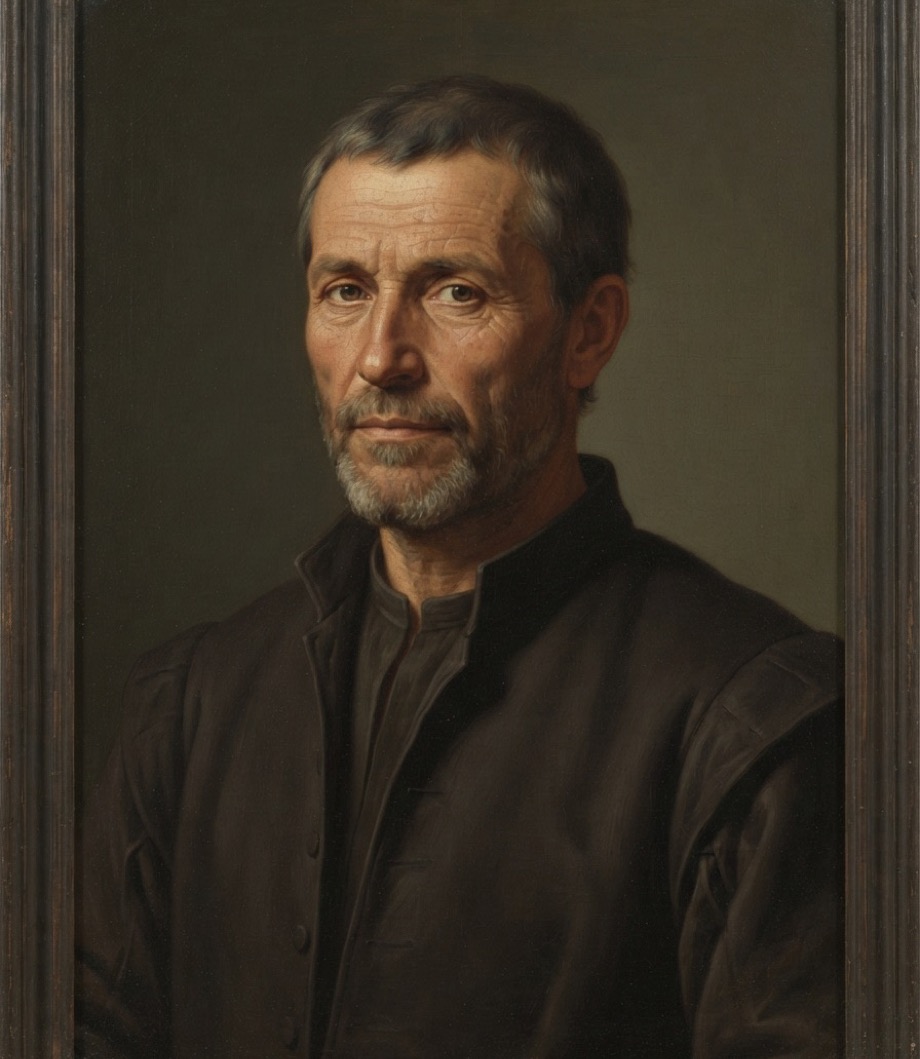
AI-assisted Portrait of Martín Alonso Pinzón
The Man Who Made the Voyage Possible, Then Vanished From It
Before there was a fleet, there was a problem: no crew in Palos wanted to sail west into open water on the word of a Genoese stranger with a royal letter and no ships of his own. Christopher Columbus could plan the voyage; he could not staff it. Martín Alonso Pinzón could — and did. A shipowner, pilot, and the most respected mariner in the port, Pinzón is thought to have helped cover part of the expedition's costs and personally walked the docks vouching for the enterprise, turning royal paper into three actual crewed ships. He then took the Pinta's helm himself. This was not the profile of a visionary; it was the profile of an ESTP — a man built for the concrete, the physical, and the immediate, who trusted his hands and his reputation over anyone's abstract chart of the ocean.
That trust in the present moment defined the entire voyage. Pinzón is credited by several crew accounts with being the first to spot the signs — the birds, the branches, the changed color of the water — that argued for turning the fleet's course in the final days before landfall, and some traditions hold he sighted land itself before Rodrigo de Triana's famous cry ever went up from the Pinta. He was a doer, reading the world directly off its surface, acting on what was in front of him rather than what theory said should be there. Once in the Caribbean, that same instinct pulled him away from Columbus's authority entirely: without permission, without a plan filed and approved, he split off in search of gold, chasing rumor and opportunity on his own initiative. It was reckless. It also nearly worked.
Pinzón's story does not end in glory. He beat Columbus back to Spain, was becalmed and forced to make port separately, and reportedly died within days of returning — spent by the crossing, denied any real chance to press his claim to a share of the credit. What survives him is less a legend than a corrective: the discovery of the New World was not one man's solitary vision but a joint venture of Palos capital, seamanship, and nerve, and Pinzón supplied most of the last two.
Pinzón was an ESTP to the bone — dominant Extraverted Sensing wearing a captain's coat, reading the sea and the moment with a directness Columbus's visions never had.
A Reputation Built on What He Could Deliver
Extraverted Sensing is the function of the immediate world — physical, present, actionable — and Pinzón's entire biography reads as a demonstration of it. His authority in Palos was not inherited or theorized; it was earned ship by ship, voyage by voyage, in a trade where a wrong reading of wind or coastline killed men. When Columbus needed sailors willing to risk the Ocean Sea, it was Pinzón's word on the docks, not the crown's letter, that closed the deal. Men signed on because they trusted a captain they'd sailed with, not a stranger's theory of the earth's shape.
At sea, that same sensory command showed constantly. Pinzón is remembered for reading the natural signs of nearby land — birds flying in formation, drifting vegetation, a shift in the water's color — and pushing to alter course on that evidence days before anyone else was willing to commit to it. This is Se doing what it does best: trusting direct, immediate data over doctrine, and acting on it decisively rather than waiting for confirmation from above.
It also explains his most controversial act. Once ashore in the Caribbean, Pinzón broke from the fleet to chase rumors of gold on Hispaniola's coast, answering to no one but the opportunity in front of him. A more cautious type would have stayed in formation, deferring to the expedition's chain of command; Pinzón simply went. It was insubordinate, unilateral, and entirely in character — the same appetite for immediate action that built his career now working against the mission's cohesion.
A Pilot's Private Logic
Beneath the bravado sat a working mind that had to get the mechanics right, and this is where Introverted Thinking did its quiet labor. Navigation in 1492 was a craft of internal calculation — dead reckoning, currents, the set of a ship's rigging against a given wind — performed largely alone, in a captain's own head, with no instrument to check it against beyond experience and arithmetic. Pinzón's decades on the water had built exactly that kind of private, tested system, and it is why the crown and Columbus alike needed him rather than merely tolerated him.
His break from the fleet in the Caribbean was not just an Se impulse; it was one backed by a Ti sailor's confidence in his own competence to navigate independently and find his way back. He did not need Columbus's chart to trust his position — he trusted his own reckoning, built ship-length by ship-length over a lifetime, and that self-contained certainty is what let him act alone without hesitation.
Where Ti auxiliary usually shows as a taste for abstract systems, in a practical operator like Pinzón it showed instead as an unspoken, unshowy expertise — the kind that doesn't explain itself because it has never needed to. He rarely appears in the record arguing theory; he appears making the correct call and letting the outcome argue for him.
The Recruiter's Charm
Tertiary Extraverted Feeling explains what Se and Ti alone cannot: how a shipowner with no royal commission talked frightened, superstitious sailors into boarding three small vessels bound for the edge of the known world. Pinzón's standing in Palos was social as much as nautical — he understood the town's mood, its debts, its rivalries, and its hunger for a windfall, and he pitched the voyage in those terms rather than Columbus's grander, more abstract vision of a westward route to the Indies.
That same social fluency let him operate as a genuine partner in the enterprise rather than a subordinate — recruiting family members and townsmen onto the Pinta and the Niña, smoothing tempers, keeping a fractious crew cohesive across a crossing many of them feared would kill them. It is a lower-stakes, more instinctive Fe than a natural people-reader would show — tertiary rather than dominant — but it was decisive precisely where Columbus's own social skills with his own countrymen were thin.
It also curdled, in the end, into rivalry. Fe in this position can tip toward wanting the group's recognition rather than merely the group's cohesion, and Pinzón's late scramble for gold and his rush to beat Columbus home read as much as a bid for personal credit and standing as for profit.
A Blind Spot for the Long View
Inferior Introverted Intuition is where the type's weakness shows, and Pinzón's final months display it plainly. He had no real feel for how his unauthorized detour in search of gold would look once the fleet reunited, no long-range read on how the crown or history would weigh a captain's initiative against a captain's insubordination. He acted for the moment's payoff and let the future sort itself out — which it did, unkindly.
The race home is the clearest case. Rather than coordinate a return with Columbus, protecting a shared account of the voyage's success, Pinzón sailed for Spain on his own, evidently hoping to reach the crown first and claim precedence for the discovery. It was a short-horizon gambit from a man with no real strategy for what came after — and it failed; storms delayed him, Columbus arrived first, and Pinzón landed to find the credit already claimed.
He died within days, reportedly worn down by illness contracted on the voyage, before any reconciliation or vindication could reach him. It is a very ESTP ending: a life spent entirely in the present tense, with no inferior-function capacity left over to manage the legacy that present tense would leave behind.
Why ESTP Over ISTP
Why not ISTP?
An ISTP shares Pinzón's hands-on competence and comfort with direct, physical problem-solving, but leads with an inward, private Ti rather than an outward, socially engaged Se. It does not explain how Pinzón built a public reputation across an entire port town, recruited crews personally, or operated as a visible, persuasive figure rather than a reserved technician. His extraversion was not incidental to his skill — it was the mechanism by which that skill became a fleet.
ESTP fits because every documented act points outward and forward at once: reading the sea in real time, recruiting through personal charisma, breaking formation on a gambler's instinct, and racing home on nothing but present-tense urgency. There is no evidence anywhere in his record of the patient long-range planning, the introspective theorizing, or the guarded reserve that would argue for almost any other type. He was a man of the moment, for better and for worse, from the docks of Palos to his final harbor.
Connected Figures
Further Reading
- Nueva lista documentada de los tripulantes de Colón en 1492 — Alice Bache Gould (Real Academia de la Historia, 1984)The documentary backbone for who actually crewed the 1492 fleet, Pinzón included.
- Columbus — Felipe Fernández-Armesto (Oxford University Press, 1991)A skeptical, well-sourced account that restores Pinzón's role against the solitary-genius myth.
- Columbus: The Four Voyages — Laurence Bergreen (Viking, 2011)A narrative history covering the recruitment in Palos, the crossing, and Pinzón's fatal split from the fleet.
