 Historical Figure MBTI
#698 · 5-25-26 · The Age of Exploration
Bartholomew Columbus
The Brother Who Governed · Adelantado of Santo Domingo
c. 1461 — 1515
3 min read
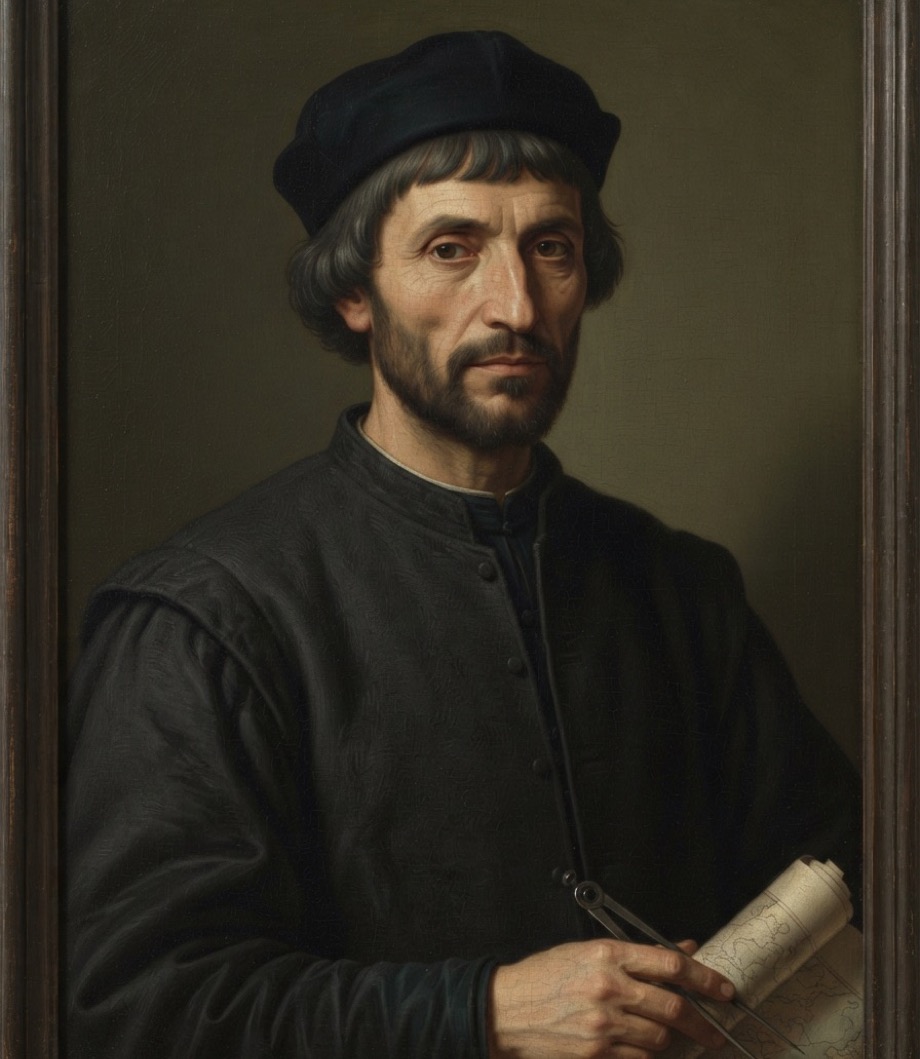
AI-assisted Portrait of Bartholomew Columbus
The Man Who Stayed to Govern
History remembers the Columbus who sailed — the one who stood on a foreign shore and declared it the edge of paradise, who wrote of destiny and divine favor, who mistook conviction for evidence three times over and never once revised the map in his head. It remembers less well the Columbus who stayed behind to run the place his brother discovered, because running a place is duller than discovering it, and duller stories get told less often. But Bartholomew Columbus was there for the part that actually mattered — the part where a scattering of starving, mutinous Spaniards and an already-hostile Taíno population had to be governed, fed, defended, and kept from tearing each other apart, month after month, with no map for any of it.
He had trained as a cartographer in Lisbon, drawing coastlines other men would later sail past. It was careful, exacting work, the kind that rewards patience over imagination, and it suited him. When Christopher went looking for someone he could trust with the thing he could not be bothered to do himself — actually administering Hispaniola — he sent for his brother. Christopher granted him the title Adelantado and handed him the colony's daily catastrophe: the food shortages, the forts, the punitive expeditions, the endless management of men who had come across an ocean expecting gold and found labor instead.
Where Christopher supplied the myth, Bartholomew supplied the ledger — and someone, eventually, always has to balance the ledger.
The Adelantado's Ledger
What survives of Bartholomew in the record is almost entirely procedural — where he built, who he fought, what he requisitioned, how he tried to hold a colony together that was, by any honest account, falling apart around him. He put down uprisings, negotiated with restive settlers, founded Santo Domingo itself as a functioning town rather than a fortified camp, and did it all as the deputy of a man who was, by then, mostly absent and increasingly erratic. This was not glamorous work. It required the opposite temperament from his brother's: attention to what was actually in front of him rather than what he wished were true, a willingness to grind through the unglamorous logistics of feeding and defending a colony rather than chase the next horizon.
He was, by every surviving account, loyal past the point most men would have stopped being loyal. When Christopher's governorship collapsed — when the Crown, alarmed by reports of cruelty and incompetence, sent an investigator who arrested Christopher and shipped him home in irons — Bartholomew went too, arrested alongside a brother whose failures were not, strictly, his own. He did not distance himself. He did not use the moment to seize the colony for himself, though he plausibly could have. He simply absorbed the fall as part of the job, the way a foundation absorbs the weight of whatever is built on top of it.
That loyalty was not blind sentiment; it read more like an internalized sense of duty — a private, settled conviction about what a brother owed a brother, held to regardless of whether the world was watching or rewarding it. He was not chasing Christopher's vision so much as honoring an obligation he had quietly decided was his to keep. It is the least mythologized kind of steadiness, and the kind an empire actually runs on.
Connected Figures
Further Reading
- Columbus — Felipe Fernández-ArmestoCovers Bartholomew's governorship of Hispaniola in detail.
- Columbus: The Four Voyages — Laurence BergreenTraces the brothers' relationship through the collapse of the Hispaniola colony.
