 Historical Figure MBTI
#711 · 5-27-26 · The Age of Exploration
Martin Waldseemüller
Cartographer of Saint-Dié · The Man Who Named America
c. 1470 — 1520
2 min read
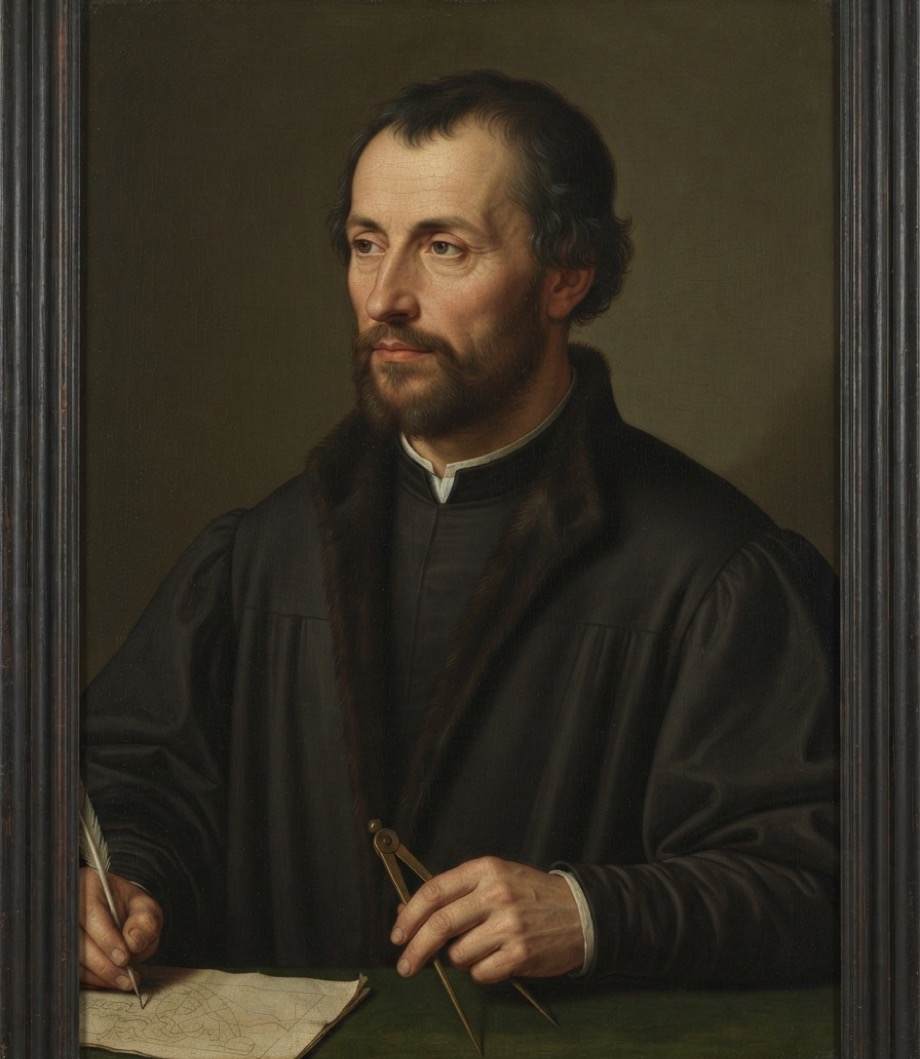
AI-assisted Portrait of Martin Waldseemüller
A Name, Set Down Almost in Passing
Martin Waldseemüller does not survive in the record as a personality — no letters of complaint, no rivalries, no anecdotes of temper or charm. What survives is a map, and a habit of mind visible only in the map's margins: a small circle of scholars at Saint-Dié, in the hills of Lorraine, working through classical geography and the fresh, half-credible reports coming out of the Atlantic, and trying to reconcile the two on paper.
In 1507 that reconciliation produced the Universalis Cosmographia, a world map printed to accompany a slim volume that included a Latin rendering of Amerigo Vespucci's letters — letters arguing, against the inherited authority of Ptolemy, that the lands across the ocean were not the eastern edge of Asia but something the classical geographers had never mapped at all. Waldseemüller found the argument sufficient. On the southern landmass he printed a name: America, a Latinized, feminized form of Amerigo, built on the same logic that had given Europe, Asia, and Africa their names — a continent, a mythic or historical namesake. It was a philologist's solution to a cartographer's problem, decided by one man, alone with his sources, and it stuck long before anyone thought to ask whether it should.
Nothing about the decision suggests bravado. Waldseemüller was not trying to make himself famous by proxy, and he was not staking a claim on Vespucci's behalf against Columbus or anyone else. He was closing a taxonomic gap the way a careful reader closes any gap in a system — by finding the rule already in use elsewhere and applying it consistently. That the rule happened to fix, for the rest of history, whose name a hemisphere would carry was, to him, incidental.
He named a continent the way an INTP settles most things — quietly, by the logic of the evidence in front of him, with no thought that the decision might outrun his authority to make it.
Connected Figures
Further Reading
- The Naming of America: Martin Waldseemüller's 1507 World Map and the Cosmographiae Introductio — John HesslerThe standard scholarly account of the map, the book, and the naming decision itself.
- The Fourth Part of the World — Toby LesterA full narrative history of the 1507 map's creation and its afterlife.
