 Historical Figure MBTI
#712 · 5-27-26 · The Age of Exploration
Peter Martyr d'Anghiera
Court Chronicler · Coiner of 'New World' · Early Critic of the Encomienda
1457 — 1526
3 min read
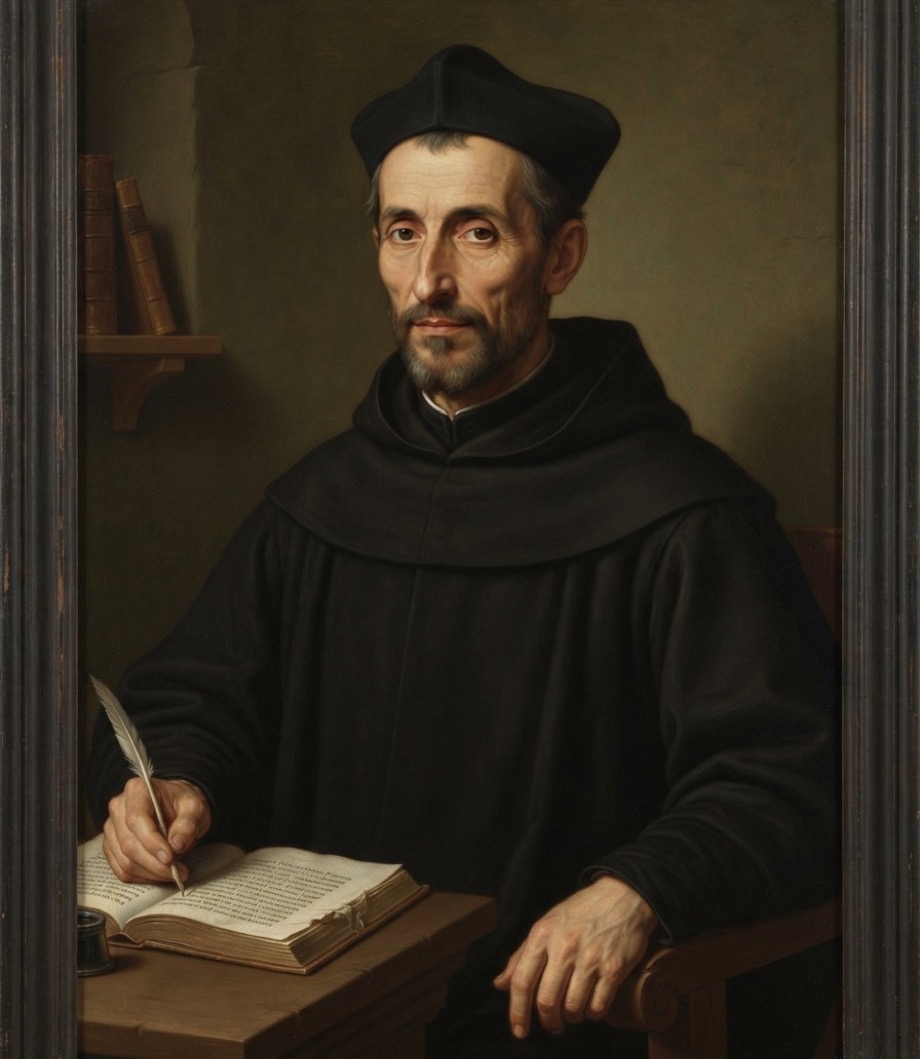
AI-assisted Portrait of Peter Martyr d'Anghiera
A Scholar Who Never Sailed
Peter Martyr d'Anghiera spent his career in the antechambers of history rather than on its stage. An Italian humanist drawn to the Spanish court under Isabella and Ferdinand, he tutored young nobles, said Mass, advised on colonial appointments, and did a hundred small administrative things — but the ships that mattered to him left without him aboard. He never saw the Caribbean, never walked a shore in the Americas, never met an ocean he wrote about with such hunger. What he had instead was proximity: a chair at court where returning captains, disembarking officials, and half-literate sailors' testimonies all eventually passed through, and a habit — obsessive, almost involuntary — of writing it all down.
That habit became "De Orbe Novo," a running series of letters composed as events unfolded, beginning in the 1490s and continuing for decades. It was the first sustained European attempt to make sense, in real time, of what was being found across the Atlantic — and it gave the era the name it still carries: the New World, Novus Orbis, coined by a man who watched it arrive secondhand and never once touched it himself.
He typed as INFP — a man who processed the New World not through ambition or command but through private conviction, curiosity, and a quiet, private uneasiness he rarely let become argument.
He never organized a faction, never petitioned the crown for reform, never published a polemic in his own lifetime the way Las Casas eventually would. What survives instead is tone — the accumulated weight of small, private judgments scattered across decades of letters, each one modest on its own, each one a data point in a man quietly refusing to let ambition or courtly caution flatten what he had heard. It is not the record of a reformer. It is the record of someone who kept noticing, and kept writing it down anyway.
Connected Figures
Further Reading
- De Orbe Novo: The Eight Decades of Peter Martyr d'Anghera — Peter Martyr d'Anghiera, trans. Francis MacNuttThe letters themselves, published in installments from the early 16th century and translated in full in 1912.
- European Encounters with the New World — Anthony PagdenSituates Martyr's letters within the broader intellectual struggle to comprehend the Americas.
