 Historical Figure MBTI
#691 · 5-24-26 · The Age of Exploration
Isabella I of Castile
Queen of Castile · Unifier of Spain · Patron of Columbus
1451 — 1504
10 min read
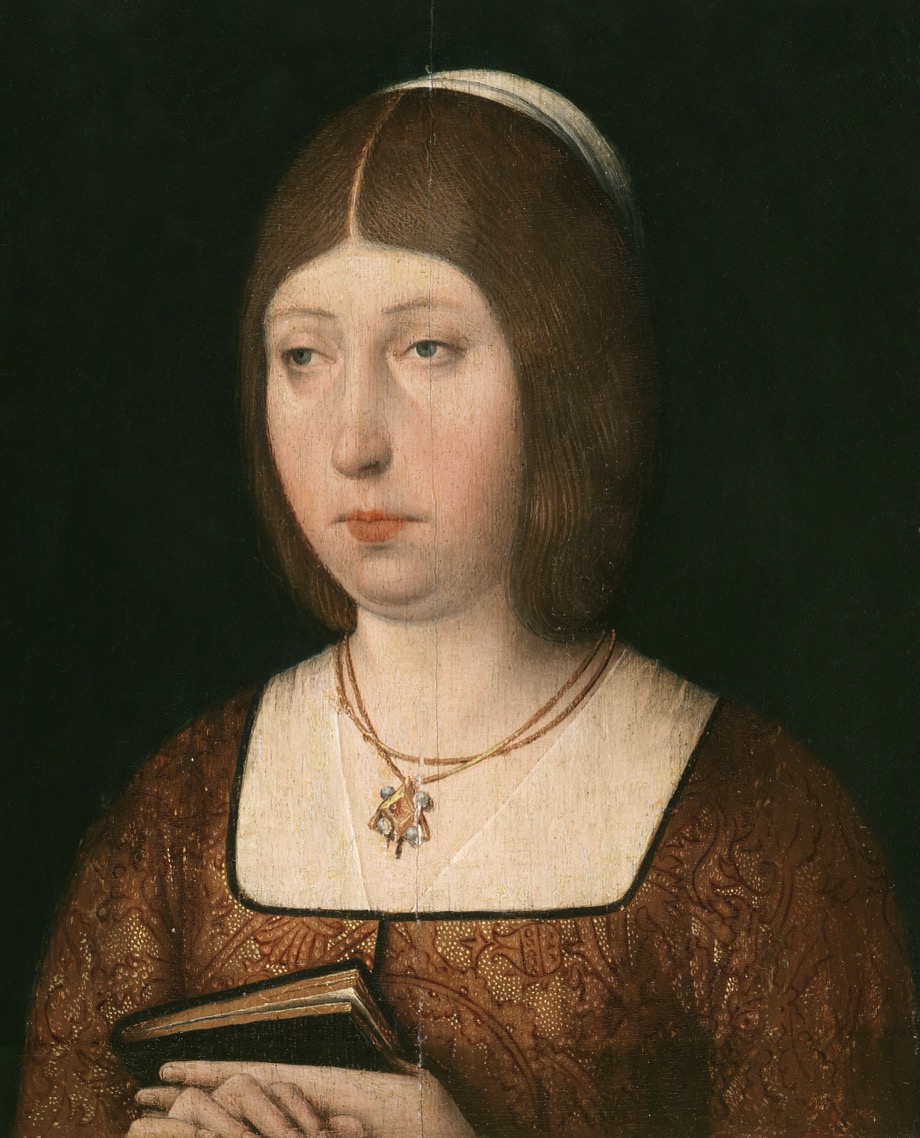
Portrait of Isabella I of Castile
The Queen Who Drew the Map First
In October 1469, an eighteen-year-old princess slipped out of her half-brother’s reach, rode to Valladolid, and married a seventeen-year-old Aragonese prince who had crossed Castile in disguise as a servant. The papal dispensation they produced for the ceremony was a forgery. The king they were defying was her own brother, Enrique IV, who had every intention of marrying her to Portugal and keeping Castile in his daughter’s hands. Isabella married Ferdinand anyway, because the map she had drawn in her head required Aragon, and no other husband on offer supplied it.
Everything that followed reads as the same map being filled in. She fought a five-year succession war against her niece Juana — la Beltraneja, so called because half of Castile believed her fathered by the royal favorite Beltrán de la Cueva — and won it at Toro in 1476. She spent a decade grinding the emirate of Granada down fortress by fortress, and on 2 January 1492 took its keys from Boabdil, closing a reconquest that had run for seven hundred and eighty years. In March of the same year she signed the Alhambra Decree and gave Castile’s Jews four months to convert or leave. In April she signed the Capitulations of Santa Fe and sent a Genoese fantasist west across an ocean nobody had crossed. Three acts of enormous consequence in ninety days, all of them serving one idea she had held since adolescence: a single, sovereign, Catholic Spain.
That is the shape of an INTJ life — not the improvisation of a brilliant opportunist but the patient, decades-long construction of something first seen whole. Isabella did not react to Castile. She had a picture of what Castile was supposed to become, and she spent thirty years removing whatever stood between the country and the picture: her brother’s will, her niece’s claim, the grandees’ private armies, the Nasrid dynasty, and finally the religious plurality of her own kingdom. The cost of that picture was borne by other people. She never appears to have doubted it was worth paying.
Isabella is the archive’s cleanest portrait of INTJ Ni: a single image of the finished thing, held for thirty years, with every institution she touched bent into the shape of a step toward it.
The Thirty-Year Line
Dominant introverted intuition is not prophecy; it is the refusal to be interested in more than one future. Isabella’s Granada campaign is the model case. She did not fight it as a war of battles — there was no decisive field engagement to win. She fought it as a program: take Alhama in 1482, Ronda in 1485, Loja, Málaga in 1487, Baza in 1489, then sit down in front of the capital and build a town. Santa Fe went up in front of Granada in stone, in the shape of a cross, because Isabella intended the siege to outlast any season the defenders could wait out. Ten years of methodical strangulation, financed by taxes and papal crusade bulls she personally chased, aimed at a single frame she had carried since girlhood: the last emir handing over the keys.
The same singularity governs the 1492 decisions that historians still find morally incomprehensible when set beside her piety. Ni does not weigh plural goods; it subordinates everything to the one picture. A unified Catholic Spain, in her conception, could not contain a Jewish population — not because she reasoned to that conclusion in 1492, but because the picture never had them in it. The Alhambra Decree was drafted three months after Granada fell, and the sequence is not coincidence: the last Muslim kingdom removed, the Jewish communities removed next. Between eighty and two hundred thousand people were forced out or forced to the font. She had already, in 1478, obtained the bull establishing an Inquisition under royal rather than papal control, and installed her Dominican confessor Tomás de Torquemada as its first Inquisitor General. Nothing about this was reluctant or delegated away. It was the vision reaching its logical terminus, and she signed every stage of it.
Columbus is the counterintuitive proof. The royal cosmographers were right and Columbus was wrong — his globe was far too small, and the Talavera commission rejected him twice on sound technical grounds. Isabella funded him anyway, at the moment of maximum expense, weeks after a war that had emptied her treasury. An ISTJ treasury mind does not do this; a sensor weighing the ledger does not do this. She did it because the picture had an outer edge she wanted filled — a route to the Indies that outflanked Portugal and carried the faith with it — and the cost of three ships was trivial against the size of the thing if it worked. That is Ni arithmetic: absurd odds are acceptable when the payoff is the vision itself.
Machinery Built to Outlive Her
Isabella inherited a kingdom where the crown was one magnate among many. Her auxiliary extraverted thinking went to work on that condition with an engineer’s lack of sentiment. At the Cortes of Toledo in 1480 she revoked the grants Enrique IV had scattered to buy loyalty, clawing back roughly thirty million maravedís in annual revenue from the nobility in a single legislative stroke. She ordered illegally built castles demolished. She nationalized the Santa Hermandad — the towns’ old vigilante leagues — into a crown-funded rural police with its own summary courts, giving the monarchy something no Castilian ruler had possessed: a standing armed force answerable to her rather than to a duke.
Then she staffed the state with people who owed her everything. The corregidores — royal magistrates planted in the cities over the heads of local oligarchies — were the instrument, and Isabella filled those posts and her councils with university-trained letrados and lesser gentry rather than grandees, because a bureaucrat with no lineage cannot become a rival. She sat in judgment personally, riding circuit and hearing petitions; she pushed through the codification that became the Ordenanzas Reales. And she ran an itinerant court on horseback for decades, covering thousands of miles a year, present in person wherever royal authority needed a face.
The partnership with Ferdinand shows the division precisely. Tanto monta, monta tanto was not a courtesy: Castile was hers by right, and she signed, taxed, appointed, and made war in her own name. Ferdinand’s gift was tactical — the ENTP diplomat, improvising alliances, reading a room, running Italy. Hers was structural. She designed the machine; he and the letrados operated it. Every treaty he negotiated advanced an objective she had fixed years earlier, and after her death in 1504 the difference showed immediately: Ferdinand kept ruling well, but nothing new of that magnitude was ever conceived again.
A Conscience With No Door In It
Tertiary introverted feeling in an INTJ is a private, absolute, unarguable moral core — not warmth, and not responsiveness to the feelings of others. Isabella’s was severe and entirely internal. She wore the Franciscan habit in later life, chose confessors for their austerity rather than their flexibility, and picked Francisco Jiménez de Cisneros — a hermit who had to be ordered by the pope to accept the see of Toledo — over every ambitious courtier-prelate in Spain. When she wanted Torquemada, she wanted the hardest man available, and got him.
That same core produced her one famous act of protection. On hearing that Columbus had shipped Taíno captives back to be sold in Seville, she stopped the sale and had them returned, and her will of 1504 instructed her heirs that the Indians be treated justly and suffer no harm in their persons or their goods. The instinct is real — but note its logic. Baptized subjects of the crown fell inside her moral circle and were therefore inviolable; those who refused the faith fell outside it, and the same conscience that shielded the Taíno signed the expulsion and lit the autos-da-fé. Fi draws a line, and what matters is which side of the line you stand on, not the weight of your suffering.
Her personal conduct followed the same interior standard: a marriage of unusual fidelity by the standards of fifteenth-century monarchs, a court purged of the licentiousness she had watched under her brother, a genuine and unfeigned devotion. It was never a conscience open to external appeal. Grandees, cities, ambassadors, and Jewish notables all discovered that arguments changed nothing once she had decided where the line ran. Abraham Seneor and Isaac Abravanel reportedly offered 300,000 ducats to buy off the expulsion. She refused.
The Queen in Armor at the Siege Line
Inferior extraverted sensing shows up as deliberate, performed physicality — the function used as a tool rather than inhabited. Isabella rode to the Granada front repeatedly, appeared before the army in armor, and understood exactly what the sight of the queen in the camp did to men who had been besieging a city for a decade. She reorganized the campaign’s logistics down to field hospitals — thehospital de la reina, six large tents that followed the army — and to the roads and bridges her engineers cut through the Alpujarras so artillery could reach places nobody had dragged guns before. This is a mind that grasped the physical world through planning, not through feel.
And when the physical world imposed itself directly, it broke her. During the siege of Málaga a Muslim assassin got into the royal camp and stabbed at the tent where he believed the sovereigns were, wounding two others by mistake; the response was not caution but hardening. More tellingly, the pattern of her last years is the pattern of an inferior function overwhelmed by grief that no amount of foresight could plan around. Her son Juan died in 1497 at nineteen; her daughter Isabel died in childbirth the next year; that grandson died at two; her daughter Juana went visibly mad. The architect of the dynasty watched the dynasty’s continuity dissolve in the flesh, and by all accounts stopped eating, stopped riding, and withdrew.
She died at Medina del Campo in November 1504, at fifty-three, having asked to be buried in the Alhambra — in a plain Franciscan habit, in the ground, in the city she had taken. Even the last instruction is Ni: the body placed where it would mean something permanent.
Why INTJ Over ISTJ
This is the archive’s hardest close call, and the ISTJ case is not weak. Look at what Isabella actually did day to day and you see a duty-bound administrator: revoking grants by statute, codifying law, appointing magistrates, sitting in judgment, keeping accounts, enforcing an inherited orthodoxy with inherited machinery, personally devout, personally austere, personally tireless. Her stated justification for nearly everything was precedent — the Reconquista was a duty owed to her ancestors, the Inquisition an institution of the Church, her claim to Castile a matter of law. Almost every documented act is procedural. Half the ISTJ profile is written in her handwriting.
Why not ISTJ?
Si builds from what has existed and defends it; Isabella repeatedly destroyed precedent to reach something that had never existed. The secret marriage broke her brother’s explicit will and required a forged dispensation. The Hermandad and the corregidores were not restorations but new instruments of a new kind of state. Funding Columbus against the unanimous judgment of her own expert commission is the single most un-Si decision available in the period — a sensor-judger defers to the data and the ledger, and she overrode both. Above all, an ISTJ inherits the system and maintains it; Isabella designed the system, and Ferdinand, the letrados, Cisneros, and Torquemada were the ones who ran it.
The resolution is that procedure was her instrument, not her orientation. Law, precedent, and bureaucracy were what she reached for because they were the most durable tools available for making an idea permanent — and durability, not tradition, was the point. The archive supplies the control case in her own bloodline: her grandson Charles V, the genuine ISTJ, inherited the machine she designed and spent a lifetime honestly, exhaustingly maintaining it across two continents, adding nothing to its founding conception and finally abdicating under its weight. Grandmother and grandson used the same instruments toward opposite ends: one built the thing, one carried it. That is the difference between Ni running the show and Si running it.
Connected Figures
Further Reading
- Isabel the Queen: Life and Times — Peggy K. LissThe standard English-language biography, revised 2004; strongest on her political formation and the machinery of Castilian rule.
- Isabella of Castile: Europe's First Great Queen — Giles TremlettVivid modern narrative that keeps the 1492 trio — Granada, the expulsion, Columbus — in a single frame.
- Isabella of Castile: The First Renaissance Queen — Nancy RubinDetailed on the succession war, the marriage negotiations, and her court's cultural program.
- Christian Sources on the Fall of Granada — Kenneth Baxter Wolf (ed.)Translated contemporary accounts of the conquest, useful for how 1492 was narrated at the time.
