 Historical Figure MBTI
#612 · 5-7-26 · The Reformation
Charles V
Holy Roman Emperor · King of Spain · The Empire on Which the Sun Never Set
1500 — 1558
8 min read
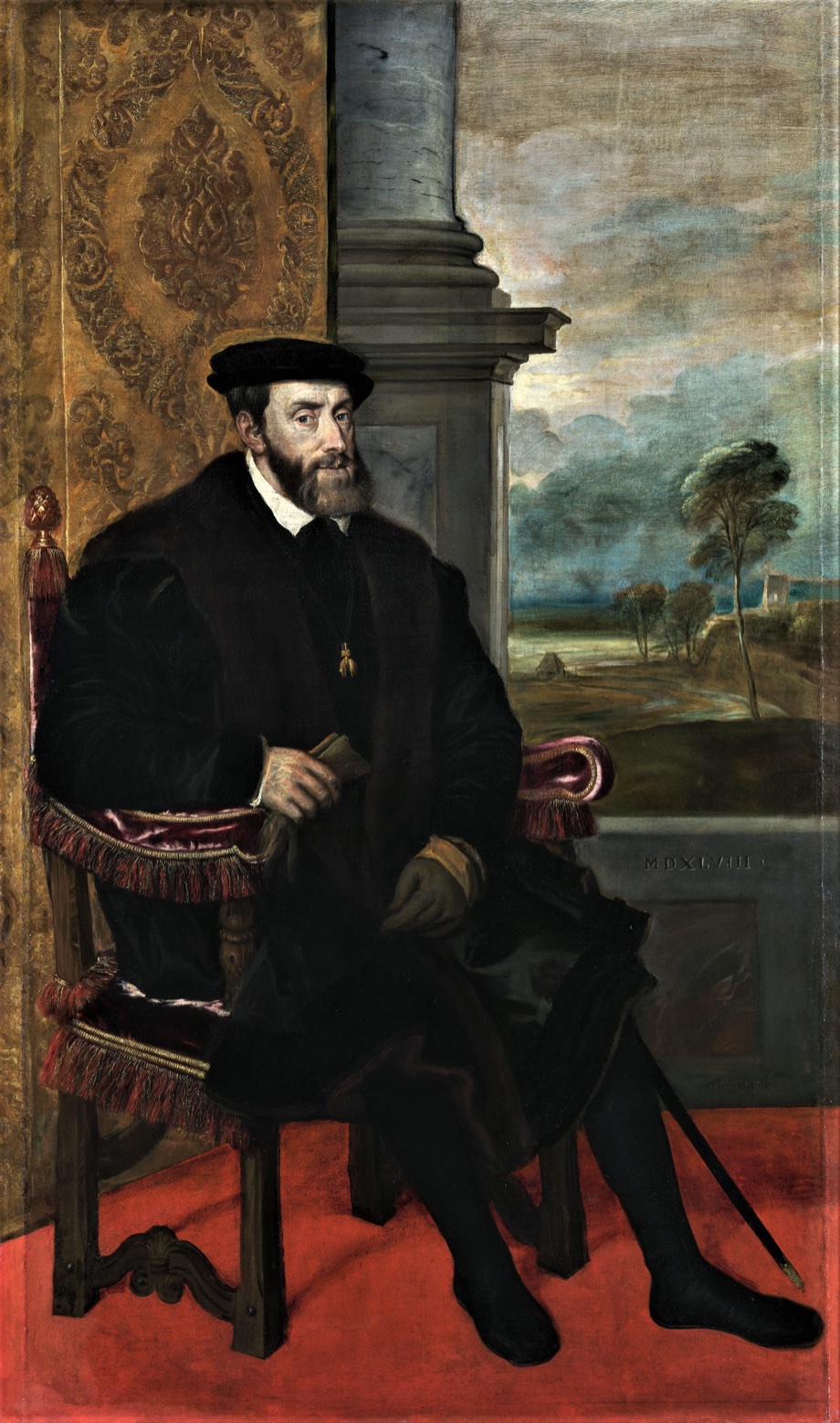
Portrait of Charles V
The Steward of an Impossible Inheritance
No one in Europe ever inherited more, and no one wanted it less. By an accident of Habsburg bloodlines, Charles of Ghent fell heir before the age of twenty to the largest dominion assembled since Charlemagne: the wealthy Netherlands where he was raised, Spain and its vast New World empire, Naples and Sicily, the Austrian lands of his father's house, and—when the electors chose him in 1519—the crown of the Holy Roman Empire. It was said that the sun never set on his realm; it was also said, by Charles himself, that he had spent his whole life travelling and fighting and had never known a year of true rest.
He was devout, dutiful, hardworking, and constitutionally melancholic—a man who read his inheritance not as an opportunity but as a charge laid on him by God and dynasty, to be defended and handed on intact. That is the temperament of the ISTJ: the steward who does not ask whether the given order should exist, only how it may be preserved. And Charles preserved with everything he had, crossing the Alps and the sea for four decades to fight the French in Italy, the Ottomans in the Mediterranean, and the Protestant princes of Germany—never to remake the world, always to keep it from coming apart in his hands.
Charles is the ISTJ as world-emperor: a man of immense power and almost no appetite for it, who carried an impossible inheritance out of pure Si duty—a conservative, Catholic, dynastic sense of obligation—and the grinding Te labor of administering and defending it, until the weight broke him and he simply laid it down.
The Weight of the Given World
Si — dominant
Dominant Si lives inside inherited order—tradition, precedent, the settled way of things—and experiences duty to that order as the deepest fact of existence. Charles did not conceive of his empire as his to reshape; he held it in trust, from his grandparents and for his heirs, and above all for the Catholic Church. When Luther's challenge reached him, his response was the reflexive loyalty of the conservator: at the Diet of Worms in 1521 he set down his creed in a few plain sentences, that he would stand by what his forefathers and the councils of the Church had always believed, and a single friar could not be right against a thousand years of Christendom. That is Si in its purest voice—the past as authority, continuity as truth.
The same conservatism ran through everything. Where a bolder ruler might have cut the empire's losses—abandoned Germany, say, to consolidate Spain—Charles could not surrender any part of the trust; he fought on every front at once because every front was a piece of the whole he had sworn to keep, winning his wars, when he won them, by patient outlasting. And Si carries its shadow: melancholy. Charles was a sad man, bearing gout and the ruin of his body with the fatalism of one who believes the burden is simply his to carry, given by God—not to be questioned, only shouldered, for as long as he could stand under it.
The Machinery of a Global Empire
Te — auxiliary
Si supplies the loyalty; auxiliary Te supplies the means. To defend an inheritance sprawled across a continent and an ocean, Charles became an administrator of unprecedented scale. He ran councils in Castile, the Netherlands, and the Empire; he raised armies and, harder, paid for them, mortgaging New World silver and the credit of the Fugger bankers to keep soldiers in the field. He fought Suleiman the Magnificent from Vienna to Tunis and warred against Francis I of France for thirty years, capturing the French king outright at Pavia in 1525.
But Te measures itself by results, and the record shows its limits. His empire was too big and too broke to command cleanly: his own unpaid troops sacked Rome in 1527, an atrocity against the pope he served, by an army he could not afford to control. He was less a visionary architect than a supremely conscientious manager, patching and financing across zones no single man could hold. Even his one clear triumph, crushing the Protestant princes at Mühlberg in 1547, changed nothing—Te can win the battle and organize the state, but it cannot compel belief. The Peace of Augsburg conceded in 1555 that the split he had fought his whole life was permanent. His diligence had been total, and it had not been enough.
The Private Conscience Beneath the Crown
Fi — tertiary
Beneath the administrator ran a deep, quiet, personal faith—tertiary Fi, the ISTJ's inner moral core, held close and rarely displayed. Charles's piety was genuinely interior; he examined his conscience and measured his failures against a private standard of religious duty that mattered to him more than glory. When he refused to condemn Martin Luther by trickery at Worms, honoring the safe-conduct he had granted even to a man he regarded as a heretic, it was Fi keeping faith with a personal pledge at real cost. His devotion to his wife Isabella of Portugal, whose early death he mourned for the rest of his life, was equally real—but it lived in private, expressed through duty rather than display. His conscience shaped how he carried his burden, not whether he carried it. And at the very end, when the machinery finally stopped, it was this inner self—the private, devout, tired man—that stepped out from behind the crown.
The World He Could Not Reimagine
Ne — inferior
Inferior Ne is the ISTJ's blind spot: the possibility that the inherited order itself might need to change. Charles had almost none of it, and that absence defines the tragedy of his reign. Faced with the Reformation—a genuine rupture that could not be argued back into the old shape—he could only ever try to restore what had been, where a more Ne-driven ruler might have seen raw material, as Henry VIII did in England when he turned the schism to his own advantage. Remaking the settled order to suit new circumstances read to Charles as betrayal, not innovation.
So when inferior Ne finally spoke in him, it arrived not as vision but as exhaustion and release. Worn out and disillusioned, he at last conceived the one genuinely surprising act of his life—not a new plan for the empire, but the decision to be rid of it. That, for an ISTJ, is the closest thing to a leap into the unknown: to lay the whole inheritance down and walk away.
Why ISTJ Over ISFJ or INTJ
Why not ISFJ?
The ISFJ shares Charles's dutifulness, conservatism, and warmth, and the temptation is real, because his piety and family devotion were genuine. But the ISFJ's mode is personal caretaking and attention to individual people (Fe); Charles's was executive and administrative—running councils, financing armies, governing provinces, organizing systems rather than tending relationships. His feeling was real but subordinate to duty and system. That is Te over Fe: a steward of institutions rather than a keeper of people.
Why not INTJ?
Charles was no visionary. The INTJ's core is Ni—a singular, original design for how the future ought to be, pursued against the grain of the present. Charles had no such design. His aim was not to build a new world but to hold together the Catholic, Habsburg, imperial one he had inherited, exactly as handed to him. Where an INTJ would have seen the Reformation as a landscape to be re-planned, Charles saw only damage to be repaired. He reacted and defended; that reflexive loyalty to the given order is Si, not Ni.
The distinction that settles it is motive. Charles wielded more power than almost any European who ever lived, and he wanted essentially none of it. He carried what fell to him because it fell to him, and because God and his ancestors seemed to require it. That is the ISTJ at the summit of history: not the conqueror, not the prophet, but the steward—the man who defends the given world rather than reimagining it, and who, when he can carry it no longer, sets it down.
Connected Figures
Further Reading
- Emperor: A New Life of Charles V — Geoffrey ParkerThe definitive modern biography — exhaustively researched from Charles's own papers, and the fullest portrait of the man beneath the crown.
- Charles V: The World Emperor — Harald KleinschmidtA concise, thematic study of Charles's rule and the improbable global scale of his inheritance.
- The Reign of Charles V — William S. MaltbyA clear, compact scholarly overview of the reign — an ideal starting point for the politics and the wars.
- The Reformation: A History — Diarmaid MacCullochThe essential single-volume account of the religious upheaval Charles spent his life resisting — indispensable context for his failure.
