 Historical Figure MBTI
#611 · 5-6-26 · The Reformation
Johann Tetzel
Dominican Friar · Seller of Indulgences · The Spark of the Reformation
c. 1465 — 1519
6 min read
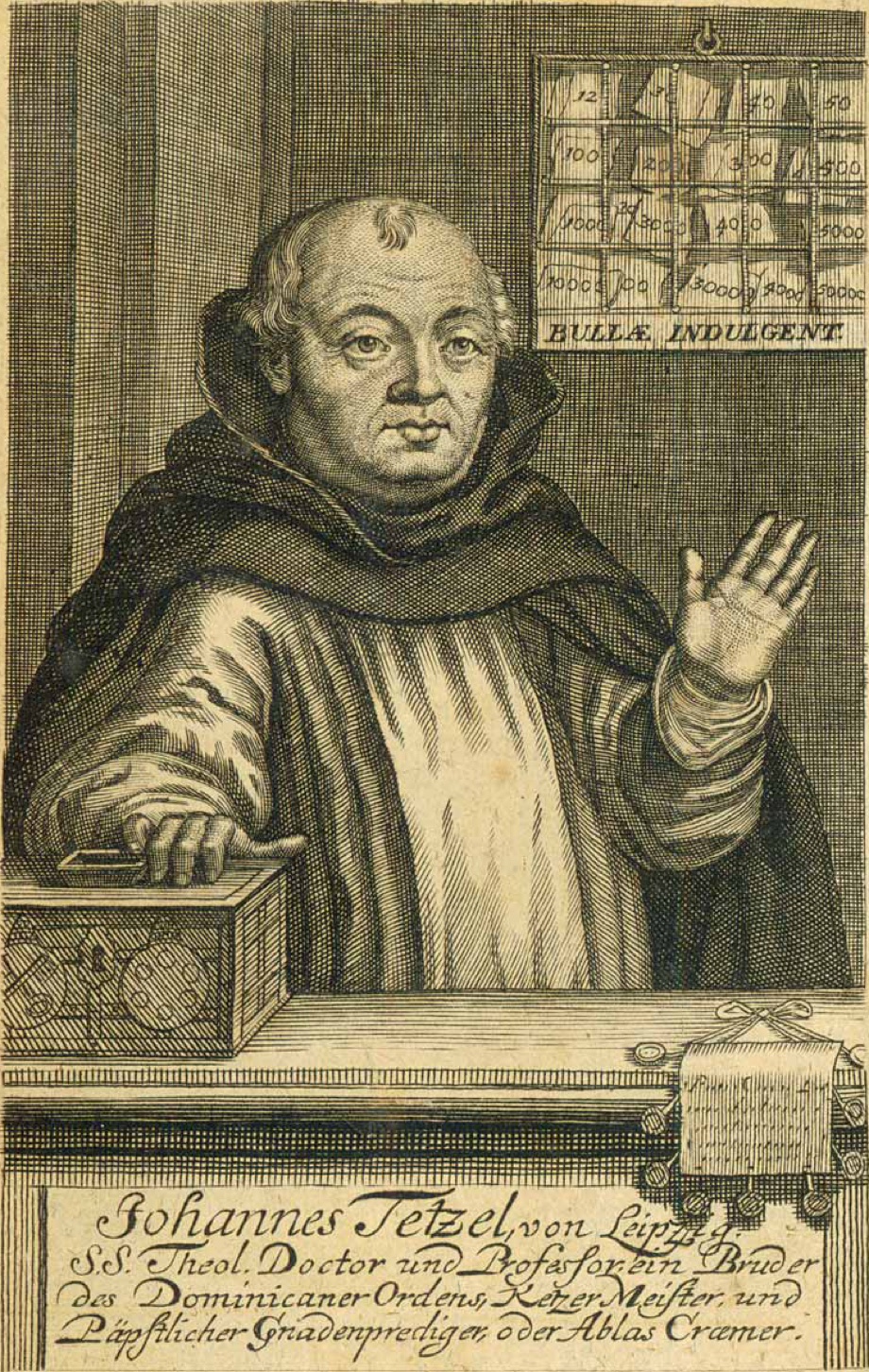
Portrait of Johann Tetzel
The Barker Before the Cross
He arrived in a town the way a spectacle arrives — a great cross planted in the marketplace, the papal bull borne aloft on cloth-of-gold, and then Johann Tetzel mounting the pulpit to work the crowd until it wept. He had one product to sell, and he sold it better than anyone alive: a slip of paper that promised to spring a dead mother or father from the fires of purgatory, on the spot, for coin. The Dominican friar was the most gifted indulgence-salesman of his age, and his genius for the crowd — vivid, theatrical, entirely shameless — lit the fuse of the Protestant Reformation without his ever meaning to strike a spark.
Born around 1465 and trained as a Dominican preacher, Tetzel drew the plum commission of his life: to hawk the special “St. Peter's indulgence,” sold nominally to fund the vast new basilica rising over the grave of St. Peter in Rome under Pope Leo X — and, in secret, to repay the debts of Archbishop Albert of Mainz. Tetzel neither knew nor cared much about the accounting. He knew his lines, his crowd, and a jingle that would outlive him: “As soon as the coin in the coffer rings, the soul from purgatory springs.”
Tetzel is the ESFP showman in his purest and most dangerous form: dominant Se working a live crowd for immediate effect — the tears, the spectacle, the coin ringing audibly in the box — married to an Fi that genuinely believed it was selling comfort to the grieving.
The Coin in the Coffer
Se — dominant
Dominant Se lives for the vivid present and the immediate effect, and Tetzel's whole art was the management of a live room. He staged his campaigns like theater: the towering cross, the arms of the pope, the ceremonial entry, a sermon that first painted purgatory in flames so terrible that mothers heard their dead children screaming, then offered instant release for a coin. He read the crowd the way a great performer reads a house — escalating the fear, then the relief, until the purse-strings loosened. Nothing about it was abstract; it was sensation and spectacle, aimed at getting hands into pockets before the feeling cooled.
The jingle distills that Se genius: cause and effect made audible in the ring of metal on metal. He did not ask his audiences to reason through the theology of penance — he gave them a sound, a physical proof, a result you could hear. The most damning charge against him, that he promised a soul would leap from the flames the instant the coin dropped, no contrition required, is Se run to its limit: the tangible payoff delivered now, with no patience for the slow interior work the Church actually taught.
A Salesman Who Believed His Own Pitch
Fi — auxiliary
It would be easy to file Tetzel as a cynic moving product he knew to be worthless. The evidence points the other way, and that is where his auxiliary Fi lives. In his own heart he was not fleecing the grieving — he was consoling them. He seems genuinely to have believed that indulgences did what he said, that he was bringing real release to souls and real comfort to the living who loved them. It was a crude faith, but a sincere one, and sincerity is a salesman's most effective instrument. The tears he summoned he could summon because he half-felt them himself.
That private conviction is also why he could not retreat when the ground shifted. Fi does not calculate; it stands on what it holds to be true. When his selling was challenged, Tetzel took the attack personally, as an insult to a pious work, and struck back with wounded indignation instead of going quiet. The same warmth that made him irresistible in the marketplace made him incapable of the cold retreat that might have saved him.
The Fire He Never Saw Coming
Ni — inferior
Inferior Ni is a blindness to consequence — an inability to see, behind the vivid present, the shape of the future taking form. Tetzel optimized ferociously for the crowd in front of him and never imagined the storm his selling would call down. He pushed the pitch further because it worked in the room: he was said to promise pardon for sins not yet committed and the instant release of dead relatives, claims so extravagant that they scandalized a brooding Augustinian monk named Martin Luther into nailing up ninety-five theses in 1517. Tetzel had handed the Reformation its opening line and had no idea he had done it.
When the backlash came, he met it the only way he knew — with more performance, counter-attacking in print with the same wounded energy he had poured into the pulpit, never grasping that the argument had already outrun him. As the scandal swelled into a movement, his own side quietly disowned him, and the Church's star salesman became its embarrassment. He died in 1519, broken and reviled, the villain of a story he never understood he had started — and in a last act of grace, Luther reportedly sent the dying friar a consoling letter, telling him not to take it so hard. It is the one moment of the future arriving that Tetzel lived to see.
Why ESFP Over ESTP
Why not ESTP?
Both types run on Se, and Tetzel's flair for the immediate and theatrical is real. But the ESTP is a cool tactical operator who reads a situation and plays the angles; Tetzel had no angles. He sold by feeling and spectacle, believed his own product with an Fi conviction that left him unable to retreat, and was undone by the storm he raised rather than maneuvering through it. An ESTP would have sensed the danger and cut the pitch; Tetzel walked straight into the fire, because he never saw it coming.
The distinction is between a performer and a schemer. The ESTP plays the crowd and knows it; the ESFP is moved by his own show, and the crowd feels it. He was the salesman, not the strategist — which is precisely why he could sell the Reformation into existence without ever knowing he had made the sale.
Connected Figures
Further Reading
- Here I Stand: A Life of Martin Luther — Roland H. BaintonThe classic biography of Luther — its account of the indulgence controversy is the enduring popular portrait of Tetzel and his jingle.
- Brand Luther: How an Unheralded Monk Turned His Small Town into a Center of Publishing — Andrew PettegreeOn the print revolution that carried the quarrel across Germany — essential for understanding why Tetzel's local sales pitch became a continental rupture.
- The Reformation: A History — Diarmaid MacCullochThe magisterial single-volume history — places the indulgence trade, Albert of Mainz's debts, and Leo X's basilica in their full context.
