 Historical Figure MBTI
#610 · 5-6-26 · The Reformation
Frederick the Wise
Elector of Saxony · Protector of Luther · The Cautious Prince
1463 — 1525
5 min read
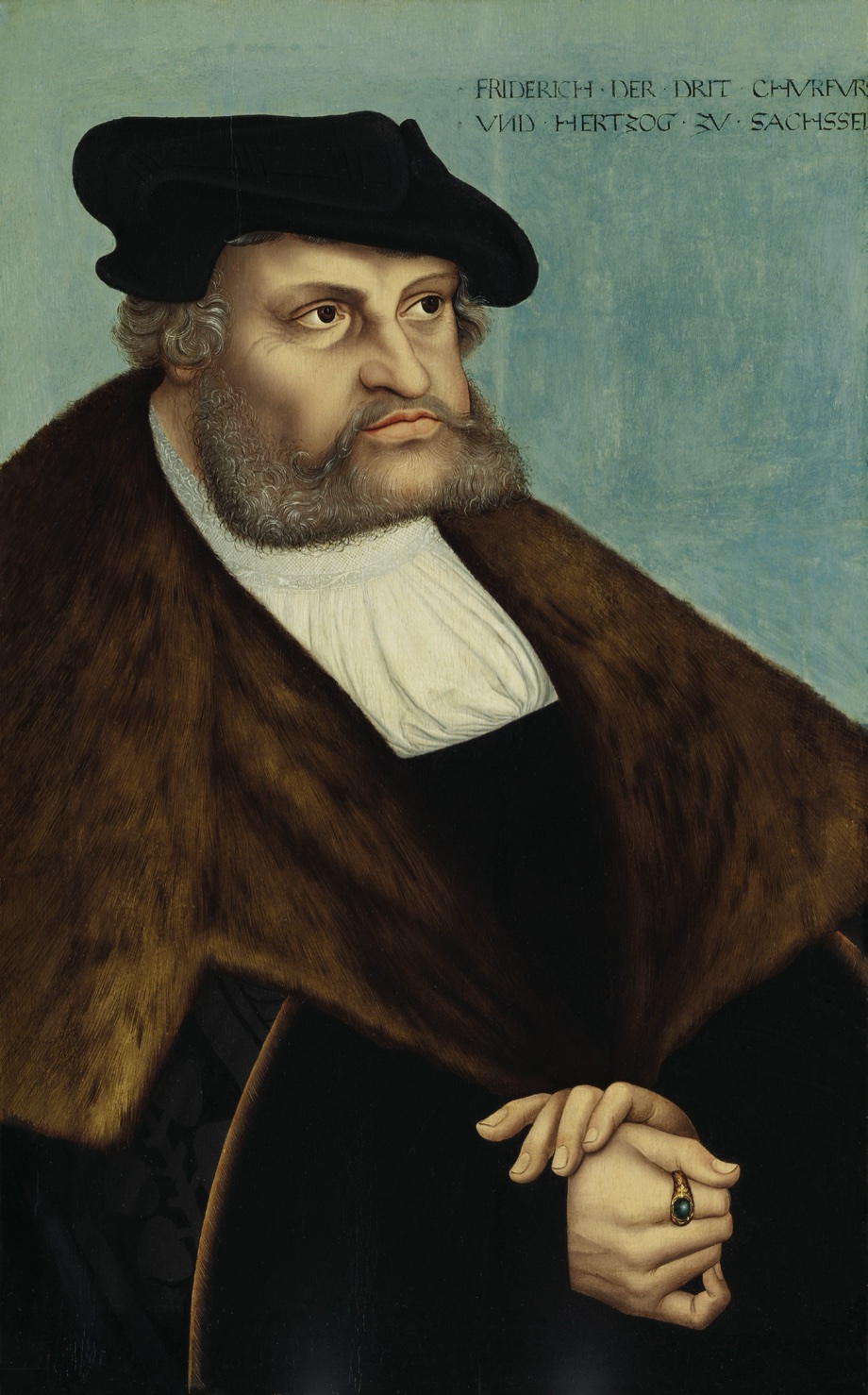
Portrait of Frederick the Wise
The Prince Who Saved a Revolution He Did Not Believe In
He collected relics by the thousand — splinters of the True Cross, bones of martyrs, indulgences reckoned in tens of thousands of years. This was precisely the machinery that Martin Luther would take an axe to. And yet it was Frederick III of Saxony — a conventional, pious, relic-hoarding Catholic prince — who threw a shield around the man dismantling his faith, and held it there through excommunication and imperial ban until the Reformation was too deeply rooted to pull up. He did not do it because he agreed with Luther; as far as anyone can tell he never made up his mind about the theology. He did it because it was owed.
Frederick the Wise (1463–1525) was among the most respected of the seven imperial electors — so esteemed that in 1519 the imperial crown itself was offered to him, and he turned it down. He founded the University of Wittenberg in 1502, where a friar named Luther happened to hold a chair. When Rome demanded that friar, the elector's answer was not conviction but procedure: not without a fair hearing, not without safe-conduct, not outside the law. It was the temperament of a man who trusted precedent over passion — the cautious, correct ISTJ, saving history almost by accident.
Frederick is the ISTJ as accidental revolutionary: Si's reverence for order, precedent, and due process, executed with Te's administrative steadiness — a prince who protected a heretic not out of belief but because the law and his own sense of what was proper would not let him hand the man over unheard.
The Collector and the Cautious Man
Si — dominant
Dominant Si is the mind that anchors itself in the established, the accumulated, the proven — and Frederick lived it with almost comic literalness. His relic collection in the Castle Church at Wittenberg swelled to more than nineteen thousand items, each one catalogued and appraised for the exact quantity of indulgence it conferred: Si turned into a devotional hobby, the veneration of tangible tokens of the sacred past. That the theses Luther nailed to that very church's door in 1517 were an assault on the whole apparatus of indulgences is one of history's neater ironies — the elector went on amassing relics while his professor demolished the logic that gave them value.
The same conservatism governed how he ruled. Frederick distrusted upheaval and treated precedent and legal right as something close to sacred. When the storm broke, his instinct was never to take a side but to insist on the forms: a proper hearing, a lawful process, the customary protections owed a subject of the Empire. This was not sympathy for the new doctrine but the deep Si conviction that things ought to be done the way they had always properly been done — that a prince who surrendered his own subject unheard would be breaking faith with the order he was sworn to uphold.
The Elector Who Declined an Empire
Te — auxiliary
If Si made Frederick cautious, auxiliary Te made him competent — a capable, respected administrator whose weight in imperial politics was real. He governed Saxony ably, founded a university that would become the engine room of a continental revolution, and earned a standing among the electors that few could match. The clearest measure of it came in 1519, when the electoral college offered the imperial crown to Frederick himself. He refused it. He judged — correctly, in the Te manner of a man reckoning costs against capacities — that he lacked the resources to hold the office against the Habsburg and Valois powers, and swung his decisive vote behind Charles V.
His defense of Luther, too, was executed with an administrator's cool method. After the Diet of Worms outlawed the friar in 1521, Frederick had him “kidnapped” on the road and spirited away to the Wartburg, where he lived in disguise and translated the New Testament into German. It was a managed operation, deniable and precise: the elector reportedly kept himself ignorant of the hiding place so he could honestly answer that he did not know where Luther was. That is Te and Si together — solving a concrete political problem through procedure and prudence while scrupulously preserving his own legal standing before Emperor and Pope alike.
What Was Owed
Fi — tertiary
Beneath the procedure ran a private moral conviction — tertiary Fi, the quiet inner sense of what is right that the ISTJ rarely announces but will not violate. For all his caution, Frederick had a stubborn, personal notion of justice, and it settled on a simple point: a man of his was entitled to a fair hearing, and he would not throw that man to Rome to be burned unexamined. He clung to it against a pope, an emperor, and the whole weight of Christendom. It was principle, not affection.
And here is the strangest thing about the whole relationship: Frederick and Luther never once met face to face. The prince who risked his standing to save the man dealt with him entirely at arm's length, through his secretary and chaplain Georg Spalatin. This is what makes the protection so distinctly ISTJ rather than warmly personal — it ran on duty and right, not on the bond of two men who knew and loved each other. Only at the very end did the interior man tip his hand: on his deathbed in 1525, Frederick the relic-collector received communion in both kinds — the Protestant manner — a last, quiet signal of where his private conscience had, at length, come to rest.
Why ISTJ Over ISFJ
Why not ISFJ?
The ISFJ is the obvious temptation — a cautious, pious, tradition-loving protector shielding a vulnerable man looks like Fe warmth. But Frederick's shield came from principle, legal right, and Saxon interest, not from personal attachment. He never met Luther and dealt with him only through a secretary; there was no affection to speak of, only a conviction about what was proper and owed. An ISFJ protects the person; Frederick protected the process. That is Te–Si propriety, not Fe loyalty.
The distinction is the whole of the man. In place of the warmth an ISFJ would have felt for Luther stood a cooler, harder thing — the ISTJ conviction that rules and rights are not to be broken for anyone, not even a pope. History was rescued by a man who would have been baffled to be called its hero.
Connected Figures
Further Reading
- Frederick the Wise: Seen and Unseen Lives of Martin Luther's Protector — Sam WellmanA full biography of the elector himself — the rare book that puts the protector, not the reformer, at the center of the story.
- The Reformation: A History — Diarmaid MacCullochThe standard modern narrative of the whole upheaval; essential for seeing where Frederick's shield fits in the larger drama.
- Here I Stand: A Life of Martin Luther — Roland H. BaintonThe classic life of Luther — vivid on the Diet of Worms, the imperial ban, and the Wartburg rescue that Frederick engineered.
