 Historical Figure MBTI
#609 · 5-6-26 · The Reformation
Thomas Müntzer
Radical Preacher · Prophet of the Peasants' War · The Sword of Gideon
c. 1489 — 1525
6 min read
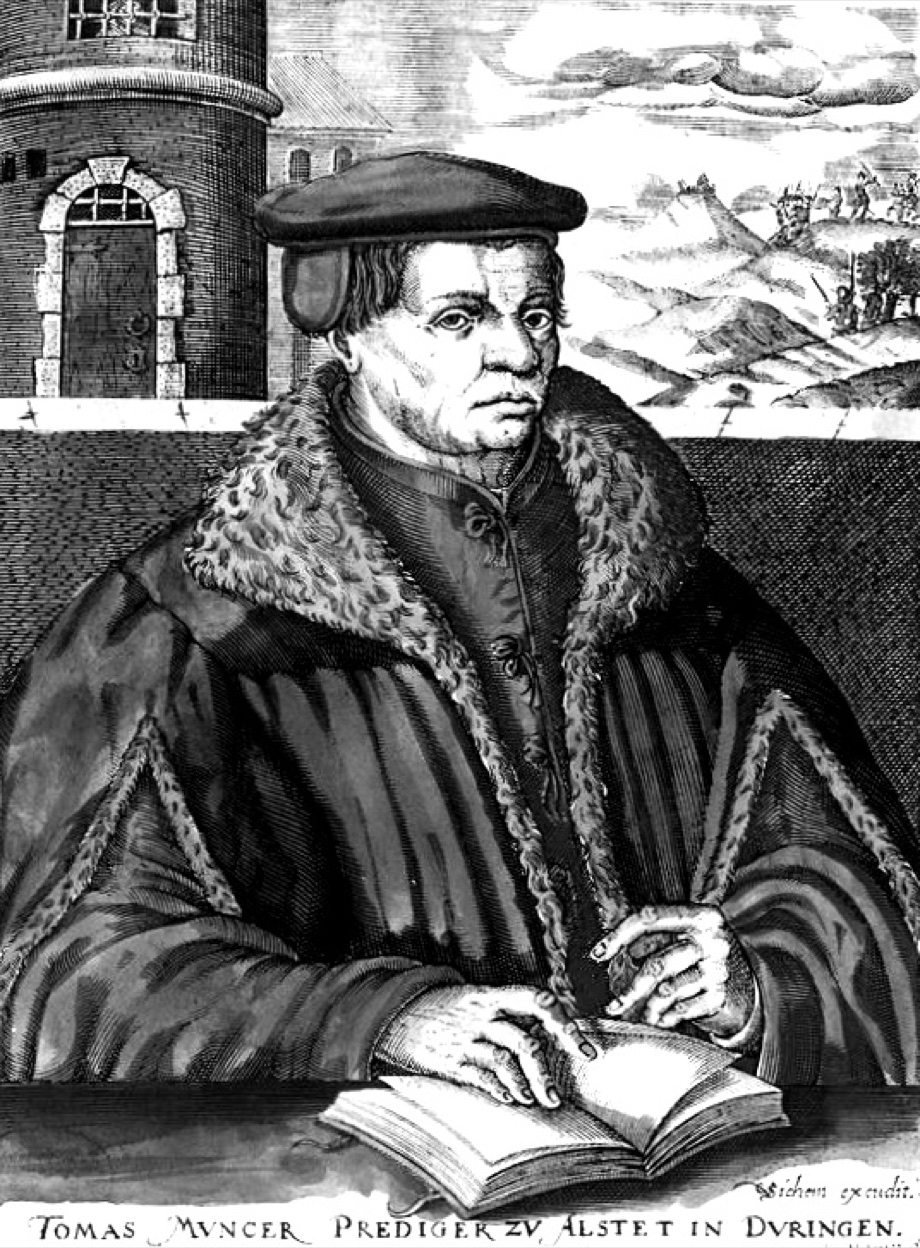
Portrait of Thomas Müntzer
The Sword of Gideon
He began as a disciple and ended as an enemy. When Martin Luther struck the first spark of the Reformation, Thomas Müntzer was among those who caught fire from it — but where Luther wanted a reformed church, Müntzer wanted the end of the world. He preached that the Holy Spirit spoke directly into the hearts of the faithful, that the dead letter of scripture was nothing beside living inspiration, and that the last days were at hand: God was about to sweep the ungodly from the earth and raise up a kingdom of the elect. And the elect, he told the poor who crowded to hear him, were themselves.
Müntzer (c. 1489 — 1525) was a learned man who turned his learning into a torch. He denounced Luther as “Doctor Liar,” the soft-living flesh of Wittenberg, a lackey of the princes who had betrayed the common people. Then he did what Luther never would: he took his gospel out of the pulpit and into the field, becoming a leader of the great Peasants' War of 1524–25, marching under a rainbow banner with a sword in his hand as the new Gideon, promising his followers that God would shield them from the princes' guns.
Müntzer is the ENFJ turned prophet and firebrand: Fe channeling the collective grievance and hope of the oppressed into a mass movement, fused to an Ni vision of imminent divine judgment held with absolute, unbending conviction — a man who could make a crowd believe the kingdom of God was one battle away.
The Preacher and the Crowd
Fe — dominant
Dominant Fe reads the emotional temperature of a group and moves it, and Müntzer's genius was for the collective. He did not persuade individuals in studies; he roused congregations. At Allstedt and Mühlhausen he gathered the resentments of miners, weavers, and impoverished peasants — their hunger, their fury at tithes and lords — and gave them a voice that sounded like the voice of God. Where Luther argued doctrine, Müntzer conjured a feeling: that the humble were the true chosen, that their suffering was sacred, and that heaven itself was on their side against the powerful.
This is Fe as an instrument of mass mobilization. He bound the elect into a sworn league and wrote a German liturgy so the people could worship in their own tongue. His most famous sermon — preached before the Saxon princes themselves — took the dream of Nebuchadnezzar and told the rulers, to their faces, that their statue was about to be shattered and they might either lead the godly or be swept away with the ungodly. It was the ENFJ's characteristic move: naming what a whole community feels and turning that feeling into a summons to act.
The Kingdom at Hand
Ni — auxiliary
Auxiliary Ni gave that fervor its single, fixed image of the future: the imminent end of days and the purified world beyond it. Müntzer did not hold this as a hope but as a certainty. He had seen it — the harvest was ripe, the tares would be pulled up and burned, and a kingdom of the elect would stand in the ruins. Everything he preached bent toward that one vision, and the vision admitted no compromise. Reform was too slow; patience was betrayal. The Spirit was moving now.
It is this apocalyptic conviction that separates him from every gradualist of the Reformation. He trusted direct revelation over the printed page precisely because a text could be debated and a vision could not. That certainty made him dangerous: a man who believes he can see God's design on a timetable will stake everyone who follows him on being right. When he told the peasants at Frankenhausen that God would catch the enemy's cannonballs in the sleeves of His coat, he was not lying to them. He believed the vision that fully.
Under the Rainbow Banner
Se — tertiary
What makes Müntzer more than a visionary recluse is that he took the field. Tertiary Se pulled the prophet out of the pulpit and into the physical world of the revolt — the marching, the banner, the drawn sword. He did not bless the Peasants' War from a safe distance; he rode with the host, styling himself the sword of Gideon and raising a rainbow banner — the sign of God's covenant — over his followers. He translated apocalyptic certainty into an army in a real field on a real morning.
That grip on the concrete moment was also his undoing, because the moment did not obey the vision. At Frankenhausen in May 1525 his ill-armed peasant host, promised divine protection, faced the professional armies of the princes. The slaughter was total — thousands cut down in an afternoon. Müntzer was found hiding, captured, tortured, and beheaded. The man who had summoned the collective to the field could rouse a crowd and could stand under fire, but he could not command an army, and the Se that put him on the battlefield could not save him once he was on it.
Why ENFJ Over INFJ
Why not INFJ?
The apocalyptic vision, the mystical certainty, the sense of a chosen prophet reading God's design — these all read as Ni, and an INFJ typing is tempting. But the INFJ is fundamentally a withdrawn visionary who contemplates and writes and works on the world one soul at a time. Müntzer was the opposite: an outward agitator who organized covenants, preached to armies, and marched to war under a banner. His gift was not private contemplation but the rousing and leading of the collective — Fe forward, with the vision serving the movement rather than a hidden inner life.
The distinction is the whole shape of his life. An Ni-dominant recluse would have written the tract and waited; Müntzer put on armor. The engine was always the crowd, and his deepest instinct was to gather its grievance and point it at the powerful. The vision told him the kingdom was coming; Fe made him the man who would lead the people into it. That is an ENFJ's motivation, not an INFJ's: not to see the truth alone, but to make a multitude rise on it.
Connected Figures
Further Reading
- Thomas Müntzer: A Tragedy of Errors — Eric W. GritschA sympathetic critical biography that reads Müntzer's life as a series of misjudged turns from reformer to revolutionary.
- Thomas Müntzer: Theology and Revolution in the German Reformation — Tom ScottThe fullest scholarly study in English of how Müntzer's radical theology drove him into social revolt.
- The Reformation: A History — Diarmaid MacCullochThe standard modern survey — places Müntzer and the Peasants' War within the wider upheaval Luther set off.
