 Historical Figure MBTI
#605 · 5-6-26 · The Reformation
Martin Luther
Augustinian Friar · Author of the 95 Theses · Father of the Reformation
1483 — 1546
13 min read
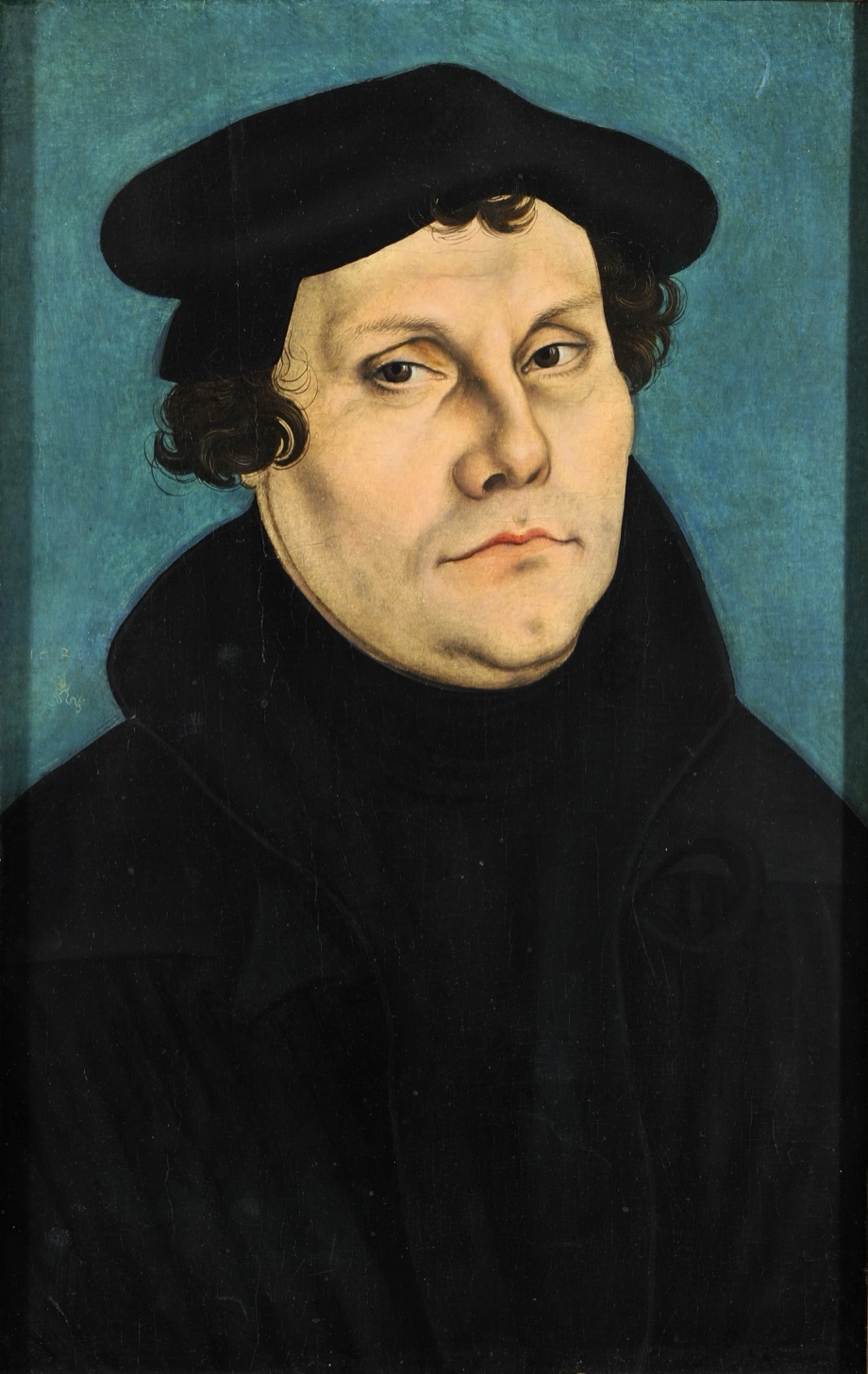
Portrait of Martin Luther
The Fountain That Broke Christendom
He could not stop talking, and he could not stop writing, and for the last thirty years of his life all of Europe was forced to listen. Martin Luther is usually remembered as a monolith — the granite monk who nailed his defiance to a door and split the Church of Rome in two — but the man himself was nothing so solid. He was a torrent: a flood of treatises and translations, hymns and table talk, insults and prayers and jokes about his own bowels, pouring out faster than the new printing presses could set them. He wrote a catechism and he wrote pamphlets calling the pope the Antichrist. He gave Germany its Bible and its hymnbook and a river of obscene invective in the same restless decades. To read him is to feel the pressure of a mind that generated faster than any institution could contain.
He had been meant for the law. A miner's son of fierce, anxious intelligence, Luther was terrified into a monastery by a thunderbolt — a vow shrieked at Saint Anne in a lightning storm in 1505 — and there he nearly destroyed himself with scruples, confessing for hours, certain he could never do enough to satisfy a righteous God. What saved him was not discipline but a discovery that felt like sunrise: that grace is a gift, not a wage — that the just shall live by faith, not by the frantic accountancy of works. It was a private liberation before it was a public revolution, and the whole Reformation is, at bottom, one man insisting that everyone else be freed the way he had been. When he attacked the sale of indulgences in 1517, he was not launching a program. He was pulling a single loose thread, and the entire garment of medieval Christendom came away in his hands.
That is the paradox of Luther: the most consequential systematizer of the modern age was himself no systematizer at all. Others — his gentle colleague Melanchthon, the ruthless Calvin in Geneva — would build the ordered theologies. Luther generated; he did not organize. His mind threw off ideas the way a fire throws off sparks, and he spent his life chasing them into print rather than pruning them into a system.
Luther is the ENFP at the scale of world history: a Ne fountain of ceaseless generation — treatises, translation, hymns, controversy, laughter — anchored to an immovable Fi conscience that could stand before an emperor and say it would not, could not, recant.
The Inexhaustible Pen
Ne — dominant
Dominant Ne is a generative engine — a mind that cannot look at anything without seeing what else it connects to, what else might be said, what door it opens next. Luther's output is the purest monument to it in the history of ideas. In 1520 alone, the annus mirabilis of the Reformation, he produced the three great treatises that redrew the whole map at once: the Address to the Christian Nobility, which demolished the wall between clergy and laity; The Babylonian Captivity of the Church, which reduced the seven sacraments to two; and On the Freedom of a Christian, the tender little masterpiece that could hold the entire gospel in a paradox. No single, laser vision drove these. They are three different battering rams thrown against three different walls in the space of months, because the Ne mind attacks on every front the instant it sees the fronts exist.
And he never slowed. He translated the entire New Testament into German in eleven weeks while hiding at the Wartburg, then spent the rest of his life revising the Old Testament with a committee, hunting for the exact German word a butcher's wife or a child in the street would actually use. He wrote hymns because worship needed songs and the songs did not yet exist — “A Mighty Fortress Is Our God” among them. He dashed off catechisms, sermons, polemics, open letters, and thousands of pages of commentary. And in the evenings, at a crowded table, he simply talked — his students frantically writing it down — and even that overflow became a book, the Table Talk, a whole genre born from a man who could not let a thought pass unspoken.
The Ne temperament is also why the man is so gloriously, exhaustingly self-contradictory. He was earthy and coarse and funny, cracking scatological jokes about the devil and the pope in the same breath as the most delicate theology of grace. He could be warm and paternal in one letter and volcanic with rage in the next. He generated faster than he could govern what he generated — which is why the revolution kept outrunning him, and why the darkest thing he ever wrote, the savage antisemitic tracts of his last years, came from the same ungoverned overflow as the Bible that shaped a language. The fountain did not discriminate. It simply poured.
A Conscience Captive to the Word
Fi — auxiliary
If Ne is the fountain, auxiliary Fi is the bedrock it springs from — the deep, inarticulable core of personal conviction that gives all that generation its direction and its nerve. Fi is not a system of ethics argued from principle; it is a felt certainty, a private moral compass that cannot be reasoned away because it was never reasoned into place. Luther's entire theology begins in Fi: justification by faith was not, for him, a doctrine deduced from Scripture so much as an experience of grace that then went looking for its words. He had felt himself damned and then felt himself loved, personally, unearnably — and no council, no pope, no tradition could tell him the feeling was false.
This is why the great scene of his life is a scene of refusal. Hauled before the Emperor Charles V and the assembled might of the Empire at the Diet of Worms in 1521, shown a table piled with his own books and ordered to take them back, Luther asked for a night to think — and then he would not. He could not. “My conscience is captive to the Word of God,” he said. “To go against conscience is neither right nor safe. Here I stand; I can do no other.” That is Fi in its absolute form: not defiance for its own sake, not stubbornness, but the flat impossibility of acting against an inner conviction one experiences as more real than the emperor in the room. A whole young man's life was on the table — outlawry, probable burning — and the conscience simply would not move.
“Here I stand; I can do no other” is the Fi credo made flesh — a man who will pour out ten thousand pages of glorious, contradictory Ne, but who has, at the very center of himself, one thing that cannot be argued, bribed, or frightened out of place.
The same Fi core explains the ferocity. Luther fought so savagely because every controversy touched the one thing that was not negotiable. He broke bitterly with Zwingli over the Eucharist — chalking hoc est corpus meum, “this is my body,” on the table and refusing to let the words become metaphor — not out of pedantry but because his conscience was bound to the plain sense of the text. When conviction is seated this deep, disagreement feels like an assault on the soul, and Luther defended his soul with everything the fountain could throw.
The Prophet Sides With the Princes
Te — tertiary
Tertiary Te is the ENFP's uneasy relationship with power, order, and hard external consequence — a function that can act with sudden, brutal decisiveness, but often without the calibration a dominant thinker would bring. For years Luther generated ideas with no regard for who might act on them; then reality forced the reckoning. In 1524 the peasants of Germany rose in revolt, quoting his own gospel of Christian freedom back at him, some of them stirred by the radical preacher Thomas Müntzer, who took Luther's revolution to a place Luther never intended it to go. The fountain had overflowed into open rebellion, and Luther recoiled in horror.
His response was the tertiary Te grip in its most violent form. In a pamphlet whose title says everything — Against the Robbing and Murdering Hordes of Peasants — he urged the princes to strike the rebels down without mercy: to stab, smite, and slay, that whoever could do so should, as one would kill a mad dog. It was the man who had preached freedom demanding order at the point of a sword, and the princes obliged with a slaughter that killed perhaps a hundred thousand. Luther had grasped a hard external truth — that his spiritual reformation could survive only under the protection of temporal authority, that the Gospel needed the sword to guard its house — but he grasped it with the blunt, overcorrecting force of an inferior thinker suddenly deciding to be ruthless.
Tertiary Te also did the patient, unglamorous work of institution-building that the revolution required and that Luther himself found tedious. He organized visitations of the parishes, wrote orders of service, drilled the clergy, and leaned on his electors — Frederick the Wise and his successors — to give the new church a legal and administrative spine. He could do it. But he was always happier hurling a pamphlet than drafting a church order, and the durable structures of Lutheranism owe more to the calmer, systematizing hands he left them to than to his own.
The Body, the Devil, and the Beer
Si — inferior
Inferior Si is the ENFP's undertow — the pull of the concrete, the bodily, the remembered and familiar, surfacing where the airy generator least expects it. In Luther it erupts through the body. No great theologian has ever been so relentlessly physical. He suffered constantly — constipation, kidney stones, ringing in the ears, crushing bouts of what he called Anfechtungen, black terrors of the soul — and he narrated all of it in vivid, earthy detail. His famous account of the breakthrough on justification places it, by his own telling, in the privy tower. He experienced the devil not as an abstraction but as a physical presence in the room, to be driven off, he said, with a fart or a flung inkpot. This is inferior Si turned demonic: the concrete body and its miseries pressing in on a man whose native home was the world of ideas.
It surfaces, too, in a deep conservatism that surprises people who expect a revolutionary. Luther never wanted to invent a new church; he wanted to restore an old one, to strip away accretions and recover the plain, familiar Word he believed had always been there. He kept far more of the traditional Mass than Zwingli or Calvin would tolerate — the vestments, the candles, the elevation of the host — because the remembered forms held a comfort he would not surrender. For a man who broke Christendom, he was strikingly reluctant to break with the tangible past. He reformed by conserving.
And inferior Si found its rest, at last, in a home. In 1525 Luther married Katharina von Bora, a runaway nun he had helped smuggle out of a convent in a herring barrel, and the fiery friar settled into the most concrete, domestic, bodily happiness imaginable. Katharina ran a boisterous household in the old Augustinian cloister — brewing beer, keeping pigs, managing money the improvident Luther scattered, filling the rooms with children and boarders and the din of the Table Talk. He called her his “Lord Katie,” half in jest and half in gratitude. The man of endless ideas had found the one thing the fountain could not supply itself: a place to stand, a body fed, a table to sit at. It was the inferior function's gift, arriving late and holding him to the end.
Why ENFP Over INFJ
Why not INFJ?
The instinct to type a great religious reformer as an INFJ is strong — the type is the archive's prophet, the visionary who sees one truth with piercing Ni clarity and bends a life to it. But that is precisely the wrong shape for Luther. The INFJ reformer is austere, singular, and systematizing; his mind is a beam. Luther's was a fountain — expansive, prolific, gregarious, self-contradictory, throwing off treatises and hymns and jokes and heresies on every side at once. He never even systematized his own revolution; he left that to Melanchthon and Calvin. He did not narrow toward a vision. He generated a whole world of language and ideas and could not have narrowed if he tried.
The archive already holds the INFJ version of the reforming monk: Savonarola, the austere Florentine prophet who fixed on a single burning vision of a purified city and drove it to the pyre — and to his own. That is the Ni prophet: one vision, held to the death, admitting no abundance. Luther is the opposite kind of reformer entirely. His conviction was every bit as immovable — the Fi core that stood at Worms — but it expressed itself not through a laser of prophetic vision but through an inexhaustible overflow of Ne. Where the INFJ narrows the world to one truth, Luther flooded it with a thousand. The conscience was singular; the mind was a fountain. That is ENFP, not INFJ.
Connected Figures
Further Reading
- Here I Stand: A Life of Martin Luther — Roland H. BaintonThe classic popular biography — warm, vivid, and still the best single narrative introduction to the man and the drama of Worms.
- Martin Luther: Renegade and Prophet — Lyndal RoperThe major modern life — psychologically searching and unflinching about the body, the rage, and the darkness alongside the genius.
- Luther: Man Between God and the Devil — Heiko A. ObermanA profound study of Luther inside his own medieval world of God, devil, and apocalyptic dread — indispensable for understanding his terrors.
- The Reformation: A History — Diarmaid MacCullochThe authoritative panorama of the whole upheaval — places Luther within the continent-spanning movement he set off but never controlled.
- On the Freedom of a Christian & the 95 Theses — Martin LutherRead him directly: the tender little treatise on grace and the famous theses that started it all, both short and both revelatory of the mind.
