 Historical Figure MBTI
#601 · 5-5-26 · The Age of the Borgias
Girolamo Savonarola
Friar of San Marco · Prophet of Florence · The Bonfire of the Vanities
1452 — 1498
8 min read
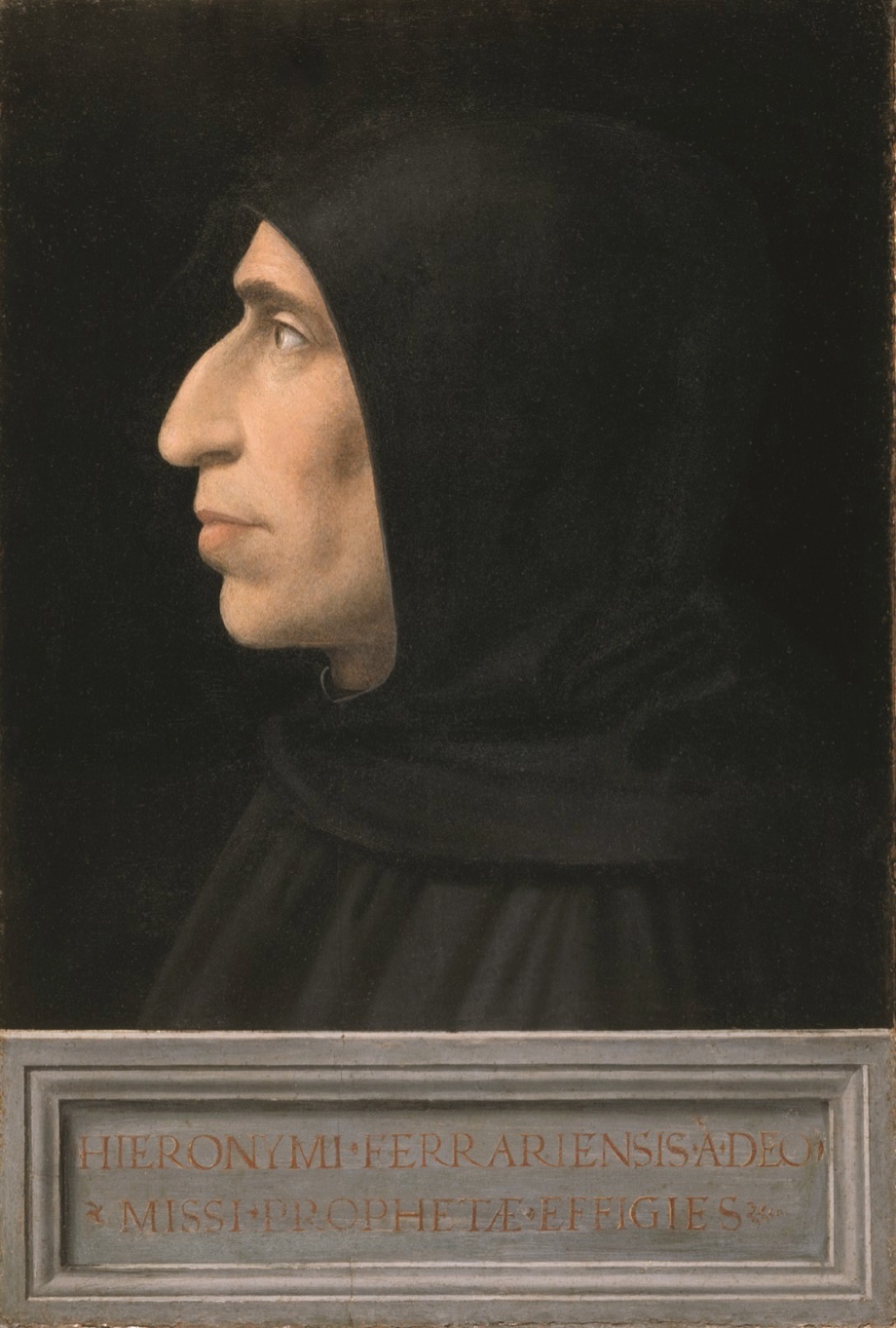
Portrait of Girolamo Savonarola
The Man Who Saw the Fire Coming
He was small, ugly, and unforgettable. When Girolamo Savonarola climbed into the pulpit of the Duomo, a plain Dominican in a plain habit, the largest church in Florence filled until men stood in the aisles and wept at what he told them. He did not flatter and he did not charm. He told a city drunk on beauty and money that the sword of God was already raised over it, that a scourge was coming to purge Italy of its filth, and that only repentance could turn the blade. Then, in the autumn of 1494, the scourge came: the French king Charles VIII poured over the Alps, the Medici fled, and a friar who had prophesied exactly this became the closest thing Florence would ever have to a king who wore no crown.
Born in Ferrara in 1452 and trained in medicine and Thomism before he took the Dominican habit, Savonarola came to the convent of San Marco as an unremarkable preacher whose early sermons emptied the pews. What transformed him was not eloquence but conviction — the unshakeable certainty that he had been shown the future and that his task was to make a whole city obey what he alone could see. For roughly four years he governed Florence through the pulpit, founding a puritan “Christian republic” with Christ proclaimed as its true king. Then the same absolute certainty that raised him destroyed him, and the piazza where he burned the vanities became the place where they burned him.
Savonarola is the INFJ as apocalyptic prophet — Ni's single fixed vision of a coming judgment and a purified city, held against pope and prince, and Fe's power to bend a whole fractious republic into one collective act of repentance. He did not persuade Florence. He converted it.
The One Vision
Ni — dominant
Dominant Ni is the mind that fixes on a single image of what is coming and cannot be argued out of it. Savonarola's image never changed: a Church and a city scourged, purged, and reborn. He preached it before it had any evidence and clung to it long after the evidence turned against him. In his sermons on the Ark and the Flood he cast himself as Noah, warning a doomed generation while there was still time to climb aboard — and when Charles VIII's army appeared, seeming to fulfill the prophecy to the letter, the vision stopped being one preacher's obsession and became, for a season, the official truth of the Florentine state. He did not weigh options; he saw an end and worked backward to it, rebuilding the constitution around a Great Council and declaring Christ the King of Florence not as metaphor but as constitutional fact.
And when the picture met reality, Ni chose the picture. Ordered by Rome to stop preaching, he stopped, then resumed, because silence would mean the vision had lied. Excommunicated, he declared the excommunication itself invalid, since no earthly pope could annul what God had shown him. This is the terrible logic of the dominant intuitive prophet: the more the world contradicts the vision, the more fiercely the vision must be defended, until there is nothing left to defend it with but the prophet's own body.
The Voice That Moved a City
Fe — auxiliary
Auxiliary Fe is the channel through which the lone vision reaches the crowd — the instinct for the collective feeling of a room and the power to shape it. Savonarola had it to an almost frightening degree. Contemporaries who came to mock stayed to sob; hardened humanists, merchants, and even his eventual enemies described the physical effect of his voice, the sense that the man in the pulpit had reached into the shared conscience of thousands and was pressing on it. He did not win Florence figure by figure. He moved it as a body, converting a whole civic mood at once from pleasure to penitence.
The great engine of that Fe was the Bonfire of the Vanities. In the carnival seasons of 1497 and 1498 his followers — the Piagnoni, the “Weepers” — raised an enormous pyramid in the Piazza della Signoria: mirrors and cosmetics, gaming tables and lutes, fine dresses, books of poetry, and paintings surrendered, it was said, by the artists themselves. They burned it, singing hymns, while the city watched its own vanity go up in flame — Fe made theatre, a ritual that turned private guilt into a public act no one could stand apart from. Yet this was Fe in the service of Ni, not for its own sake: he did not soothe the crowd, he terrified it, binding Florence together not by making its people feel loved but by making them feel, all at once, the weight of the same coming reckoning.
The Schoolman in the Prophet
Ti — tertiary
Tertiary Ti gives the INFJ prophet an internal scaffolding of logic — a need to make the vision systematic, defensible, argued. Savonarola was no unlettered enthusiast; he was a trained Thomist who had studied medicine and cut his teeth on scholastic disputation, and beneath the fire of the sermons ran a rigorous theological architecture. That analytic streak sharpened his most dangerous move: the case against the pope. He did not simply rage at Alexander VI's corruption; he built an argument — that a manifestly simoniacal, unchaste pope was no true pope, that his excommunication therefore carried no force, and that a general council might be summoned to depose him. This was Ti in service of Ni, the schoolman's tools turned into weapons against the Vicar of Christ himself.
But tertiary functions overreach, and Savonarola's did. The same confidence in his own inner reasoning that let him declare a papal ban void also let him believe he could argue his way past the actual machinery of Rome — that being right was the same as being safe. He had the logic of his position perfectly worked out. He had badly miscalculated everything outside it.
The Trial by Fire
Se — inferior
Inferior Se is the INFJ's blind side: the world of brute physical fact — force, bodies, the hard present — that the visionary mind is slowest to reckon with. Savonarola's ruin lay exactly here. He commanded a city with a voice, but he never commanded a soldier. He had no army, no fortress, no bodyguard of steel; his only power was the belief he could summon, and belief is the frailest of foundations once the present world turns hostile. As papal pressure mounted, the French alliance soured, plague and hunger gnawed at Florence, and the rival faction of the Arrabbiati — the “Enraged” — grew bolder, the friar had no answer in the register that now mattered: raw power.
The catastrophe came, fittingly, as a trial by fire. In April 1498 a rival Franciscan challenged Savonarola's claims to a test: let a friar walk through flames and let God decide. The ordeal was arranged before a vast crowd thirsty for spectacle — and then collapsed into farce, called off amid squabbling and a sudden rainstorm, with no miracle and no walk. To the crowd it read as failure; the prophet who lived entirely in the world of the unseen was undone by a demand for a visible sign he could not produce. A mob stormed San Marco, and the machinery of the body took over where the machinery of the spirit had failed. He was racked until confessions were wrung from him, tried by a stacked commission, and on 23 May 1498 hanged and then burned in the very piazza where he had burned the vanities — his ashes thrown into the Arno so that no relic could remain. The man who had never reckoned with force met his end entirely at its hands.
Why INFJ Over ENFJ or INTJ
Why not ENFJ?
The extraverted-feeling case is tempting, because Savonarola so obviously moved crowds. But the ENFJ leads with Fe: authority rooted in warmth, connection, the ability to make people feel seen and gathered in. Savonarola's authority came from the vision, not from affection. He was austere, harsh, and uncompromising — he drove Florence by the terror and grandeur of what he foresaw, not by winning its love. His Fe was the instrument of a prophecy that came first; the crowd served the vision, not the reverse. That is a dominant Ni harnessing an auxiliary Fe, not an Fe-dominant harmonizer.
Why not INTJ?
The INTJ shares the fixed inner vision, and Savonarola's strategic reworking of Florence's constitution can look like Ni–Te statecraft. But his mode was never cold Te calculation of means and ends. It was moral and religious to its marrow — an appeal to conscience, sin, repentance, and salvation, pitched at the shared feeling of a whole community. He wanted souls purified, not systems optimized. That emotive, collective, conscience-driven register is Fe, not the impersonal Te of the strategist.
The essential distinction is one of source. Savonarola was not a warm shepherd of his flock nor a cool architect of a better state. He was a man possessed by one absolute inner sight of judgment and renewal, who used a mesmerizing gift for the collective heart to make an entire city live inside his vision for a few extraordinary years. When the vision collided with the hard facts of power, he chose the vision and died for it. Ni supplied the certainty; Fe supplied the reach; and the refusal to recant even under torture is the signature of the type at its most uncompromising — the prophet who would rather burn than admit he had not seen what he saw.
Connected Figures
Further Reading
- Fire in the City: Savonarola and the Struggle for the Soul of Renaissance Florence — Lauro MartinesA vivid, immersive account of the friar's Florence — the sermons, the politics, and the machinery of his destruction.
- Savonarola: The Rise and Fall of a Renaissance Prophet — Donald WeinsteinThe authoritative modern study of Savonarola as prophet — how the visions formed, spread, and finally consumed him.
- The Life of Girolamo Savonarola — Roberto RidolfiThe classic full-length biography, exhaustively sourced and long the standard scholarly life of the man.
