 Historical Figure MBTI
#602 · 5-5-26 · The Age of the Borgias
Pope Julius II
Pope of Rome · The Warrior-Pope · Patron of the Sistine Ceiling
1443 — 1513
7 min read
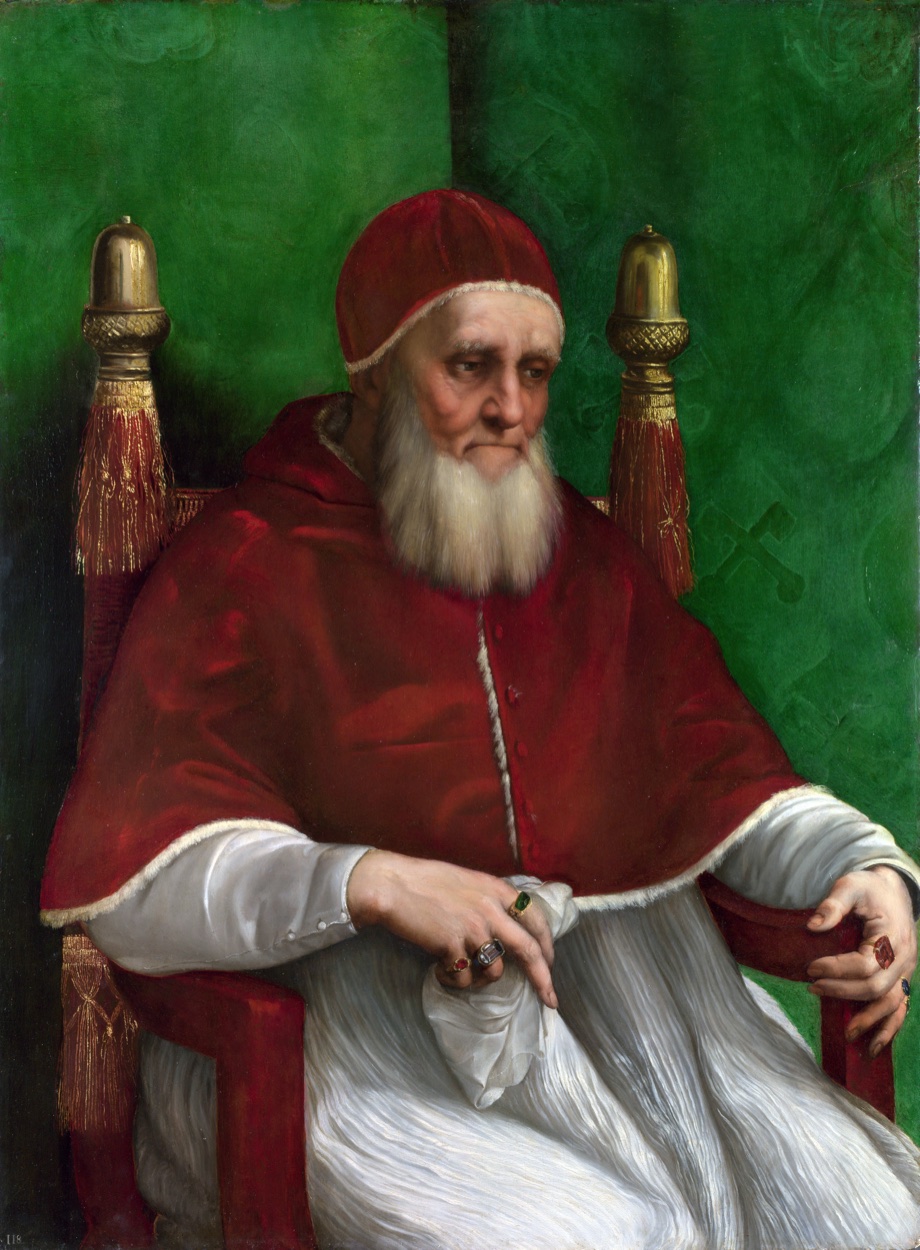
Portrait of Pope Julius II
Il Papa Terribile
He was a pope who wore armor. In 1506, at the age of sixty-three, Giuliano della Rovere rode at the head of his own army through the mud of the Romagna, breastplate over his cassock, to take the city of Bologna by force. Contemporaries did not know what to call it — the Vicar of Christ leading cavalry, cursing his engineers, sleeping in the field — and settled on a phrase that stuck for five centuries: il papa terribile, the Terrible One. It was not an insult but awe. Julius II frightened everyone around him because he wanted things on a scale no one else could imagine, and would spend armies, treasuries, and the patience of geniuses to get them.
Della Rovere (1443–1513) had waited thirty years for the tiara. As a cardinal, nephew of Pope Sixtus IV, he had watched it pass to his mortal enemy Rodrigo Borgia — Alexander VI — and spent years in bitter French exile while the Borgias carved the Papal States into a private duchy for Alexander's son Cesare Borgia. When Alexander died in 1503, della Rovere seized the throne and took the name Julius — not for a saint, but for Julius Caesar. He would not merely occupy the papacy; he would make it an empire again.
And he did. In ten furious years he broke the Borgias, reconquered the Papal States, fought Venice and then France in person, and simultaneously commissioned the most ambitious program of art in the history of the West. The warrior and the patron were the same man pursuing the same vision, and that vision is the key to him: a restored, magnificent, independent Rome, capital of a reborn golden age.
Julius is the ENTJ as empire-builder: Te that commanded armies and marshaled the greatest artists alive as instruments of a single Ni vision — not to administer the papacy he inherited, but to remake what a pope, and a city, could be.
The Pope Who Rode to War
Te — dominant
Dominant Te bends the external world toward a result, and no pope bent harder. Julius took the throne to find the Papal States dismembered — the Borgias had turned the Church's territories into Cesare's duchy, and Venice and the great families had helped themselves to the rest. His response was not negotiation but reconquest. He first outmaneuvered Cesare Borgia, stripped him of his fortresses, and shattered the power he had hated all his life; then he went after everyone else, personally leading the 1506 campaign that recovered Perugia and Bologna, riding in armor and directing the siege lines himself. A pope behaving as a field commander scandalized Christendom; Julius did not care. Results were the only currency he recognized.
His statecraft was the same instrument on a wider board. He built the League of Cambrai to strip Venice of its mainland conquests, and once Venice was humbled, simply reversed the alliance — abandoning his French partners and forging the Holy League to drive France out of Italy altogether. Allies were tools, discarded the instant they had served. His legendary war cry, “Fuori i barbari!” — “Out with the barbarians!” — was Te distilled to a slogan. The same executive drive ran through the art, which he did not commission so much as compel into existence — managing Bramante, Raphael, and Michelangelo at once, on credit and by force of will, treating painters exactly as he treated generals: as means to an outcome only he could see whole.
A Reborn Rome
Ni — auxiliary
Auxiliary Ni supplies Te with its single fixed image of the future, and Julius's image never wavered: Rome restored to the grandeur of the Caesars, the papacy her unchallenged sovereign, a golden age reborn in stone and paint. This is what separates him from a mere power-hungry prelate. The wars were never the point — they were the clearing of ground. What Julius could see, and almost no one around him could, was the whole magnificent thing entire: a new St. Peter's to humble the Pantheon, a Vatican declaring the marriage of Christian faith and classical genius, a city that would be the capital of the world again.
The art program is that vision made visible. Raphael's School of Athens, painted for his library, gathers Plato, Aristotle, and the whole pagan intellect of antiquity into a serene Christian architecture — the exact synthesis Julius intended his Rome to embody; Michelangelo's ceiling unrolls the arc of Creation across the vault of the pope's own chapel. These were not decorations but arguments in fresco that a new age had arrived and Rome was its center. A caretaker commissions altarpieces; a visionary commissions a worldview — and he grasped that marble and fresco would outlast every treaty he signed.
The Choleric Old Man
Se — tertiary
Tertiary Se gave Julius his ferocious physical presence and his appetite for the immediate act. He was famously choleric — a roaring, impatient man who struck servants and cardinals alike with his staff and threw himself bodily into whatever was in front of him. At an age when most men of his era were long dead, he endured winter campaigns and drove his soldiers through weather that killed. The armor was not costume; Julius genuinely wanted to be in the field, at the point of decision.
That same restless physicality shaped his dealings with artists. His stormy relationship with Michelangelo is the most famous case: the two furnace-tempered men clashed constantly, and once, when the sculptor answered a demand to know when the ceiling would be done with “when it is done,” Julius struck him with his staff. Yet the friction was productive — his overbearing energy dragged the reluctant artist up the scaffold and kept him there until the vault was painted. In a dominant position this appetite would have made him merely a brawler; held beneath Te and Ni, it became the engine that let a strategist act — the nerve to demolish a sacred basilica, to lead a charge, to seize Bologna before his enemies could rally.
The Private Vision Beneath the Armor
Fi — inferior
Inferior Fi is the ENTJ's buried interior — the private conviction the instrumental mind rarely voices but that quietly drives it. In a man as loud and external as Julius it is easy to miss. He was not sentimental; he sacked cardinals and abandoned allies without apparent pang. Yet beneath the choleric surface ran a fierce personal devotion — not to the Church as an institution he happened to head, but to a vision of its dignity that he took as a wound whenever it was violated.
His hatred of the Borgias was, at bottom, a moral revulsion. He believed Alexander VI had defiled the papacy, and that private disgust, nursed for thirty years, was the fuel for his entire reign; he refused even to sleep in the Borgia apartments, sealing them off and moving to fresh rooms he had Raphael paint anew, as if the walls were contaminated. What Julius could not do was show tenderness or self-doubt; the inferior function stayed locked, and he poured his whole inner life into stone and paint instead — which is perhaps why the art matters to us so much more than his treaties. The tomb, the ceiling, the basilica were the only language in which a man like this could say what he cared about. He built his heart out of marble because he could not speak it.
Why ENTJ Over ESTJ
Why not ESTJ?
The ESTJ case is tempting: Julius was a supreme administrator and reconqueror who worked institutions and seized territory with hard practical drive. But the ESTJ is a steward — Te paired with Si, guarding the order that already exists. Julius did the opposite. He inherited a diminished papacy and reimagined what it could be, gambling everything on a monumental vision no one else could see: a new St. Peter's, the Sistine ceiling, a Rome reborn to rival the ancients. That is Te in the service of Ni, not Te–Si caretaking. He was not preserving a tradition; he was inventing a golden age.
The difference is between managing an office and transforming it. An ESTJ pope would have balanced the books, restored the fortresses, and left the papacy stronger but recognizably the same. Julius left it unrecognizable, its capital rebuilt from the ground up as the stage set for a new era. Every act of destruction — the demolished basilica, the shattered Borgia duchy, the discarded alliances — served a single future image only he held whole. The ESTJ conserves the given world; the ENTJ replaces it with the one he can see. Julius spent ten years, three wars, and the labor of the greatest artists alive proving which of those he was.
Connected Figures
Further Reading
- Julius II: The Warrior Pope — Christine ShawThe definitive modern biography — meticulous on the wars, the reconquest of the Papal States, and the political will behind the throne.
- Michelangelo and the Pope's Ceiling — Ross KingThe vivid account of the four-year battle of temperaments that produced the Sistine ceiling — the fullest portrait of Julius as art patron.
- The Borgias and Their Enemies — Christopher HibbertThe rivalry from the other side — how della Rovere's hatred of Alexander VI and Cesare shaped the papacy he seized in 1503.
