 Historical Figure MBTI
#606 · 5-6-26 · The Reformation
Erasmus
Prince of the Humanists · Author of In Praise of Folly · The Man Who Laid the Egg
1466 — 1536
8 min read
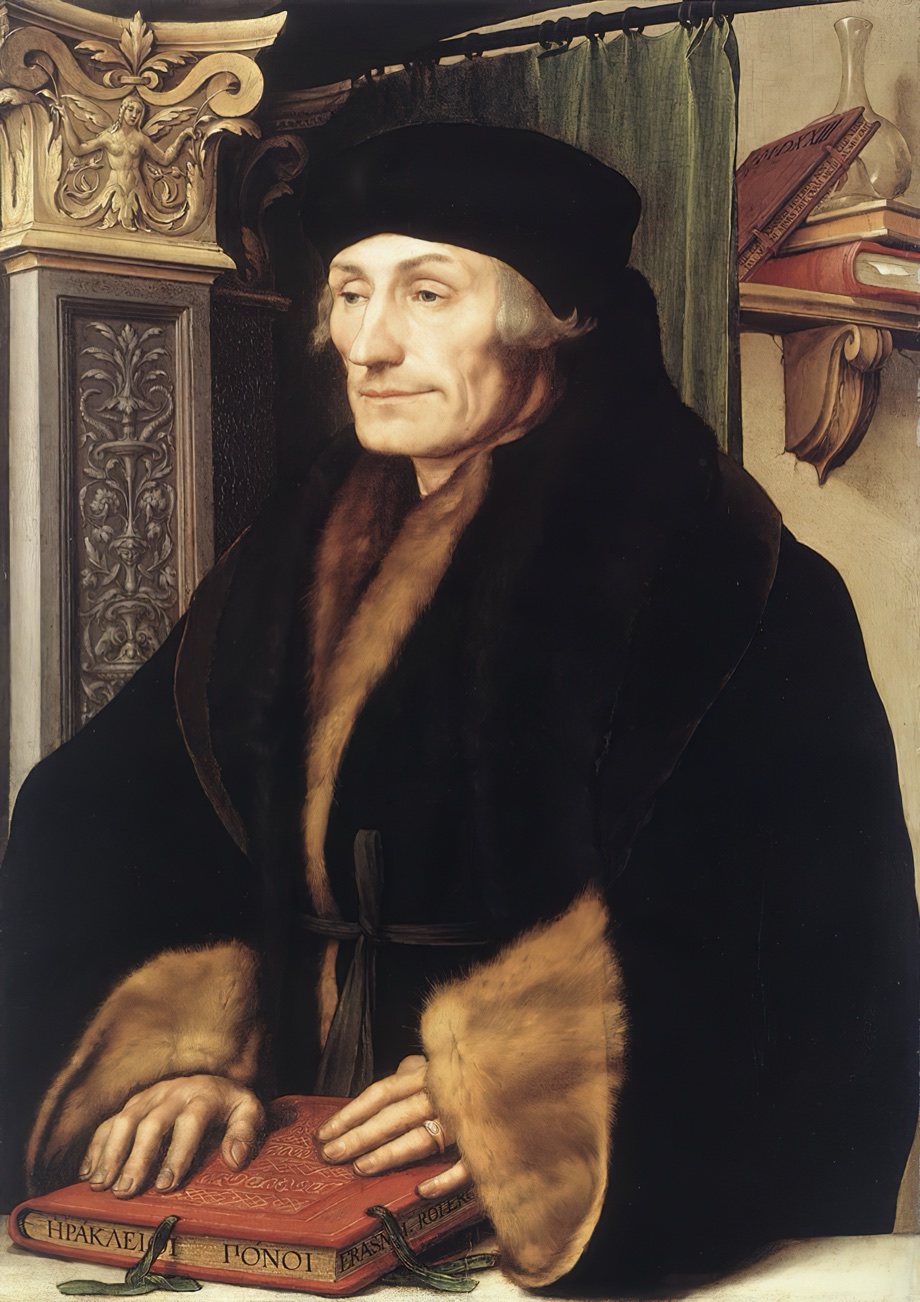
Portrait of Erasmus
The Scholar Who Would Join No Side
He was the most famous mind in Europe, and he owned almost nothing anyone could seize. An illegitimate boy from Rotterdam who had wriggled out of a monastery he detested, Erasmus made himself the arbiter of a civilization by the only instrument he fully trusted — a cool, exact, endlessly curious intellect. Kings and popes courted him; printers competed for his manuscripts; every reformer and every reactionary wanted his blessing, and he gave it to none of them without reservation. His great gift was also his great refusal: he could see through everyone, and so could commit to no one.
Desiderius Erasmus of Rotterdam (1466–1536), the “Prince of the Humanists,” was a wandering scholar who crossed Paris, England, Italy, and the Low Countries with a trunk of books and a portable reputation. He produced the first printed Greek New Testament, edited the Church Fathers, gathered thousands of proverbs into the ever-growing Adages, and in In Praise of Folly wrote the wittiest indictment of human stupidity in the age. He wanted reform — a stripped-down “philosophy of Christ,” a Church cleansed from within — but never a fight to the death over it. When the storm he had helped gather finally broke, he stood in the one place an age of zealots had no room for: the middle.
Erasmus is the INTP as conscience of an age: a cool, surgical Ti that dissected folly and superstition wherever it found them, married to a restless Ne that ranged across the whole of learning — a mind that trusted questioning over belief, and so refused to hand itself to any cause.
The Editor's Scalpel
Ti — dominant
Dominant Ti is the drive to get a thing exactly right for its own sake — to test every claim against an internal standard of logic and evidence and discard whatever fails. Erasmus applied it, astonishingly, to the sacred text itself. His Greek New Testament of 1516 did what no reverence for tradition had allowed: it treated Scripture as a text with a history, collating readings and correcting the Latin Vulgate that a thousand years of Christendom had taken as settled. Where the received Latin was mistranslated, he said so and offered his own rendering. It was philology as surgery, and it cut wherever the evidence pointed.
The same exacting intelligence powered his satire. In Praise of Folly is not an emotional cry against corruption but a cool anatomy of it — folly herself, given a mouth, calmly demonstrating how much of religion, scholarship, and power runs on self-deception. He dissected the cult of relics, the mechanical piety of pilgrimages, the vanity of theologians who could argue for pages about angels but had never read the Gospels plainly. The tone is amused, never enraged; the target is illogic and pretension.
What makes the Ti unmistakably his is that it never resolved into a system. He built no theology and founded no movement; he clarified, corrected, and questioned, then declined to march the argument to a fighting conclusion. His weapon was the footnote and the raised eyebrow, not the manifesto.
The Whole of Learning
Ne — auxiliary
Auxiliary Ne is the appetite for connection and range — the pleasure of moving across every field and seeing how it all speaks to itself. Erasmus was constitutionally incapable of staying in one subject. The Adages began as a few hundred classical proverbs and swelled, edition after edition, into thousands, each saying unfolding into a little essay that wandered from Greek comedy to Roman history to the follies of contemporary princes — a mind that cannot cite a proverb without chasing where it leads.
His wit was Ne, too. The pun that titles In Praise of Folly — Moriae Encomium, a play on the name of his friend Thomas More, at whose London house he dashed the book off — is the reflex of a mind that sees the double meaning in everything and cannot resist it. The same restlessness kept his body moving — Paris, Oxford, Turin, Venice, Rome, Basel — and made him the hub of the “republic of letters” that stretched across a divided continent, his correspondence tying humanists, printers, bishops, and kings into a single web. He belonged to no nation and every library, valuing the free traffic of ideas above any border, court, or creed.
Back to the Sources
Si — tertiary
Tertiary Si is a reverence for the original, the tested, the authentic thing as it actually was — and Erasmus channeled his whole program through it. His rallying cry was ad fontes, “to the sources”: strip away the accumulated commentary of the medieval schoolmen and go back to the earliest, purest texts, the Greek Gospels and the Church Fathers in their own words. His painstaking editions of Jerome and the New Testament were acts of Si — a patient recovery of what the record had said before centuries of misuse buried it.
This is what kept his radicalism controlled. A man whose reform means to restore — to recover the simple ethical teaching of the Gospels from beneath the scholastic apparatus grown over it — has no appetite for demolition. He revered the early Church as an earlier, cleaner state to be regained, not as raw material for invention. So when Luther proposed instead to break the structure open, Erasmus's deepest reflex — repair the source, do not shatter the vessel — pulled hard the other way, in the caution that would soon read as timidity.
The Egg and the Fighting-Cock
Fe — inferior
Inferior Fe is the INTP's uneasy relationship with the collective — a longing for harmony and belonging that the analytic mind cannot quite manage, and that turns to anxiety under pressure. For most of his life Erasmus held aloof from factions, and it worked: detached, he could be everyone's friend and no one's soldier. Then Luther forced the question inferior Fe least wants to face — whose side are you on?
Erasmus had, it was said, “laid the egg that Luther hatched” — his scholarship had exposed the very abuses Luther now thundered against. He answered the jibe with characteristic wit: he had laid a hen's egg, and Luther had hatched a fighting-cock. The distinction was the whole man. He wanted reform through persuasion and learning, and was horrified by schism, mob violence, and the shattering of the Christian body into warring camps. That rupture — a wound to the whole community — distressed him far more than any point of doctrine.
Cornered, he was pushed at last into open combat, and the ground he chose is revealing. In On the Freedom of the Will (1524) he made a measured, deliberately modest case that human beings retain some freedom to cooperate with grace; Luther replied with the ferocious On the Bondage of the Will (1525), scorning Erasmus's caution as unbelief. Distrusted now by both sides — too critical for Rome, too timid for the reformers — Erasmus could not secure the one thing inferior Fe most craves: a community that would have him. He died in Basel in 1536, a moderate in an age that had abolished the middle.
Why INTP Over INFP or INTJ
Why not INFP?
The INFP reading is tempting: a gentle, reform-minded man of conscience who loathed cruelty and cant. But Erasmus's mode was irony and analysis, not moral passion — he satirized, edited, and reasoned; he did not burn. His defining choice, to expose Rome's abuses and yet refuse to break with it, was not the stand of a fervent idealist willing to be martyred, but the caution of a mind that distrusted all zealotry, the reformers' included. That is Ti detachment weighing the wreckage, not Fi conviction planting a flag. An INFP would have followed the cause his heart endorsed; Erasmus followed no one's.
Why not INTJ?
The INTJ shares the detachment and the cool intellect, but builds — erecting systems, driving toward a designed future, organizing movements to get there. Erasmus did none of this. He constructed no theology and led no faction; he prized the open question over the finished structure, and left his program as a spirit rather than a plan. Where the INTJ's Ni closes toward a single vision, Erasmus's Ne kept everything provisional — the mark of a critic, not an architect.
What settles the case is the shape of his refusal. Offered the leadership of the Reformation on one side and the gratitude of Rome on the other, Erasmus declined both and kept his freedom to think. That is the INTP's deepest loyalty: not to a party or a program but to the unhindered judgment of his own mind. It cost him a home in his own age — and is exactly why he still speaks so clearly across it.
Connected Figures
Further Reading
- Erasmus of Rotterdam — Johan HuizingaThe classic short biography — a sympathetic, penetrating portrait of the man and his contradictions by one of the great cultural historians.
- In Praise of Folly & The Freedom of the Will — Desiderius ErasmusHis own words: the wittiest satire of the age, and the measured essay that drew him into his fateful duel with Luther.
- Erasmus, Man of Letters — Lisa JardineA modern study of how Erasmus deliberately fashioned his own towering reputation through print and correspondence.
- The Reformation: A History — Diarmaid MacCullochThe definitive single-volume account of the upheaval that engulfed him — essential for seeing why the middle ground collapsed.
