 Historical Figure MBTI
#377 · 4-3-26 · Tudor England
Thomas More
Lord Chancellor · Author of Utopia · The King's Good Servant, but God's First
1478 — 1535
7 min read
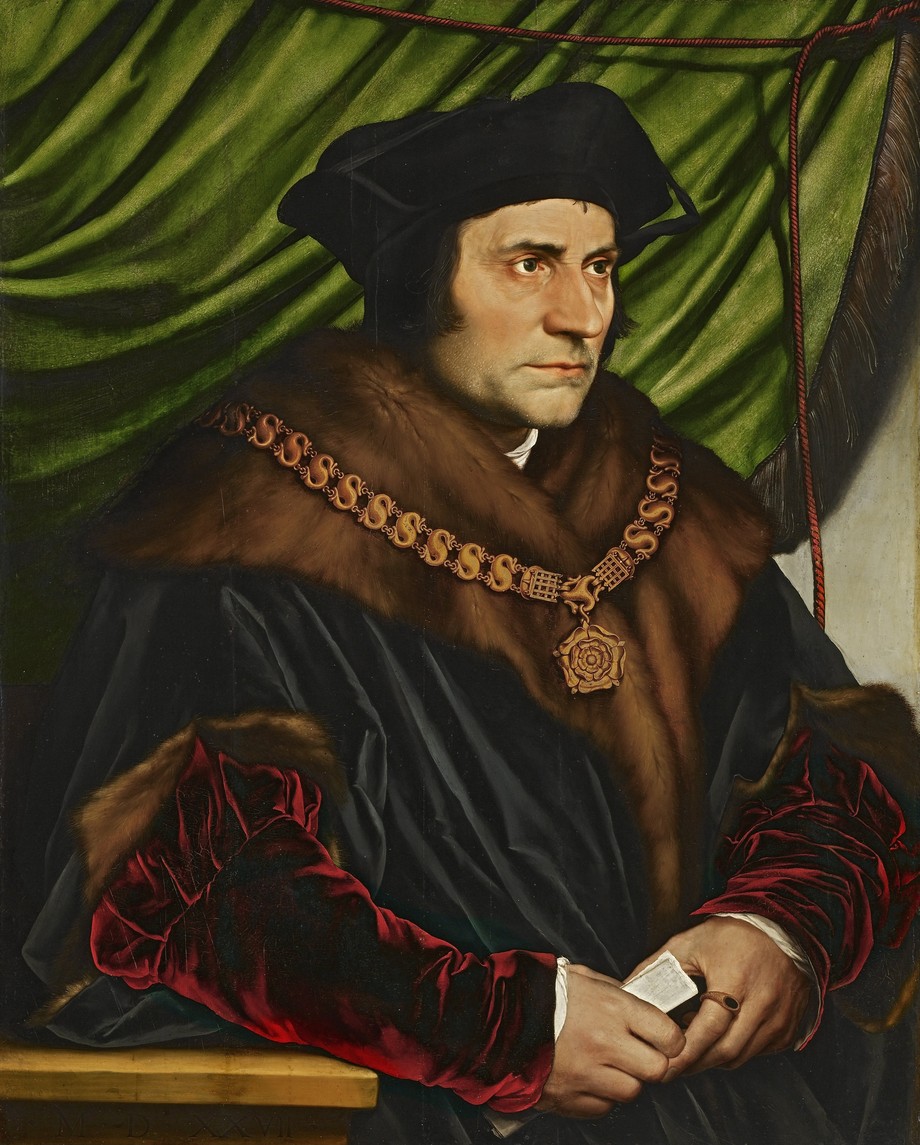
Portrait of Thomas More
The Man Who Would Not Speak
Thomas More—barrister, Greek scholar, wit whose conversation Erasmus crossed the Channel to enjoy—was the author of a single book that gave the English language a permanent word. Utopia (1516) imagined an island commonwealth where property was held in common, war abhorred, and reason governed human life: a society glimpsed entire, from above, as if designed from first principles. He rose under Henry VIII to Lord Chancellor in 1529—the first layman ever to hold the office—keeping a famously warm household at Chelsea where his daughters were educated in Latin and Greek alongside his sons. His Catholicism was not a costume; it was the bedrock beneath everything.
The crisis came when Henry broke with Rome. More resigned the chancellorship in 1532, withdrew from public life, and kept a careful, lawyerly silence—refusing the Oath of Supremacy without ever attacking the king he had loved and served. It was not enough. He was imprisoned in the Tower, tried in 1535 on perjured testimony, and beheaded—moving his beard from the block at the last, since it at least had committed no treason. “The King's good servant,” he said, “but God's first.” The mind behind all of it is the mind of the INFJ: dominant Ni seeing the long arc of conscience, auxiliary Fe rooted in faith and fellowship, tertiary Ti sharpened by the law, and an inferior Se—a bodily world he would, in the end, surrender rather than betray his soul.
More was the INFJ at the scaffold—a Ni vision of conscience so total, and an Fe loyalty to the communion of his faith so deep, that he would lose his head before he would lose his soul.
The Island in the Mind
Ni — dominant
Utopia is Ni made literature. More did not assemble his ideal commonwealth piecemeal; he conceived it whole, a unified vision in which every institution—property, marriage, religion, war, labor—follows from a single coherent principle. That is how Ni works: not outward from facts but downward from an apprehended whole. The same faculty governed his conscience. Where another man might have weighed the Oath of Supremacy as a political calculation, More saw it in its long implications: to swear was to concede that the king might define the Church, that the thousand-year communion of Christendom could be amended by an act of Parliament. He saw exactly where that road led, and he would not take a single step down it.
Ni is also patient, and More's silence was the patience of a man playing a longer game than his accusers. He declined to speak, trusting that the law could not convict a man for what he had not said. For nearly a year in the Tower he held that line, because he could see the whole board—the statute, the precedent, the danger in every word. It took perjury to break him, a fabricated conversation sworn to by Richard Rich, because honest means could not. The intuitive who sees the end from the beginning had already imagined every trap.
The Communion He Would Not Break
Fe — auxiliary
Fe in More was not abstract benevolence but lived warmth. The Chelsea household was its monument: full of children, scholars, in-laws, and pets, ordered by affection rather than severity, his daughters educated in Latin and Greek because he loved them and believed their minds worth it. Erasmus thought him the most genuinely companionable man in Europe. More did not die for an abstraction; he died for a communion. His objection to the royal supremacy was relational at its root: to accept Henry as Supreme Head was to break faith with the fellowship of the faithful stretching across centuries, to set England's judgment against the whole Church's. For an Fe of his depth, that was not doctrinal nicety but a betrayal of the deepest community he belonged to.
There is a darker face to this, and honesty requires naming it. As Lord Chancellor, More pursued heretics with a zeal modern readers find chilling—books burned, men burned—and defended the practice in print without apology. This was not a contradiction of his Fe but its shadow: the same loyalty that made him die for the Church made him willing to see its enemies destroyed. The warmth and the cruelty grew from one root—an absolute conscience, pointed in two directions.
The Lawyer's Edge
Ti — tertiary
More was a lawyer to his fingertips, and his Ti shows in the surgical care of his own defense. He had not said anything the Treason Act could touch. His silence was a deliberate legal construction: the law could not infer treason from refusal to speak, since qui tacet consentire videtur—he who is silent consents. He had given the crown no words to hang him with. The court could not answer this reasoning; it could only override it, convicting on testimony More flatly denied. When the verdict came, the lawyer who had held his tongue finally spoke with cold Ti clarity—arguing that no temporal statute could bind in a spiritual matter, locating the contradiction at the root and naming it precisely. But the logic was always in service of something prior: his Ni conscience and his Fe loyalty had already settled the matter. When the law would not save him, he let the law go.
The Body He Surrendered
Se — inferior
Many INFJs carry an ascetic suspicion of the flesh, and More carried it to a literal extreme. Beneath his Chancellor's robes he wore a hair shirt and scourged himself—mortifying the body his inward nature regarded with deep ambivalence. The sensory world was not where he lived. This is why the Tower could not finally touch him: stripped of office, books, household, and every comfort, More turned inward and grew, if anything, lighter. The Dialogue of Comfort against Tribulation, written in prison, faces death with a serenity that unnerved his jailers—not because More did not fear pain (he did, and said so) but because the physical world had never been the seat of his identity.
The scaffold was the final expression of this. The body was the last thing the king could take, and More gave it up with a joke—asking help up the rickety steps, moving his beard from the block because it had done no treason. For an inferior-Se INFJ, the flesh was always the least of him. His soul was somewhere the axe could not reach.
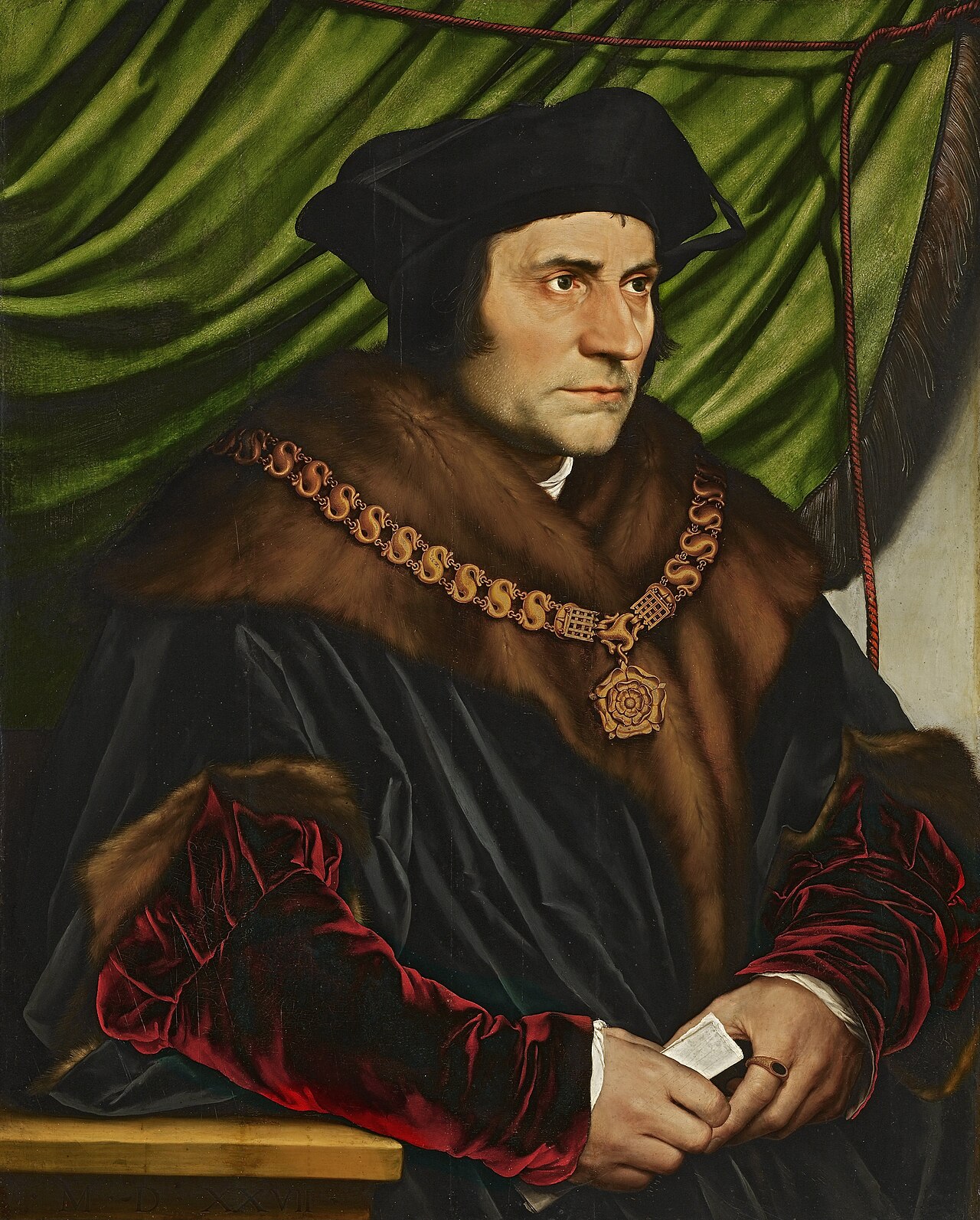
Why INFJ Over INTJ
Why not INTJ?
More and Cromwell are the cluster's great pair, and both are introverted intuitives of conviction—but Cromwell's was a cold Te design imposed on the realm, while More's was an Fe conscience rooted in the communion of the Church, in shared faith, and in his beloved household and friends. His silence and his martyrdom were not a strategist's calculation but a soul's refusal to break faith with a sacred community. Fe, not Te—INFJ, not INTJ.
Connected Figures
Further Reading
- Thomas More — Richard MariusThe fullest modern biography — unflinching on More's prosecution of heretics as well as his martyrdom.
- The Life of Thomas More — Peter AckroydA richly textured literary biography that captures the Chelsea household and the spiritual interior of More's life.
- Utopia — Thomas More (tr. Paul Turner, Penguin Classics)The primary text — best read alongside the introductory letters to understand the layers of irony More built into it.
- A Man for All Seasons — Robert BoltThe 1960 stage play that shaped the modern image of More as the supreme exemplar of private conscience resisting the state.
- Henry VIII — J. J. ScarisbrickThe standard scholarly biography of the king whose demand for supremacy forced More's impossible choice.
