 Historical Figure MBTI
#370 · 4-3-26 · Tudor England
Catherine of Aragon
Queen of England · Daughter of the Catholic Monarchs · The Immovable First Wife
1485 — 1536
8 min read
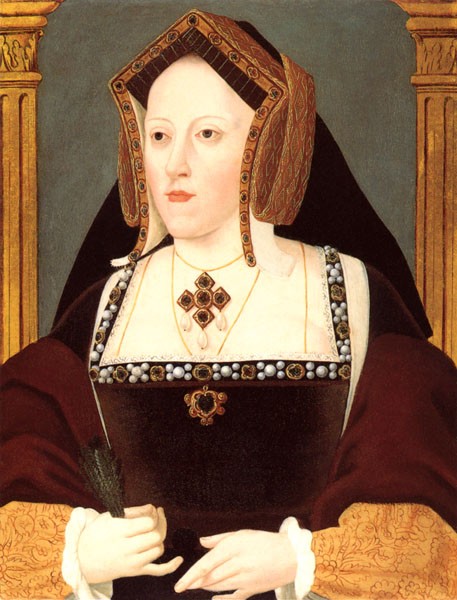
Portrait of Catherine of Aragon
Gentle on the Surface, Unbreakable Underneath
She was born in 1485, the youngest daughter of Ferdinand and Isabella of Castile, the Catholic Monarchs who unified Spain. Catalina de Aragón grew up amid ferocious piety and a mother who rode armored with her armies. Educated to a standard rare for princesses—Latin, the Church Fathers, law—she was praised by Erasmus and admired by Thomas More. The devotion instilled in childhood was not decoration. It was the deepest structure of her self, the thing every later trial would press against and fail to break.
Married at fifteen to Arthur, Prince of Wales, she was widowed five months later. There followed years of near-destitute limbo—a foreign princess held as a bargaining chip, her dowry unpaid, her future hostage to diplomacy she could not control. Through it she held to one fixed truth: her marriage to Arthur had never been consummated. She swore it as a girl and swore it on her deathbed. In 1509 Henry VIII married her. While he warred in France, she ruled England as regent and won Flodden Field.
When Henry resolved to be rid of her, he built a theological case from Leviticus and his hunger for Anne Boleyn. Catherine fought with a dignity that crushed everyone who watched. She would not accept the annulment; she would not take the convent's exit; she would not stop signing herself Queen. Gentle in manner, courteous to the last, she was immovable—not from stubbornness but from the ISFJ at full depth: Si rooted in the permanence of her vow, guarded by Fe that loved Henry even as he destroyed her.
Catherine of Aragon was the ISFJ in its deepest and steeliest form—a dominant Si anchored in the sacred permanence of a vow and a faith, wrapped in an auxiliary Fe that kept loving the man who broke her, gentle on the surface and utterly unbreakable underneath.
The Keeper of the Sacred Vow
Si — dominant
Dominant Si holds the past as the load-bearing structure of the present. For Catherine that structure was sacred. Her marriage to Henry was not a contract circumstance could revise; it was a vow made before God, blessed by a papal dispensation, and permanent in a way no court could undo. When Henry argued the union had been unlawful from the start, he was asking her to concede that twenty years of marriage and her daughter's legitimacy had all been a sin. Si would not bend to that.
The most consequential fact of her life was a Si fact: her marriage to Arthur had never been consummated. She repeated this without variation for twenty-five years—to her confessors, to the king's commissioners, and finally to the priest at her deathbed. One lived truth, held with absolute fidelity across decades, never adjusted under pressure. Where Henry could reason his way to whatever conclusion his appetite required, Catherine simply knew what had happened, and what had happened did not change.
Her devotion ran on the same current. She heard Mass daily, rose at midnight to pray, fasted, and wore the habit of the Third Order of St. Francis beneath her gowns. Stripped of her title, exiled to damp manors, forbidden to see her daughter, she lost nearly everything a queen could lose and held the one thing Si guards above all: the unbroken thread of who she had vowed herself to be.
The Love That Outlasted the Cruelty
Fe — auxiliary
Auxiliary Fe gave Catherine's steel its warmth. She loved Henry to the end, suffering the annulment not as a queen losing a title but as a wife losing a husband she still cherished. At Blackfriars in 1529, she refused to address the judges and instead knelt at Henry's feet: “Sir, I beseech you for all the love that hath been between us... I was a true maid, without touch of man; and whether it be true or no, I put it to your conscience.” A cold rule-follower would have pleaded canon law. Catherine knelt and spoke of love.
In her last letter, the Fe surfaces in its most astonishing form: she forgave him. She pardoned him all, commended Mary to his care, and closed “Katharine the Queen.” To forgive the man who broke a church to humiliate you while still refusing the lie he demanded is the signature of mature Fe yoked to Si: love genuine and freely given, never permitted to override the sacred truth.
The Quiet Logic of Her Defense
Ti — tertiary
Tertiary introverted thinking gave Catherine's appeals their spine. She was an unusually learned woman: when Henry's case rested on a single verse of Leviticus, she answered with Deuteronomy, which commands a man to marry his dead brother's widow—the very levirate obligation the papal dispensation had honored. The dispensation was lawful, the impediment removed, the union sound. That reasoning frustrated some of the finest legal minds in Europe.
But tertiary Ti serves, rather than rules, the personality. Catherine knew the truth first—by lived memory and faith—and reasoned afterward to protect it. Her logic was an instrument, not a master. A Ti-dominant thinker would have made the law the foundation; for Catherine the law was scaffolding around something sacred. When it bent against her she ceased to recognize it as binding. Her intellect made her formidable. It was never what made her immovable.
The Exits She Would Not Imagine
Ne — inferior
Inferior Ne is the ISFJ's blind spot—the faculty of alternative possibilities, the future reimagined along some new line. In Catherine it was almost entirely closed. Everyone around her kept offering exits: retire to a convent, accept the title of Princess Dowager, let the king have his annulment. She could not enter a single one, because every exit required her to concede that the truth of her marriage was negotiable—and to her it was not.
The same shut door that denied Catherine an exit made her one of history's great icons of constancy. A more Ne-driven woman would have taken the graceful retirement and been forgotten. Catherine could conceive of no version of herself that was not Henry's true wife and England's rightful queen, and so she remained both until the day she died. The inferior function cost her every available comfort. The dominant function it refused to betray made her unforgettable.
Why ISFJ Over ISTJ
Why not ISTJ?
Catherine's immovable resistance could, at a glance, look like an ISTJ's cold rule-following—a Te-and-Si insistence that the law is the law and the precedent stands. But it wasn't. Her great courtroom stand at Blackfriars did not plead canon law; it appealed to “the love that hath been between us” and put the question to Henry's conscience. The vow she defended was a marriage, not a contract; the truth she held was a lived intimacy, not a clause. That is ISFJ, not ISTJ.
An ISTJ defends a position because the rules and the record require it. Catherine inverted that order: her final loyalty was relational and sacred—to God, to her marriage as a holy bond. The reasoning served the love; it never replaced it. Her last letter, forgiving the man who destroyed her while refusing to surrender her title, is Fe wrapped around Si. The ISTJ would have been right and cold. Catherine was right and warm. She is the ISFJ guarding the sacred, not the ISTJ guarding the rule.
Connected Figures
Further Reading
- Catherine of Aragon: Henry's Spanish Queen — Giles TremlettThe fullest modern biography, drawing on Spanish archives to give Catherine's own perspective.
- Six Wives: The Queens of Henry VIII — David StarkeyAuthoritative group biography placing Catherine's struggle in the full dynastic context.
- The Divorce of Henry VIII: The Untold Story from Inside the Vatican — Catherine FletcherReconstructs the papal deliberations that Catherine's appeal triggered, and why Rome moved so slowly.
- The Spanish Tudor: The Life of Bloody Mary — H. F. M. PrescottClassic biography of Mary I that illuminates how deeply Catherine's example shaped her daughter.
