 Historical Figure MBTI
#378 · 4-3-26 · Tudor England
Cardinal Wolsey
Lord Chancellor · Cardinal · The Butcher's Son Who Ruled England
c. 1473 — 1530
5 min read
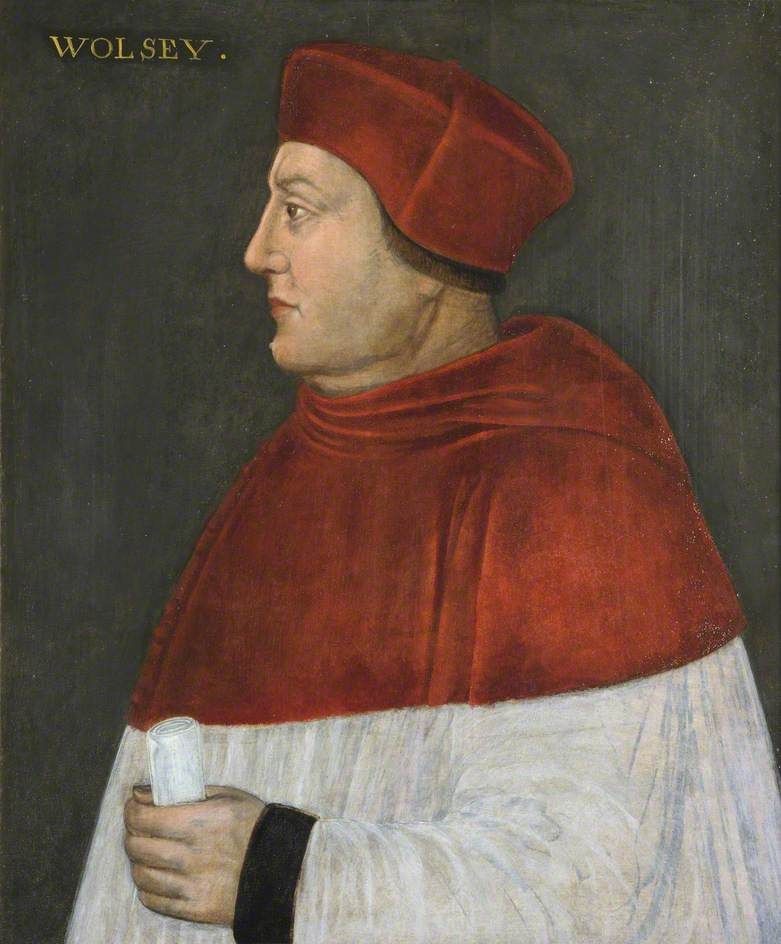
Portrait of Cardinal Wolsey
The Butcher's Son Who Ruled a Kingdom
He was born in Ipswich around 1473, the son of a butcher, in a century when birth was destiny. Thomas Wolsey refused. He took an Oxford degree at fifteen—the “boy bachelor”—entered the Church, attached himself to the right patrons, and climbed with a speed that left the old nobility breathless and furious. By the time Henry VIII came to the throne in 1509, Wolsey was at hand; within a few years he was Lord Chancellor, Archbishop of York, a cardinal of the Roman Church, and papal legate with authority over the English clergy no prelate had ever held. For fifteen years he was, in everything but name and crown, the ruler of England.
His fall came on the single thing his command could not deliver. When Henry demanded the annulment of his marriage to Catherine of Aragon to marry Anne Boleyn, the whole machinery of Wolsey's power turned on a verdict from Rome that Rome, with the Emperor's armies in Italy and Catherine his aunt, would never grant. Anne and the nobles who had hated him for twenty years turned the king against him. He was stripped of his offices and died in 1530 at Leicester Abbey on the road to his trial—“Had I but served my God as diligently as I have served my king, He would not have given me over in my grey hairs.” The minister he had trained, Thomas Cromwell, would inherit his methods and surpass his reach. Wolsey is the ENTJ in full magnificence and full hubris: the self-made administrator who organized a kingdom and was undone by the one will larger than his own.
Cardinal Wolsey was the ENTJ who rose from nothing to rule a kingdom—a dominant Te that ran courts, treasuries, and continental diplomacy as a single vast machine, an auxiliary Ni that gave his statecraft its long strategic reach, and a pride that mistook a minister's grandeur for a king's.
The Man Who Was the Government
Te — dominant
Dominant extraverted thinking wants systems that work and hierarchies that run, and it takes a near-physical satisfaction in being the one who makes the machinery turn. Wolsey was Te operating with a whole kingdom for its workshop. As Lord Chancellor he made the Star Chamber a court where even the greatest magnates could be hauled up and held to account, and pursued enclosure abuses with a thoroughness that delighted commoners and enraged the lords. He took the business of governing—the tedious grind that bored Henry to distraction—and made it the substance of his days.
His reach was continental. He engineered the Treaty of London in 1518, briefly making England the arbiter of Europe. The Field of the Cloth of Gold in 1520 was a Te feat of pure logistics dressed as spectacle: two royal courts transported, fed, and choreographed across the Channel, every precedence managed so nothing should fail. Wolsey held the seals, the legateship, the archbishopric, and the chancellorship simultaneously, and processed an avalanche of business that would have buried a lesser administrator. Thomas Cromwell learned his statecraft in Wolsey's household, but the system remained its master's. Wolsey was, for fifteen years, the operating government of England.
The Long Game Behind the Pageant
Ni — auxiliary
Auxiliary Ni supplies the converging vision toward which all the Te machinery is aimed—the sense of where events are tending and how today's arrangement serves a design visible only later. Wolsey grasped that England's advantage lay not in armies she could not afford but in the role of indispensable third party between France and the Habsburg Empire—the makeweight whose adherence decided the balance. The Treaty of London, the courting and discarding of alliances: all of it expressed a single intuition about where England could insert herself for maximum leverage. Cardinal College at Oxford was an attempt to seed Church and state with men trained in the new learning, an institutional legacy designed to outlast him.
But auxiliary Ni serves the dominant function, and its vision had a blind spot exactly where his power was most exposed. Wolsey read Europe brilliantly and misread the one variable that destroyed him: the depth of Henry's will once it fixed on Anne Boleyn, and the impossibility of bending Rome while the Emperor's troops held Italy and Catherine was the Emperor's aunt. He believed he could engineer the annulment as he had engineered everything else. The intuition that had served his statecraft for two decades failed him on the only question that finally mattered.
Scarlet, Gold, and the Theater of Power
Se — tertiary
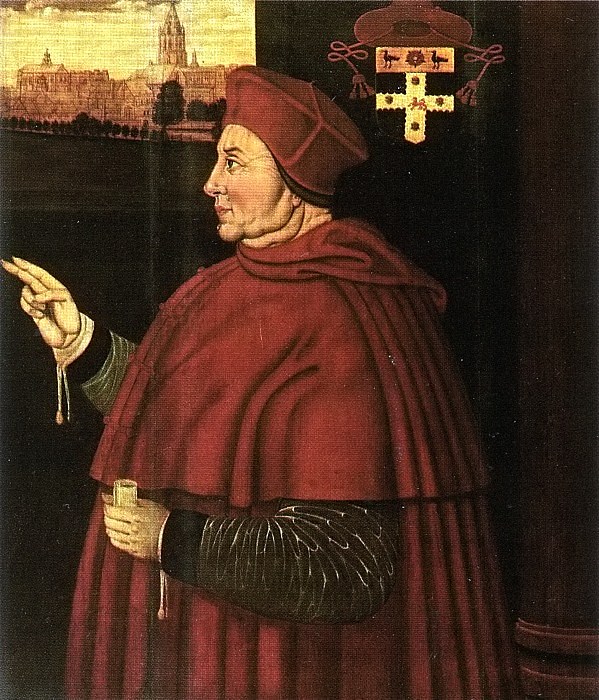
Tertiary extraverted sensing shows up in an ENTJ as the conviction that authority must be seen and felt to be real. No churchman in English history indulged it more lavishly. Wolsey moved through the realm in cardinal's scarlet, silver crosses and pillars carried before him, a household of hundreds. He raised Hampton Court on a scale of red brick and gilt that no subject had any business commanding—so splendid that Henry, who could not abide being out-shone, eventually took it for his own. The Field of the Cloth of Gold in 1520 was tertiary Se as statecraft: fountains running with wine, a temporary palace of glass, magnificence staged as argument.
The tertiary position explains both the brilliance and the danger. Se grandeur in the service of dominant Te can dazzle and intimidate—but tertiary functions are prone to excess. His accumulation of palaces, offices, and visible wealth began to rival the Crown's, making him a target the moment he ceased to be indispensable. The very splendor that announced his power furnished his enemies their indictment: when he fell, the inventories of his magnificence were read out as evidence of a subject who had presumed too far.
The Pride, and the Grey-Haired Reckoning
Fi — inferior
Inferior introverted feeling is the ENTJ's shadow—the buried sense of private values, of who one is apart from what one accomplishes. Fi tends to go unattended for most of a life, then surface late and overwhelming at the moment of collapse. For most of his career Wolsey's inferior Fi expressed itself only as pride: he had risen from a butcher's shop to the second place in the kingdom by his own ability, and he wore that knowledge as armor the old nobility found insufferable. His sense of his own worth had fused entirely with the offices he held. When Henry stripped him of the seals, Wolsey did not simply lose his position. He lost the only self he had.
The famous deathbed words are the eruption of that buried Fi in its purest form. Dying at Leicester Abbey on the road to a treason trial, the cardinal reckoned, too late, with what he had served and what he had neglected: “Had I but served my God as diligently as I have served my king, He would not have given me over in my grey hairs.” It is the inferior function speaking at last—the recognition, in extremis, of an inner allegiance the whole machinery of his Te life had crowded out. The ENTJ who organized a kingdom understood, only at the end, that he had never organized himself.
Why ENTJ Over INTJ
Why not INTJ?
The strategic reach of Wolsey's diplomacy and the long view behind his colleges tempt an INTJ read—the private architect quietly designing a future. But Wolsey ruled in the open: commanding, magnificent, a showman who needed the procession, the scarlet, the great stage of court and continent. The INTJ builds in private and lets the work speak; Wolsey spoke, loudly, through everything he built and wore and staged. His power was outward Te command, not the inward, self-effacing design of an Ni-dominant.
The decisive evidence is where Wolsey placed himself: never behind the scenes, always at their visible center. He held every great office in his own hands, processed the realm's business through his own household, moved through England in cardinal's scarlet, and built palaces so that his power should be seen. His shaping intuition served an extraverted, executive will—the Ni was the strategist's auxiliary, not the personality's core. He did not retreat to design; he advanced to command.
Connected Figures
Further Reading
- Wolsey: The Life of King Henry VIII's Cardinal — John MatusiakThe most thorough modern biography — traces the full arc from Ipswich to Leicester Abbey.
- Thomas Wolsey: Late Cardinal, His Life and Death — George CavendishWritten by Wolsey's own gentleman-usher; an eyewitness portrait of the cardinal's rise and ruin, composed c. 1558.
- Henry VIII — J. J. ScarisbrickThe standard academic life of Henry; indispensable for understanding the king Wolsey served and the political world they shared.
- The Tudor Court — David StarkeyIlluminates the culture of display and faction at Henry's court that both sustained and destroyed Wolsey.
- The Tudors — G. J. MeyerA narrative history of the whole dynasty — excellent on how Wolsey fits the larger pattern of Tudor power and its human cost.
