 Historical Figure MBTI
#371 · 4-3-26 · Tudor England
Anne Boleyn
Queen of England · The Cause of the Reformation · Mother of Elizabeth I
c. 1501 — 1536
9 min read
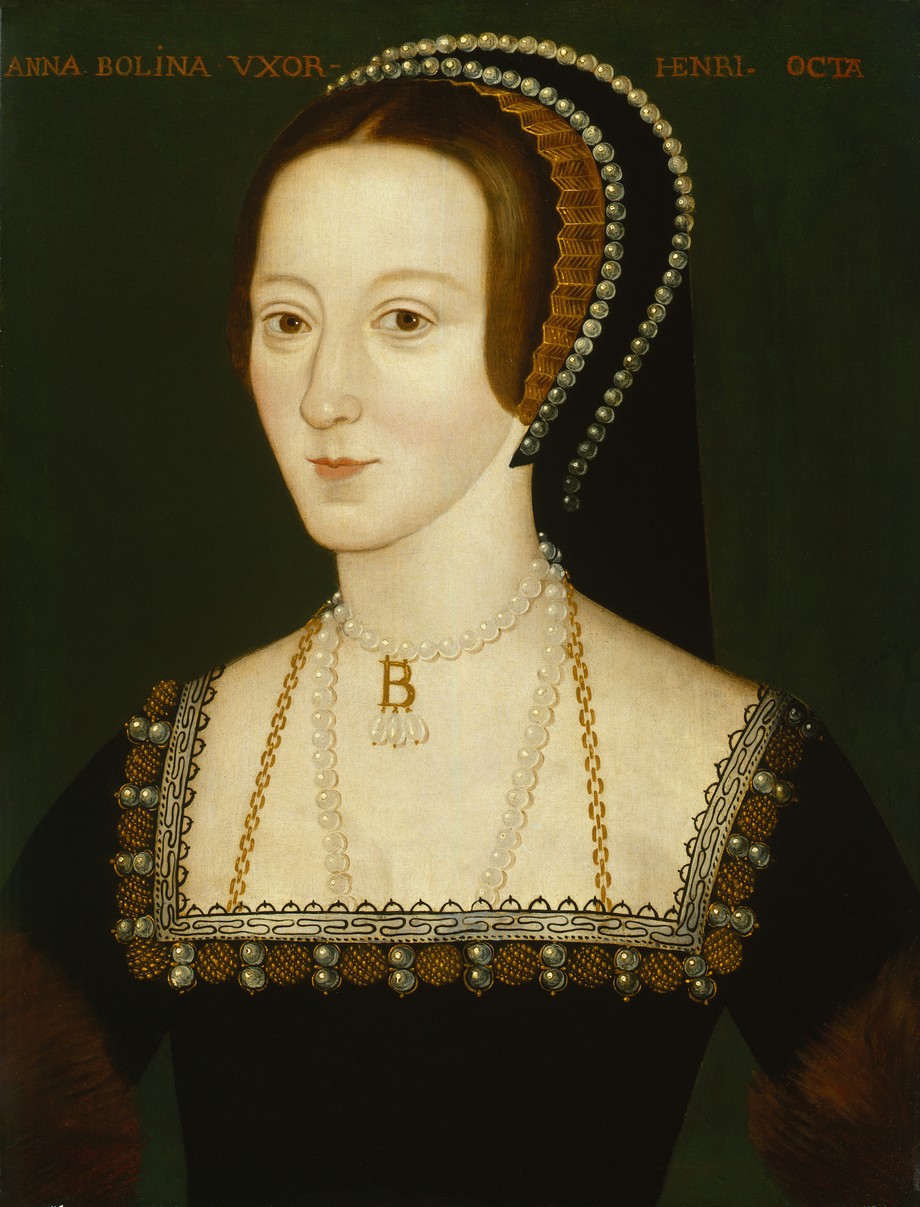
Portrait of Anne Boleyn
The Woman Who Gambled a Kingdom's Religion on Herself
She held the crown for barely a thousand days and reshaped England for the next century. Anne Boleyn came back from years at the French court around 1522 a different creature from the English girls around her: stylish, accomplished, sharp-tongued, and quietly absorbed in the dangerous evangelical ideas seeping out of the Continent. She read banned reformist books and pressed them on the people who mattered. She was not conventionally beautiful—dark where the fashion was fair—but contemporaries agreed she was magnetic, and that the magnetism was made of mind as much as looks.
Her sister Mary had been Henry VIII's mistress and took from it nothing but ruin. Anne, watching, refused the part. When the king turned his hunger on her, she held out—with an audacity that still startles—for the crown itself. The obstacle was not Henry's reluctance but a living wife, Catherine of Aragon, and a Pope who would not annul a marriage to the aunt of the most powerful monarch in Christendom. The waiting stretched to six years. In those years Henry's frustrated desire—fed by the reformist arguments she favored—tore England from the Roman Church. To have her, he made himself Supreme Head of the Church of England and rewrote a thousand years of religious allegiance. She was crowned, splendidly and defiantly, in 1533. She bore a daughter, the future Elizabeth I; miscarried a boy in 1536; and her enemies, with Thomas Cromwell assembling the machinery, struck. Charged with adultery on fabricated evidence, she was beheaded inside the Tower on the 19th of May 1536. What drove the whole astonishing arc is the unmistakable signature of the ENTP: dominant Ne in the daring, auxiliary Ti in the cold calculation, tertiary Fe in the charisma that bewitched a court, and inferior Si in the disregard for precedent that helped to doom her.
Anne Boleyn was the ENTP who staked everything on herself and her own audacity—a restless Ne intelligence that fed a king reformist ideas and a dangerous gambit, lawyered by a cool Ti into a campaign for the crown no mistress had ever dared, and performed with a wit sharp enough to win a kingdom and to make the enemies who took her head.
The Restless Wit and the Long-Shot Gambit
Ne — dominant
Dominant extraverted intuition is a restlessness with the given—a constant reaching toward what might be, and an instinct to provoke the world into showing what it is made of. Anne came back from France crackling with novelty: new fashions, new music, and—most dangerously—new religious ideas. She read the smuggled evangelical literature the authorities were burning, pressed Tyndale's writings on Henry, and made herself the conduit through which reformist possibility reached the throne. That is Ne as an engine of change: not a worked-out theology but a live sense that the settled order might be otherwise, and a refusal to let it rest.
The same function shows in the audacity of her central wager. To refuse to be a king's mistress and hold out for his crown—against a sitting queen, a powerful foreign nephew, and the Pope—is not the move of a cautious temperament. It is the move of a mind that sees an impossible possibility and decides to play for it anyway. And Ne, finally, loves to provoke. She mocked Cardinal Wolseyand helped bring him down; she sparred with courtiers in ways later twisted into evidence of adultery. The restless, irreverent mind that had carried her up was constitutionally incapable of the blandness survival at Henry's court required. The Ne that won her the crown could not be turned off once it became a liability.
The Cold Calculation Beneath the Charm
Ti — auxiliary
If Ne supplied the daring, auxiliary Ti supplied the strategy that turned daring into a six-year campaign. Anne's refusal of Henry was not coyness and not, at root, virtue—it was an exact reading of incentives. She had watched her sister be used and discarded, and she understood the brutal arithmetic: a man's desire is most powerful while ungratified, and the only way to convert wanting into permanence was to make herself unobtainable short of marriage. Holding out was a coldly calculated strategy that weaponized the king's appetite against him.
She grasped, as a logician grasps a proof, that the obstacle was the Pope's jurisdiction and the solution was to dissolve it—and the reformist books she favored supplied exactly the argument: a king answers to God alone. Ti also accounts for the quality her enemies found most unforgivable: she did not soften. Anne argued, retorted, held her ground, and made it plain when she thought someone a fool. She treated the court as a contest of wits to be won rather than a web of feelings to be managed. It was effective while Henry's desire protected her, and fatal the moment that protection lifted. The cool intelligence that built the campaign left her, in the end, with brilliantly defended positions and almost no friends.
The Charisma That Bewitched a King
Fe — tertiary
Tertiary Fe in an ENTP is not warmth in the maternal sense; it is performance—a finely tuned instinct for atmosphere, charisma deployed in the service of the self. Anne had this in a degree that bordered on sorcery, and her contemporaries reached for exactly that word. She sang, she danced, she conversed in a way that made a man feel he was the only person in the hall. Henry, a man who lived on adoration, was helpless against a woman who could command attention as expertly as he could. To keep a king's desire at full pitch across six frustrated years—alluring without yielding, indispensable without becoming familiar—requires a virtuoso command of emotional effect. That is tertiary Fe at its most potent: the social arts turned into a campaign tool, a performance precise enough to reorder a continent.
But tertiary Fe has a brittle edge. Anne could dazzle but not consistently conciliate, and a queen needs allies, not just admirers. Her charm worked on the one man whose desire she had aroused; it did not translate into the patient cultivation of a loyal faction. When Henry's ardor cooled and she failed to give him a son, the performance had no fallback. The charisma that was pure advantage on the way up left her surrounded by people who had been impressed by her and were now glad to see her fall.
The Disregard for Precedent and Safety
Si — inferior
Inferior Si is the ENTP's blind spot—a weak relationship to precedent and the accumulated wisdom of how things are done and why. Anne's entire ascent was a violation of precedent: no Englishwoman had held out for a crown the way she did, no king had broken a church for a marriage, no commoner-born queen had supplanted a princess of the blood. That she could conceive of such a path is a tribute to Ne's contempt for the way things had always been—and the contempt, having carried her to the throne, did not know how to keep her safe on it.
The fall reveals the inferior function most starkly. Having made herself the woman who could overturn a queen, she had taught everyone around her that a queen could be overturned. She kept the sharp tongue, the provocations, the open quarrels—all in a court where enemies were cataloguing every word. She underestimated, fatally, the durability of the institutions she had treated as infinitely flexible. The darker irony is that the very flexibility she had exploited was turned against her by Cromwell, who manufactured a case of adultery and treason and ran it through a court that would not acquit the king's discarded wife. The ENTP who disregards the safety of precedent meets, at the last, an opponent who has learned the lesson she taught: that nothing is fixed, and that a queen, too, can be unmade.
Why ENTP Over INTP
Why not INTP?
The cool, calculating intelligence and the love of dangerous ideas can read as INTP—but the INTP turns that intelligence inward, withdrawing to build private systems and engaging the world on its own terms. Anne did the opposite. She worked the court, performed, provoked, and out-talked her rivals in the open. Her intuition was not a quiet inner architecture but a social and combative weapon, deployed at banquets and in arguments with a public charisma the INTP simply does not possess. The INTP retreats to think; Anne advanced to win.
She did not develop her reformist sympathies in scholarly solitude—she pressed them on a king. She did not analyze papal authority for its own sake—she used the analysis to engineer a coronation. Her tertiary Fe gave her a taste for performance the introverted, feeling-last INTP conspicuously lacks. She was an idea-driven combatant who fought in public and lived or died by the room. That is the ENTP—not the INTP who would rather be left alone to think.
Connected Figures
Further Reading
- Anne Boleyn: A New Life — E. W. IvesThe definitive modern biography — exhaustive on the political and religious dimensions of her rise and fall.
- The Life and Death of Anne Boleyn — Eric IvesAn earlier version of Ives's landmark study, essential for understanding the court politics that surrounded her.
- Six Wives: The Queens of Henry VIII — David StarkeySituates Anne among all six queens, offering rich comparative context for her unique audacity and strategy.
- The Creation of Anne Boleyn — Susan BordoTraces how Anne has been represented and mythologized from Tudor propaganda to modern fiction and film.
- Wolf Hall — Hilary MantelA fictional masterwork that renders Anne through Cromwell's eyes — the most psychologically acute portrait of the court she dominated.
