 Historical Figure MBTI
#376 · 4-3-26 · Tudor England
Thomas Cromwell
Chief Minister · Architect of the Reformation · The Blacksmith's Son
c. 1485 — 1540
8 min read
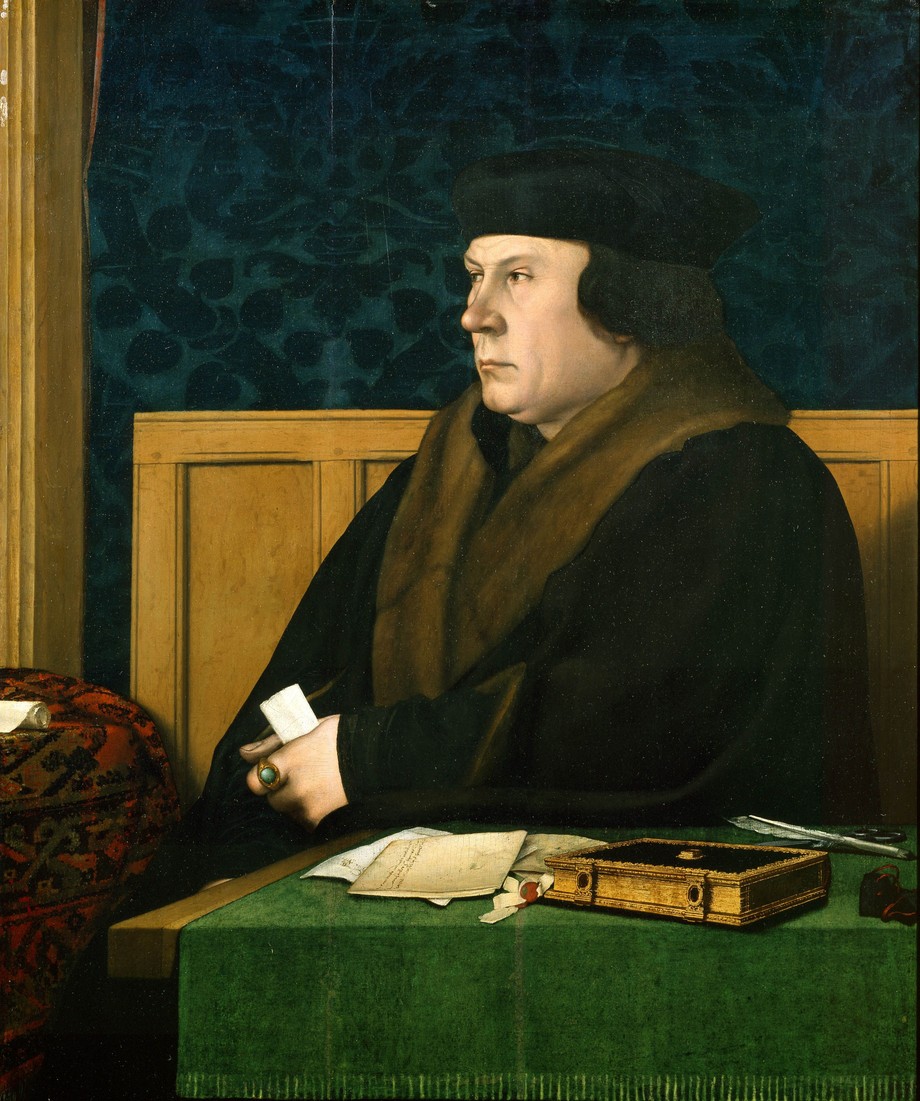
Portrait of Thomas Cromwell
The Architect Behind the Throne
He was born around 1485 in Putney, the son of a blacksmith with no land, no Latin, and no expectations. He left England as a teenage runaway, soldiered in Italy, traded in the Low Countries, learned law and money in the great commercial cities of Europe, and came home a self-made man of formidable competence. By the 1520s he was in the service of Cardinal Wolsey; and when Wolsey fell in 1529 for failing to deliver the king's divorce, the clever servant did the one thing no one expected—he survived his master's ruin and rose, within five years, to become the most powerful man in England under the king himself.
Cromwell was the true engineer of the English Reformation—not its theologian (Cranmer), and not its cause (Henry VIII's appetite for Anne Boleyn), but its architect. He drove through the statutes that severed England from Rome, masterminded the Dissolution of the Monasteries, and built the machinery of the modern centralized English state—run not by the king's person but by statute, council, and paperwork. Then he arranged the king's marriage to Anne of Cleves; Henry loathed her on sight; the conservative faction seized their moment, and Cromwell was attainted without trial and beheaded in July 1540. The architect had built everything except a defense against the court he could not feel.
Thomas Cromwell was the INTJmaster-builder of the Tudor state—a dominant Ni that saw, years ahead, the shape of a reformed and centralized kingdom run by statute, executed by a relentless Te that turned that private vision into law, paperwork, and an empire of wealth transferred to the crown.
The Kingdom He Saw Before It Existed
Ni — dominant
Cromwell's genius was never improvisation; it was design. Where Henry lurched from appetite to appetite, Cromwell saw what the king never did: that the “Great Matter” could be the lever to remake the entire constitution of England. The break with Rome, in his hands, was not a one-time expedient but the opening move of a coherent idea—a sovereign nation-state, an empire in the old legal sense, with the king as head of both church and realm and statute as the instrument that bound it all together.
That vision is visible in the preamble he drafted for the Act in Restraint of Appealsof 1533—“this realm of England is an empire”—a single sentence that contained the whole future, written into law as though it had always been true. The Dissolution of the Monasteries reveals the same pattern. Lesser men saw monasteries as plunder; Cromwell saw a structural transfer—the permanent redistribution of a fifth of England's land into the crown, binding a new class of gentry buyers to the Reformation by their own self-interest, so that the change could never be undone. He kept his true designs close, so that contemporaries mistook the architect for an opportunist. He was riding nothing. He had seen, years before the rest, the centralized statutory state England would not fully become for generations.
The Machine That Made the Vision Real
Te — auxiliary
What made Cromwell the most effective minister of his century was the auxiliary Te that gave his Ni a body. Where Wolseyhad governed by personal magnificence, Cromwell governed by statute, paperwork, council, and file. He understood that a vision becomes irreversible only when encoded in institutions, and so he worked through Parliament as no minister had before him, steering an extraordinary volume of legislation that converted a king's wish into permanent law. The “Tudor revolution in government”—reorganized finances, professionalized household departments, the Valor Ecclesiasticus of 1535 tabulating every religious house in the realm—is Te made visible: a relentless administrator holding a dozen offices at once, running England out of his own correspondence.
Te is also impersonal about obstacles. When evidence was needed against Anne Boleyn in 1536, he assembled it; when men stood in the way of the king's settlement, he had the legal instruments—attainder, the treason statutes he himself had broadened—to remove them with minimum friction. He destroyed enemies the way he balanced a ledger: without heat, because they were entries to be cleared. This is Te at its most formidable and its most chilling—a vision served by an execution so efficient the human cost registers only as a line item.
The Loyalties He Kept Hidden
Fi — tertiary
Cromwell is easily caricatured as a man without a heart, but the tertiary Fi beneath his cold surface was real—guarded and private, expressed not in display but in conviction. Its clearest sign was his loyalty to Cardinal Wolsey. When his master fell and the wise career move was to disown him, Cromwell did the opposite: he wept openly, then defended Wolsey's interests in the very Parliament turning against the fallen cardinal, at real risk to himself. Not sentimentality—the inward refusal of a privately principled person to betray a man he had served.
His Reformation was more than a job. Beneath the lawyer's coldness ran a genuine evangelical conviction—a self-made man's belief in the reformed faith and in a religion stripped of the wealth and superstition he had watched the old church accumulate. He was the driving force behind placing an English Bible in every parish church. Fi does not preach; it holds. But it surfaced too narrowly to save him: a man of guarded private loyalties moving through a court that ran on a performed social register he could neither read nor reciprocate. He valued; he did not charm. And in the world of Henry's affections, charm was survival.
The Room He Could Not Read
Se — inferior
The fatal miscalculation was the marriage to Anne of Cleves. The match was strategically sound—a Protestant alliance, exactly the kind of long-range move Cromwell's Ni favored. But it depended on a variable his inferior Se could not weigh: whether Henry, a creature of immediate physical appetite, would actually want the woman when she stood before him. Henry recoiled on sight, and the alliance that looked flawless on the strategic board collapsed at the level of the body and the glance—the very level Cromwell was least equipped to anticipate.
His enemies—Norfolk, Gardiner—understood the present-tense court better than he did. They read the king's mood, dangled the young Catherine Howard before his eye, and worked the room of Henry's feelings while Cromwell worked the machinery of state. He had built an empire of statute and paperwork and never built a defense against a faction operating in the register of charm and the king's shifting affection. In the summer of 1540 they turned Henry against him in weeks; he was arrested at the council table, attainted without the trial he had denied so many others, and beheaded. The man who saw decades ahead was destroyed by the politics of a single room.
Why INTJ Over ENTJ
Why not ENTJ?
Cromwell commanded England and reshaped its government, which tempts an ENTJ read—but the ENTJ leads from the front by force of presence, dominating assemblies through outward will. Cromwell did the opposite. His power worked through systems, statutes, and paperwork built from a private, long-range design he kept largely to himself—the introverted vision of the Ni-dominant. He was the architect behind the throne, never the orator on it.
Set him beside his great foil, the INFJ Thomas More—another visionary who served Henry and died for it—and the contrast sharpens: More's Ni served a Fe conscience that finally could not bend, and he perished for what he would not say; Cromwell's Ni served a Te execution that bent everything to the design, and he perished for what he could not feel. Both were INxJ master-builders; where More built toward a principle, Cromwell built toward a state.
Connected Figures
Further Reading
- Thomas Cromwell: A Revolutionary Life — Diarmaid MacCullochThe definitive modern biography — exhaustive, revisionist, and essential for understanding Cromwell's religious convictions.
- Wolf Hall — Hilary MantelFiction, but grounded in meticulous research; the most psychologically alive portrait of Cromwell yet written.
- Thomas Cromwell: The Untold Story of Henry VIII's Most Faithful Servant — Tracy BormanA concise and accessible biography that balances the bureaucratic genius with the human costs of his methods.
- The English Reformation — A. G. DickensThe foundational account of the religious transformation Cromwell engineered — indispensable context.
- Tudor England — John GuyThe best single-volume survey of the political world Cromwell inhabited, from Henry VII through Elizabeth.
