 Historical Figure MBTI
#379 · 4-3-26 · Tudor England
Thomas Cranmer
Archbishop of Canterbury · Author of the Book of Common Prayer · The Reluctant Martyr
1489 — 1556
7 min read
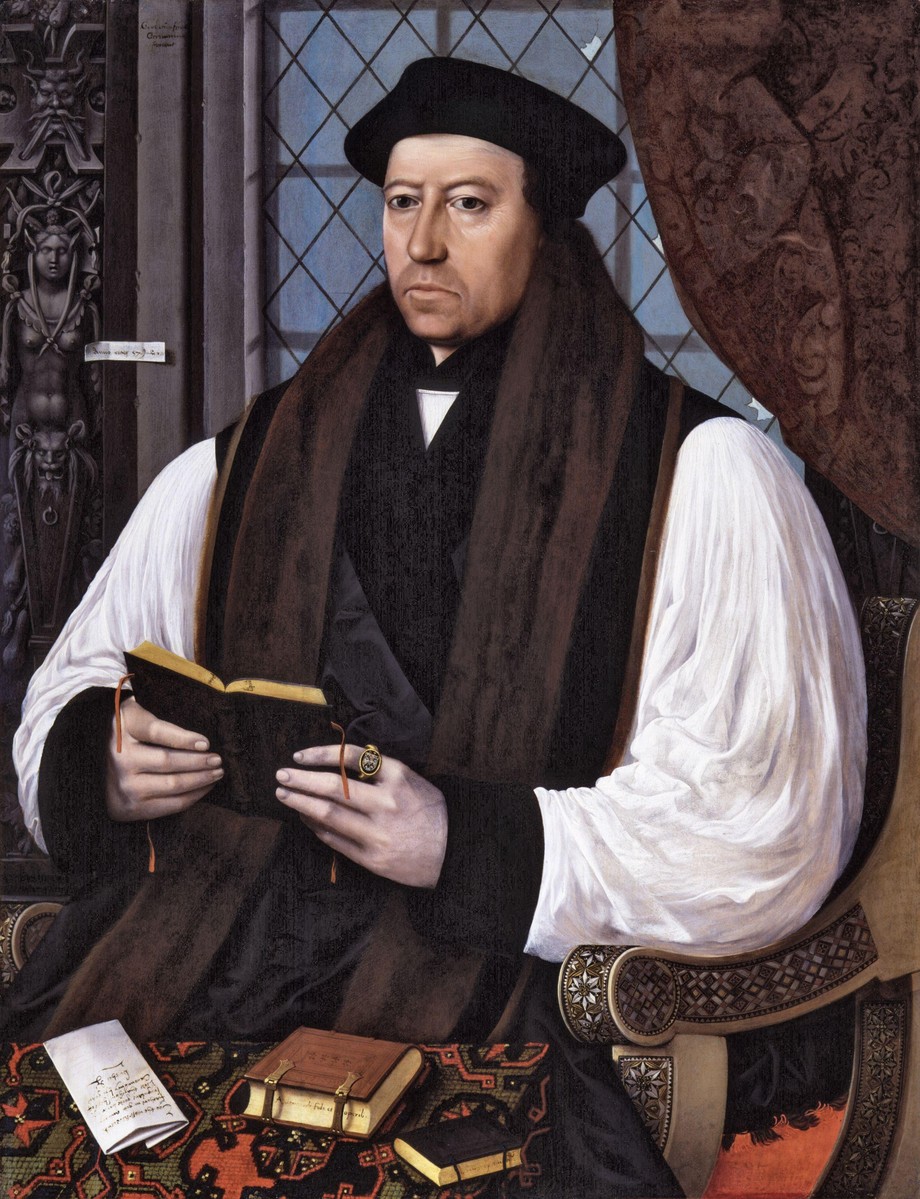
Portrait of Thomas Cranmer
This Hand Hath Offended
On the morning of 21 March 1556, Thomas Cranmer—Archbishop of Canterbury and the most powerful churchman in England—was chained to a stake in a ditch outside Oxford. He had every reason to be there in shame: worn down by imprisonment, he had signed a series of recantations repudiating the Protestant faith he had spent twenty years building. His enemies ordered him to repeat the recantation one final time in public, before the burning. And then, in the last ten minutes of his life, the broken man did the opposite. He renounced every recantation as written “contrary to the truth,” declared the Pope to be Antichrist, and thrust his right hand into the flames—“this hand hath offended”—holding it steady until it was consumed.
It makes no sense unless you understand the man. Cranmer was a reserved Cambridge scholar who survived Henry VIII's murderous reign by never giving offence, never being where the blow would land. Bolder men—Thomas More, Thomas Cromwell—lost their heads; Cranmer endured by discretion. Yet beneath the timidity ran a private conviction so deep it survived even his own cowardice. The portrait is a textbook INFP—a man ruled by an inward sense of what was true, who gave English Christianity its most beautiful prose and then, having failed his own conscience utterly, found it waiting for him at the stake.
Cranmer was the INFP in full—a quiet Fi conscience that lived far below the surface, an Ne imagination that remade a church and gave it a living English voice, and an inferior Te that left him politically timid and agonizingly slow to act. He failed, he recanted, and then, in his last ten minutes, he became immovable.
The Conscience That Outlived His Cowardice
Fi — dominant
Dominant introverted feeling does not announce itself; it is a deeply private compass held so far below the surface that it becomes visible only when it is touched—and then it becomes absolute. For most of his life Cranmer's Fi was invisible. He deferred, bent, served Henry through every twist of the king's appetites, kept his evolving Protestant convictions concealed for years, even keeping a Lutheran wife in secret at real personal risk. This was not a man without conscience; it was an Fi dominant whose conscience lived entirely in private.
The tragedy of his last years is Fi under unbearable pressure. Imprisoned by Mary I, Cranmer cracked—signing recantation after recantation, repudiating everything he believed. It is tempting to read this as the collapse of a man who never truly believed anything, but that gets it exactly backward. Fi does not negotiate; it can be overwhelmed and made to sign papers—but it does not actually change. When his captors staged a public ceremony and handed him a platform, the surface man fell away and the conscience spoke. He renounced the recantations, named the Pope as Christ's enemy, and held his offending hand in the fire: a timid scholar discovering, at the absolute end, that the one thing he could not betray was the private truth he had carried all along.
The Imagination That Gave a Church Its Voice
Ne — auxiliary
In a Fi-dominant theologian, auxiliary Ne produces neither systematic architecture nor polemical fire but something rarer: a reforming imagination with a profound feel for language. Cranmer's Protestantism evolved, gathered, absorbed Lutheran and Reformed influences and the writings of the Fathers, and expressed itself above all in shaping words ordinary people could pray.
His monument is the Book of Common Prayer (1549, revised 1552). Cranmer took the Latin liturgy of the medieval church and reimagined it in English, compressing the scattered offices of priests and monks into a single book a congregation could hold and speak. He dissolved a dozen traditions into prose that shaped the language itself: “earth to earth, ashes to ashes, dust to dust”; “to have and to hold, from this day forward.” Four centuries later, these are still the words English speakers reach for at weddings and funerals, often without knowing whose ear first arranged them.
The Scholar's Patience and the Weight of Tradition
Si — tertiary
Tertiary introverted sensing gave Cranmer the patience of the lifelong scholar. He spent decades at Cambridge before Henry ever noticed him, reading, annotating, building one of the great theological libraries of his age—gathering evidence, weighing authorities, returning again and again to the texts. His Protestantism took so long to crystallize because it was reasoned out across years of patient reading, not converted in a flash.
That same Si reverence for tradition made the Book of Common Prayer so durable. Cranmer worked with the inherited forms—the ancient collects, the shape of the medieval offices, the rhythms of the Latin originals—preserving their structure even as he reformed them. Tertiary Si held the past in one hand while auxiliary Ne reimagined it with the other, and the result was a liturgy that felt at once new and immemorial.
The Timidity That Nearly Unmade Him
Te — inferior
Inferior extraverted thinking is the INFP's shadow—the underdeveloped capacity for decisive external action. Cranmer was not a leader of men. Where Cromwell drove the Reformation with ruthless administrative genius, Cranmer supplied the theology and left the wielding of power to others. He survived Henry by never threatening anyone—a survival as much temperamental timidity as prudence.
Under Mary, inferior Te collapsed. The recantations were its lowest point: a man capitulating not because his convictions had changed but because he had no machinery for standing firm. An INTJ or ENTJ might have refused with cold defiance; Cranmer agonized, vacillated, and signed again. And yet inferior Te is not the seat of an INFP's deepest self. When he was going to die regardless, the Te calculation fell away and what remained was the Fi conscience it had been suppressing—the inferior letting go of the wheel and the dominant taking it back.
Why INFP Over ENFP
Why not ENFP?
Both types share the Fi–Ne pairing and the gift for words. But the ENFP leads with Ne: outgoing, energized by people and persuasion, quick to carry a room. Cranmer was the opposite—inward, retiring, constitutionally conflict-averse, a scholar who kept his convictions secret for years. His Fi sat in the dominant seat, private and slow to surface—not animating an assertive Ne crusade. He was the quiet INFP of inner conviction, not the magnetic ENFP of public enthusiasm.
Cranmer in the arena was timid, hesitant, and almost helplessly deferential—he survived Henry not by working a crowd but by making himself small. His boldness was entirely interior: the slow reasoning of his theology, the patient shaping of his prose, and finally the private conscience that detonated only when there was nothing left to lose. A lifetime of yielding, a catastrophic collapse, and then a single irreversible act of inward truth: the signature of a dominant Fi, not the buoyant energy of Ne-lead.
Connected Figures
Further Reading
- Thomas Cranmer: A Life — Diarmaid MacCullochThe definitive modern biography — comprehensive, scholarly, and sympathetic to the psychological complexity of its subject.
- The Stripping of the Altars: Traditional Religion in England, 1400–1580 — Eamon DuffyEssential context for understanding what Cranmer's Reformation dismantled and why it provoked such fierce resistance.
- The Book of Common Prayer: A Biography — Alan JacobsA readable account of Cranmer's greatest achievement — its creation, its theology, and its extraordinary influence on the English language.
- Reformation: Europe's House Divided, 1490–1700 — Diarmaid MacCullochPlaces Cranmer's English Reformation within the broader European Protestant movement and its continental intellectual sources.
