 Historical Figure MBTI
#616 · 5-7-26 · The Reformation
Pope Leo X
Pope of Rome · The Medici Pontiff · Patron of the Indulgence That Broke the Church
1475 — 1521
6 min read
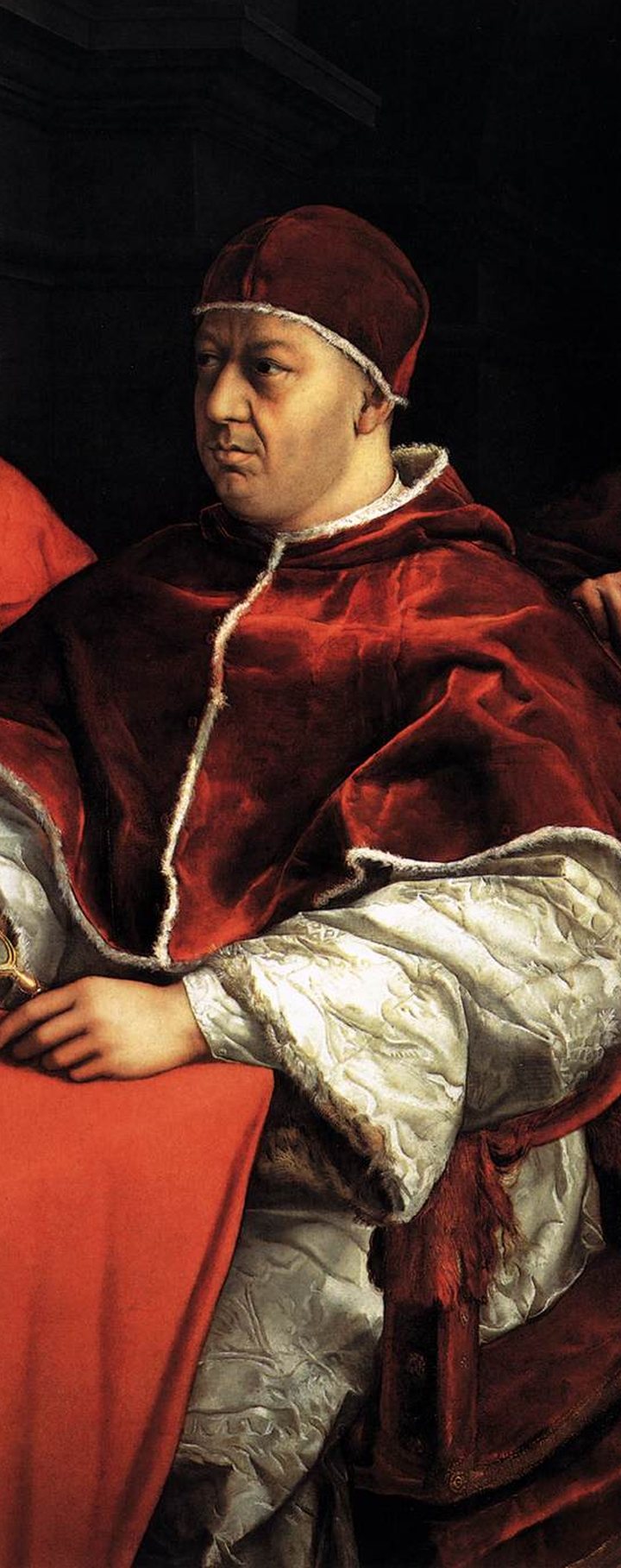
Portrait of Pope Leo X
The Best Seat at the Feast
“God has given us the papacy,” he is supposed to have written on the day of his election, “let us enjoy it.” The line may be apocryphal, but nothing about the reign of Pope Leo X makes it hard to believe. Giovanni de' Medici was groomed for the throne of Saint Peter the way other men are groomed for a fortune: son of Lorenzo the Magnificent, made a cardinal at thirteen by the sheer weight of Medici money, he reached the papacy in 1513 not as a reformer or a soldier but as a connoisseur — a plump, myopic, cultivated aesthete who saw in the richest office in Christendom the finest table ever laid.
And he sat down to it with gusto. Where his fierce predecessor Julius II had spent his reign in armor, Leo spent his in the theater and the hunt, at banquets and concerts and comedies. He showered gold on poets and painters — Raphael worked at his pleasure — and emptied the treasury as fast as it could be filled. To keep the good life flowing and Saint Peter's rising, he revived the sale of indulgences, never suspecting that the money gilding his Rome was buying the ruin of the Church he sat atop.
Leo X is the ESFP on the throne of Saint Peter: Se living wholly in the pleasure and spectacle of the present, Fi devoted to beauty and to his own glittering circle — and an inferior Ni so dim that he never saw the fire until the whole Church was ablaze behind him.
A Pope for the Senses
Se — dominant
Dominant Se lives in the vivid present, reaching for whatever pleasure, beauty, or spectacle the moment offers — and Leo drank deeper than any pope before him. His Rome was a permanent festival of theatricals, hunting parties, feasts, and his own traveling singers. He kept a pet elephant named Hanno and mourned it like a friend — the perfect emblem of the man: the papacy as a source of marvels to be enjoyed here and now. His patronage flowed from the same instinct, pouring money into Raphael and Saint Peter's and a Rome remade as the most dazzling court in Europe. A more abstract pope might have hoarded against a rainy day; Leo could not conceive of the rainy day, only of the banquet in front of him.
The same hunger for the tangible good life drove the indulgences. Leo needed cash — for the building, the court, the endless generosity — and indulgences were cash. The traffic that Johann Tetzel worked in Germany, hawking remission of sin with a jingle about coins and souls, existed to fund Leo's Rome. It was Se financing at its most reckless: a solution to the immediate need, with no thought spared for what such a market might cost the Church a year or a decade later.
Medici to the Bone
Fi — auxiliary
Auxiliary Fi gave Leo's pleasure-seeking a compass of private taste and personal loyalty. His judgments were aesthetic before they were doctrinal: he loved what he found beautiful and backed whom he found congenial, trusting his own cultivated feeling as the measure of things. That inward loyalty ran deepest toward his own blood. Leo was a Medici first and a pope second, bending the office toward his family with unembarrassed constancy — not the cold dynastic engineering of a strategist but a felt allegiance: these were his people, and their fortunes were his own.
But Fi paired with Se tends inward, toward the self, not outward toward the flock, and here lay the flaw beneath the charm. Leo's devotion was to what pleased him — his circle, his art, his comforts, his house — and the vast anonymous body of the faithful, the German laymen scandalized by the indulgence trade, simply fell outside the circle of his feeling. He was not cruel; he was oblivious. His conscience was engaged by beauty and by Medici loyalty, and largely absent everywhere the Church most needed it.
A Drunken German
Ni — inferior
If Se was Leo's glory, inferior Ni was his ruin. Ni is the reading of where things are headed — the pattern beneath events, the consequence not yet arrived — and in Leo it was nearly blank. He lived so completely in the pleasures of the present that the future was a rumor he could not be bothered to credit. When an obscure Saxon monk named Martin Luther posted his theses against the indulgence trade in 1517, Leo did not see a crisis. He saw noise. He waved the affair off as a squabble among monks, the ravings of “a drunken German” who would “feel differently when sober” — beneath the notice of a man whose attention was on Raphael's frescoes and the next hunt.
By the time he grasped that the drunken German had set half of Germany alight, the fire was out of reach; he excommunicated Luther only in 1520–21, years too late, a door slammed on an empty stable. This is the inferior function as fatal blind spot. A pope with even ordinary Ni might have sensed that a Church already resented for its wealth was sitting on dry tinder. Leo sensed nothing. He enjoyed the papacy, exactly as he had promised, and never once looked up to see where the enjoyment was leading — dying suddenly that same year and leaving Christendom cracking open behind him, the feast still spread, the house already burning.
Why ESFP Over ESFJ
Why not ESFJ?
The temptation is to read a sociable, generous, crowd-pleasing pope as an ESFJ — the warm host tending his community. But the ESFJ is driven by Fe, an anxious, dutiful attunement to what the group needs, and Leo had none of that conscience about the institution in his care. He did not fret over the flock or labor to meet the Church's needs; he pleased himself and his brilliant circle and let the rest drift. His ruin was self-indulgence and complacency, not the over-conscientious worry of an ESFJ.
Both types love a full room and a generous table, but the ESFJ throws the feast for others and frets that everyone is cared for, while the ESFP throws it because the feast itself is glorious and he means to be at the center of it. Leo's devotion was inward — to beauty, to his own taste, to his house — not outward to the duty of the office. That is Se over Fi, not Fe over Si, and it is why the Church cracked while its pope was enjoying himself.
Connected Figures
Further Reading
- The House of Medici: Its Rise and Fall — Christopher HibbertThe classic narrative of the family — places Giovanni de' Medici's papacy within the arc of Medici ambition, wealth, and patronage.
- The Reformation: A History — Diarmaid MacCullochThe authoritative modern account of the rupture — essential for understanding how Leo's indulgence trade and complacency opened the door to Luther.
- The History of the Popes — Ludwig von PastorThe monumental documentary history of the papacy — the fullest scholarly treatment of Leo's reign, its finances, and its failures.
