 Historical Figure MBTI
#617 · 5-8-26 · Sengoku Japan
Oda Nobunaga
Daimyō of Owari · The Demon King · First of the Three Unifiers
1534 — 1582
13 min read
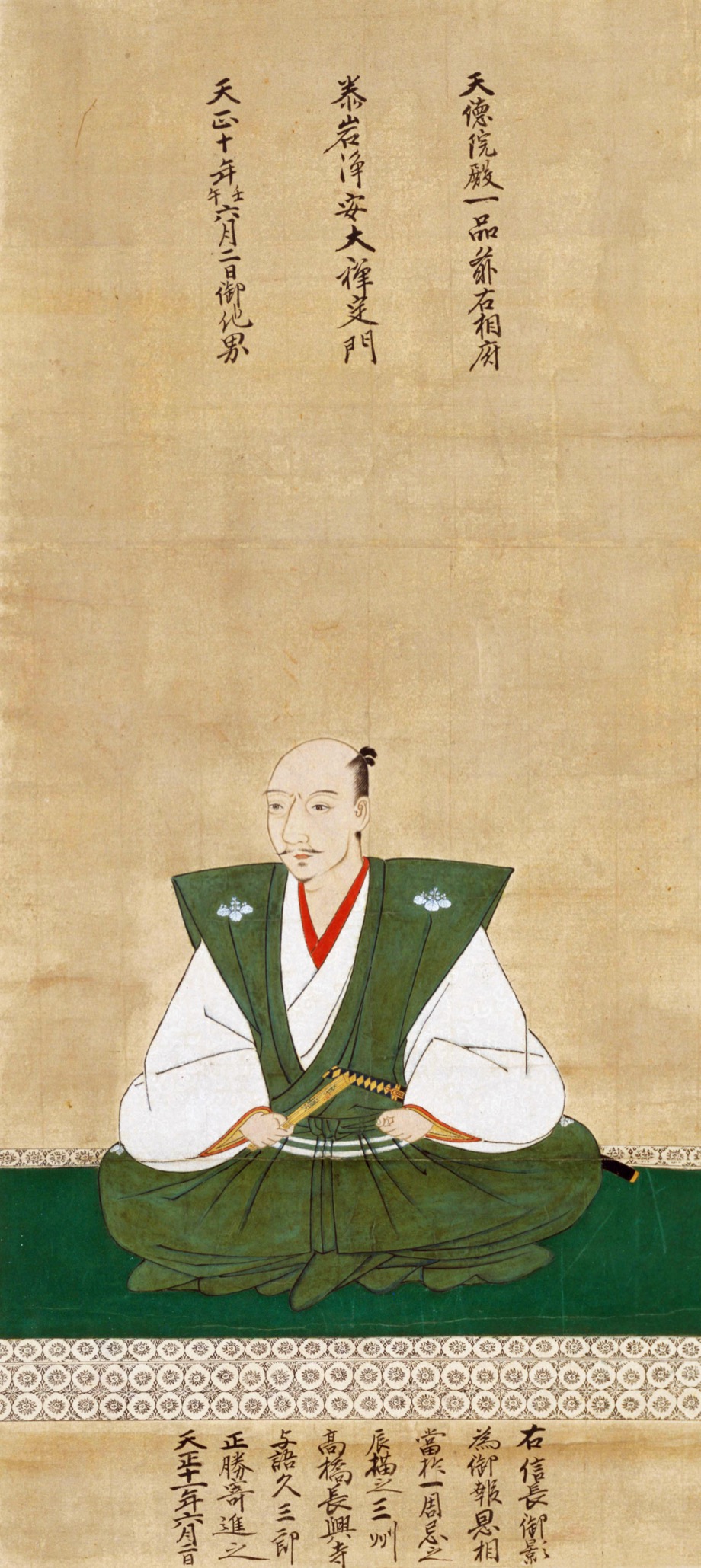
Portrait of Oda Nobunaga
The Fool Who Meant to Own the Realm
His own retainers called him the Fool of Owari. As a young lord he dressed in outlandish half-Western costume, chewed on chestnuts and persimmons in public, slung his sword on a gaudy rope, and behaved with such careless disregard for samurai dignity that one of his senior advisers, Hirate Masahide, killed himself in remonstration, hoping his death might shock the boy into propriety. It did not. What his elders read as idiocy was something they had no category for: a mind that regarded the entire inherited order of Japan — its etiquette, its warrior monasteries, its 240-year shogunate, its tangle of independent warlords — as a problem to be solved rather than a world to be inhabited. Oda Nobunaga did not want to win the wars of his age. He wanted to end the age.
He announced himself in 1560 at Okehazama, where he fell on the vastly larger invading army of Imagawa Yoshimoto in a sudden storm and cut down the great daimyō before he had finished celebrating his own advance. From that single audacious stroke Nobunaga built, over twenty-two years, the machinery that would break the old Japan: he marched on Kyoto and installed a shōgun he then discarded, ending the Ashikaga line; he burned the sacred mountain of Hiei and exterminated the warrior-monk militias that had defied secular power for centuries; he shattered the finest cavalry in the country with massed gunfire; he tore down the toll barriers and guild monopolies that strangled trade and built in their place free markets, a gleaming new castle, and a court open to Jesuits and Western science. His banner carried four characters — tenka fubu, “the realm subdued by force.” He was two-thirds of the way there when he died. He was the ENTJ not as a conqueror of provinces but as a demolisher and rebuilder of an entire civilization's order.
Nobunaga is the ENTJ in its most transformative and terrible form: dominant Te — an overwhelming, systematic will that dismantled every rival power in Japan — harnessed to Ni's single fixed vision of a unified realm under one authority. He did not fight for territory; he fought to remake the world, and burned whatever the design required.
That is the distinction his enemies never grasped, and it is the reason he is remembered as the first of the three men who unified Japan rather than as one more warlord among dozens. The Fool of Owari was never improvising. He was executing a blueprint no one else could see.
The Demolition of the Old Order
Te — dominant
Dominant Te reorganizes the external world to make it do what the mind requires, and Nobunaga applied it not to a battlefield but to a civilization. The Japan he was born into was a machine of countervailing powers — the shogunate, the great daimyō houses, the armed Buddhist establishments, the merchant guilds that owned the roads and the markets — and he set about, one by one, taking each apart. He did not negotiate the old order into submission; he identified its load-bearing structures and destroyed them. When he took Kyoto in 1568 he installed Ashikaga Yoshiaki as shōgun, used the legitimacy for exactly as long as it was useful, and then in 1573 expelled him and let the 240-year Ashikaga shogunate simply cease to exist. The title that had defined Japanese political authority for centuries was, to Nobunaga, a tool he picked up and put down.
His economic reforms show the same engineering instinct turned on a whole society's plumbing. He abolished the toll barriers that local lords and temples had strung across the roads to tax every cart, and he broke the guild monopolies — the za — that fixed prices and locked out competition, declaring open markets, the rakuichi rakuza, where anyone could trade. He standardized, he surveyed, he rationalized the flow of goods and money because a unified realm needed a unified economy, and because armies run on silver. This is Te at its most characteristic: not ideology, not sentiment, but the relentless optimization of a system toward an outcome. He welcomed the Jesuits and their firearms and their clocks and their world maps for the same reason — not out of piety or curiosity for its own sake, but because Western technology and the missionaries' hostility to the Buddhist establishment were both instrumentally useful to him.
The most chilling expression of Te was the war of extermination against militant Buddhism. In 1571 Nobunaga surrounded Mount Hiei, seat of the Tendai monastery that had bullied emperors and armed itself against secular power for seven hundred years, and burned it to the ground — monks, women, children, thousands of them, the whole holy mountain put to the sword and the torch. Against the Ikkō-ikki, the fanatical peasant-leagues of the True Pure Land sect, he waged a decade of annihilating campaigns, draining their fortress-temples and killing the surrendered by the tens of thousands. It was atrocity, and it was also solution: no unified state was possible while armed religion claimed the right to defy it, so armed religion had to be destroyed. Nobunaga looked at the single most sacred and untouchable institution in the country, judged it an obstacle to the design, and removed it. That is the terrible core of dominant Te — the willingness to treat anything, however venerable, as a variable to be zeroed out.
Tenka Fubu — The Realm As One
Ni — auxiliary
Auxiliary Ni is what separates Nobunaga from every other warlord of the Sengoku, the century of the country at war. His rivals fought to expand their domains; some were brilliant at it. Nobunaga fought toward a single image of the future that no one else in Japan seems to have held: the whole realm, tenka, gathered under one central authority and remade. He adopted the seal that read tenka fubu — the realm subdued by force — around 1567, when he was still a provincial lord with everything ahead of him, and it functioned exactly as a Ni vision does: as a fixed point on the horizon toward which every subsequent decision bent. He was not accumulating land. He was converging on an end-state.
Read against that vision, the sequence of his campaigns stops looking like opportunism and starts looking like architecture. The targets came in a deliberate order — the shogunate dismantled, the warrior-monks exterminated, the great daimyō ground down, the guilds and barriers cleared — each one a pillar of the old world that had to fall before the new one could stand. He built Azuchi Castle not as a fortress but as a manifesto: a soaring, gold-leafed keep on Lake Biwa, its interior painted by the finest masters, a monument to a centralized power that did not yet fully exist but that he could already see. He patronized the tea master Sen no Rikyū and turned the tea ceremony into an instrument of state, granting rare tea utensils to his generals as rewards more coveted than land — culture, too, folded into the single design.
Every warlord of the age wanted to win. Only Nobunaga wanted to finish — to reach an end to the wars themselves. That is the Ni horizon steering the Te machine: not the next province, but a realm remade and made to stay that way, imagined whole before a single pillar of the old order had fallen.
The proof is what happened after his death. The vision was so coherent, and the machinery he built so complete, that two of his own subordinates could pick it up and carry it to completion. Toyotomi Hideyoshi, the sandal-bearer he had raised from nothing, avenged him and finished the unification within a decade; Tokugawa Ieyasu, his patient ally of twenty years, inherited the result and locked it into two and a half centuries of peace. A saying grew up around the three of them: Nobunaga pounded the rice, Hideyoshi kneaded it, Ieyasu ate the cake. But it was Nobunaga who first saw that there was a cake to be made at all.
The Storm at Okehazama and the Guns at Nagashino
Se — tertiary
Tertiary Se gives the ENTJ strategist a taste for the vivid, physical present and a capacity for sudden, overwhelming action — the nerve to strike now, hard, when the moment breaks open. In Nobunaga it is everywhere, beginning with the battle that made him. At Okehazama in 1560, outnumbered perhaps ten to one by Imagawa Yoshimoto's invading host, Nobunaga did not fortify and wait. He located the enemy's camp, moved his small force under the cover of a sudden downpour, and burst upon the celebrating Imagawa in a lightning assault that killed the great lord before he understood he was under attack. It was raw Se: reading the immediate terrain, the weather, the enemy's complacency, and seizing the one instant when boldness would work.
The same appetite for the tangible drove his fascination with technology. Where other daimyō saw the Portuguese arquebus as an awkward curiosity, Nobunaga saw a physical fact he could exploit at scale, and he acquired firearms by the thousands. At Nagashino in 1575 he set that instinct against the most feared force in Japan, the cavalry of the Takeda — heirs of his old rival Takeda Shingen, the Tiger of Kai. Behind wooden palisades he arranged ranks of gunners in rotating volleys, so that a continuous wall of fire met the famous horsemen as they charged, and the Takeda cavalry was simply shot to pieces. It was a concrete, mechanical solution to a concrete problem, Se's command of the physical world welded to Te's hunger for what actually works.
And it ran through his whole restless, sensory personality: the flamboyant dress of his youth, the love of foreign goods and novelties, the delight he took in the tall African visitor he met through the Jesuits — whom he questioned, had scrubbed to be sure the dark skin was real, and then, impressed, took into his own service as the samurai Yasuke. Had Se sat at the top of his stack, this vivid immediacy would have made him merely a brilliant and erratic adventurer. In its tertiary place, it was the sharp edge of the blade — the daring and the physical mastery that the long design could deploy whenever a decisive stroke was required.
The Cruelty and the Blind Spot
Fi — inferior
Inferior Fi is the ENTJ's weakest and most walled-off function — the private world of personal value and feeling that the instrumental mind habitually overrides. In Nobunaga the override was near-total, and it produced a reputation for cruelty that has followed him for four centuries. He could order the slaughter of thousands of surrendered monks and peasants without apparent hesitation because the design demanded it; feeling did not enter the calculation. He drove his own oldest servants hard and discarded them coldly when they no longer served — late in life he stripped rank from veteran retainers who had fought beside him for decades. The nickname his enemies gave him, the Demon King of the Sixth Heaven, was not entirely unearned. A man for whom nothing was sacred is also a man for whom, at the deepest level, other people's inner lives barely register.
That blindness was his fatal flaw, and it is written into the story of his sister Oichi, celebrated as the great beauty of the age, whom he married off to the daimyō Azai Nagamasa to seal an alliance. When Azai turned against him, Nobunaga destroyed the house, and the marriage he had arranged as a counter on the board ended in his brother-in-law's ruin and his sister's widowhood — a human being spent as a diplomatic instrument. He understood loyalty as something you commanded and rewarded, not something rooted in feelings that could curdle if wounded. He did not see, or did not weigh, the resentment accumulating in the men around him.
And so inferior Fi took its revenge through another man's wound. In 1582, near the height of his power, Nobunaga was resting at the temple of Honnō-ji in Kyoto with only a small guard when his own general Akechi Mitsuhide — a proud, cultivated man Nobunaga is said to have humiliated once too often — turned his army around and surrounded him. There was no escape. Nobunaga fought briefly, then withdrew into the burning temple and committed seppuku; his body was consumed in the flames and never found. The demolisher of the old order, who had treated men as variables for thirty years, was undone by the one thing his cognition was worst at reckoning: the private, unmeasured grievance of a subordinate he had ceased to see as fully human.
Why ENTJ Over ESTP
Why not ESTP?
The surface makes a real case for ESTP. The eccentric, rule-breaking youth; the reckless gamble at Okehazama; the magpie love of Western guns, clocks, and novelties; the sheer bold physicality — all of it reads like Se-dominant appetite for the vivid present. But an ESTP is an opportunist of the moment, a tactician who reads the immediate situation and strikes for the immediate win. Nobunaga's ruthlessness served a coherent long-range design. The sequential demolition of the shogunate, the warrior-monks, the great daimyō, and the merchant guilds — each destroyed in turn to clear the ground for a centralized realm he could see before he built it — is not a series of seized moments. It is a twenty-year architecture. That is Te directed by Ni, not Se chasing the opening in front of it.
The tell is the difference between winning and finishing. An ESTP would have won Okehazama and a dozen battles after it, thrown out the shōgun on impulse, delighted in the guns at Nagashino — and left no blueprint behind. Nobunaga's campaigns fit together like a proof. The tenka fubu seal, adopted while he was still a minor lord, fixed the end-state a decade before he reached it; the free markets and abolished tolls were the plumbing of a state that did not yet exist; Azuchi Castle was a monument to an order he was still building. And the surest evidence is that the vision survived him: it was so complete a design that Hideyoshi and Ieyasu could finish it from his drawings. You do not inherit and complete another man's impulses. You inherit his plan.
Connected Figures
Further Reading
- Japonius Tyrannus: The Japanese Warlord Oda Nobunaga Reconsidered — Jeroen LamersThe essential modern scholarly reassessment in English — dismantles the myths and reconstructs Nobunaga the political and military strategist.
- Sengoku Jidai: Nobunaga, Hideyoshi, and Ieyasu — Danny ChaplinA sweeping narrative of the three unifiers and the age of the country at war; the most accessible single account of how the unification unfolded.
- The Samurai: A Military History — Stephen TurnbullThe standard survey of samurai warfare; strong on Okehazama, the gunnery revolution at Nagashino, and Nobunaga's tactical innovations.
- Hideyoshi — Mary Elizabeth BerryA superb study of Nobunaga's successor that illuminates the era, the machinery of unification, and how the design outlived its maker.
- History of Japan — Luís FróisThe contemporary account of the Jesuit missionary who knew Nobunaga personally — the vivid, indispensable eyewitness source for the man and his court.
