 Historical Figure MBTI
#624 · 5-9-26 · Sengoku Japan
Sen no Rikyū
Master of Tea · Perfecter of Wabi · The Aesthete Ordered to Die
1522 — 1591
8 min read
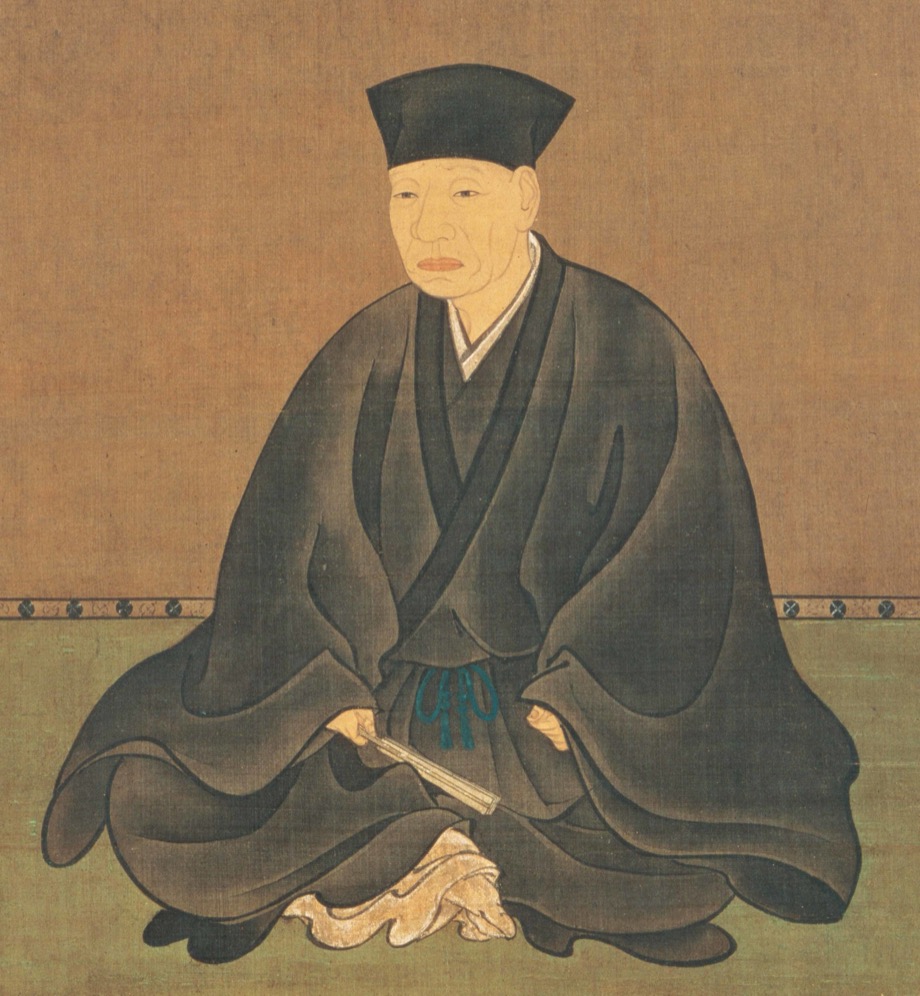
Portrait of Sen no Rikyū
The Man Who Made the World Disappear
Consider the morning-glory garden. Word had spread that Rikyū's flowers were the finest in the land, and Toyotomi Hideyoshi, the master of Japan, announced he would come at dawn to see them. When he arrived, the beds had been stripped bare—every last bloom cut down. Furious, he stooped through the low doorway into the tea room, and there, in the alcove, stood a single morning glory in a vase. The whole garden had been sacrificed so that one flower could be truly seen. That is Rikyū entire: a man who understood that beauty is not accumulation but subtraction.
Sen no Rikyū (1522–1591) was a merchant's son from the trading city of Sakai who became the supreme master of chanoyu, the Japanese way of tea, and the man who perfected wabi-cha—an aesthetic of studied poverty, imperfection, and transience. He served as tea master first to Oda Nobunaga and then to Hideyoshi, rising to become the latter's confidant and one of the most quietly powerful figures of a violent age. His medium was almost nothing: a rough clay bowl, a bamboo scoop, an hour of silence. From that nothing he built a total philosophy and turned the pouring of hot water into a form of prayer. He was an INFJ whose sensibility was never merely personal taste but a single, unifying vision, imposed with almost priestly authority on every knot of a napkin and every crack in a glaze—the objects always serving the idea, never the reverse.
Rikyū is the INFJ as spiritual aesthete: a dominant Ni vision of the world—wabi, the beauty of poverty and transience—pressed onto every physical detail, and served through Fe as an act of communion, host and guest meeting once, in a room built to make the material world dissolve into meaning.
The Whole Cosmos in a Bowl
Ni — dominant
Dominant Ni sees a single hidden pattern beneath things and bends everything toward it. Rikyū had one such pattern—wabi, the beauty found in the plain, the poor, the imperfect, the passing—and pursued it with the consistency of a man who has glimpsed a truth and cannot unsee it. Where his predecessors prized costly Chinese celadon and gold, he reached for the opposite: the rough, misshapen Raku bowl with its cracked glaze; the unlacquered bamboo scoop he cut himself; the flower left unarranged. These were not accidents but arguments—each object chosen to insist that a cracked bowl holds more of the world than a flawless one.
The architecture is where the vision becomes law. Rikyū shrank the tea room to two mats and fitted it with the nijiriguchi—a “crawling-in” entrance so low that a guest had to kneel and bow his head to pass through. A daimyō was made to leave his sword outside and enter on his knees, humbled to the stature of a farmer: the whole social order dissolved at the threshold because the idea required it. What separates Rikyū from a collector of rustic things is that the vision generated the objects—he could name a bamboo container a masterpiece by the authority of his eye, or reject a famous heirloom as vulgar. The inner picture was the source; the material world only its evidence.
One Time, One Meeting
Fe — auxiliary
If Ni supplied the vision, auxiliary Fe supplied its purpose: the tea gathering was, above all, a meeting between people. Rikyū distilled this into the principle of ichigo ichie —“one time, one meeting”—the conviction that each gathering is unrepeatable and must be treated as if it will never come again. Host and guests assemble once, in this light, with this bowl, and then the moment is gone forever. This is Fe at its most refined: not warmth for its own sake but the deliberate shaping of a shared emotional atmosphere. Everything Rikyū codified about the host's conduct is an ethic of care disguised as etiquette—he cleans the room himself, adjusts the flower to the guest's spirit, and pours as if to say: for this hour, you are the only thing that matters. In an age of ceaseless war, he built rooms where enemies could kneel together over the same cup.
That same Fe made him a formidable political creature. To read the mood of a room, to sense what a guest needed before he spoke it, is the faculty that made Rikyū indispensable to Hideyoshi as a confidant. His power at court was never coercive; it was the soft authority of a man everyone trusted to feel the room correctly. It is a bitter irony that this very intimacy—his nearness to the ruler's inner life—is likely part of what got him killed.
The Grammar of Emptiness
Ti — tertiary
A vision this consistent needs an internal logic, and Rikyū's tertiary Ti supplied it. He did not merely feel that a bowl was right; he could say why, and build a coherent system from first principles. Chanoyu under him became a precisely reasoned discipline—the placement of every utensil, the folds of the silk cloth, the sequence of each gesture, the proportions of the room. Nothing was arbitrary; each rule followed from the premise of wabi. He was the architect of a grammar: a finite set of principles generating an infinity of correct gatherings.
The seven rules attributed to him show the Ti economy at work. Asked the secret of tea, he answered with things that sound like nothing—make a satisfying bowl of tea; lay the charcoal so the water boils; arrange the flowers as they are in the field; be ready ahead of time; give those with you your full attention. When a disciple protested that he knew all this already, Rikyū replied that if the man could truly do it, he would become his pupil. The principles are simple and complete; the entire difficulty lies in their flawless execution.
The Sensuous World, Held at Arm's Length
Se — inferior
Here is the paradox that makes Rikyū fascinating—and that could fool a hasty typist. No one in this archive worked more intimately with physical sensation: the temperature of water, the texture of clay, the fall of light through a paper screen. Yet his relationship to the senses was inferior Se's—not indulgence but discipline. He did not surrender to sensation; he curated it ruthlessly, admitting only what served the vision. Where a dominant-Se aesthete would heap the room with richness, Rikyū emptied it, so that a single sensation—one flower, one crack, one sound of boiling water—could ring out against the silence.
This tension was dramatized as decor: Hideyoshi, the earthy ruler, built a tea room lined entirely in gold; Rikyū built a hut of mud two mats wide—Se in its acquisitive glory against Se pressed into the service of an austere idea. And the senses had their revenge, as inferior functions do, at the end. When Hideyoshi ordered his death, the sentence was seppuku—the body opened by its own hand. The man who had spent his life making the material world dissolve into meaning was compelled, in his last hour, into the most literal encounter with the flesh. He met it, by every account, with perfect composure.
Why INFJ Over ISFP
Why not ISFP?
The ISFP case is the strongest rival read: here is an intensely sensory aesthetic artist devoted to beauty, seemingly a pure vessel of Fi taste and Se craft. But an ISFP's aesthetic is idiosyncratic and personal—this pleases me, this is mine—and refuses to universalize. Rikyū's did the opposite: he built a systematic philosophy, wabi-cha, a total worldview he articulated in principles and imposed on others with near-religious authority, ranking bowls and humbling lords by the power of a doctrine. That is a shared vision demanding assent (Ni–Fe), not a private preference seeking expression (Fi–Se). His senses served the idea; they never were the idea.
The deciding distinction is the direction of authority. An ISFP's art radiates outward from an inner feeling that is its own justification—beautiful because it is true to the self. Rikyū's descended from a vision of how the world essentially is, a picture of poverty, impermanence, and communion that he pressed onto clay, space, and conduct and taught as a way. He did not want you to admire his taste; he wanted you to see what he saw. That world-imposing certainty is the signature of dominant Ni served by Fe, and it is why the merchant's son who arranged flowers is an INFJ mystic, not an ISFP craftsman.
Connected Figures
Further Reading
- The Book of Tea — Okakura KakuzōThe classic short meditation on chanoyu and its philosophy — the essential English-language introduction to the spirit of tea and to Rikyū's aesthetic of wabi.
- Cha-no-yu: The Japanese Tea Ceremony — A. L. SadlerThe most thorough traditional account of the tea ceremony in English — its history, ritual, utensils, and the life of Rikyū.
- Rediscovering Rikyu and the Beginnings of the Japanese Tea Ceremony — Herbert PlutschowA modern scholarly reassessment that sets Rikyū in the political world of Nobunaga and Hideyoshi and re-examines the mystery of his forced suicide.
