 Historical Figure MBTI
#622 · 5-8-26 · Sengoku Japan
Yasuke
Retainer of Nobunaga · The African Samurai · The Warrior from Afar
fl. 1579 — 1582
5 min read
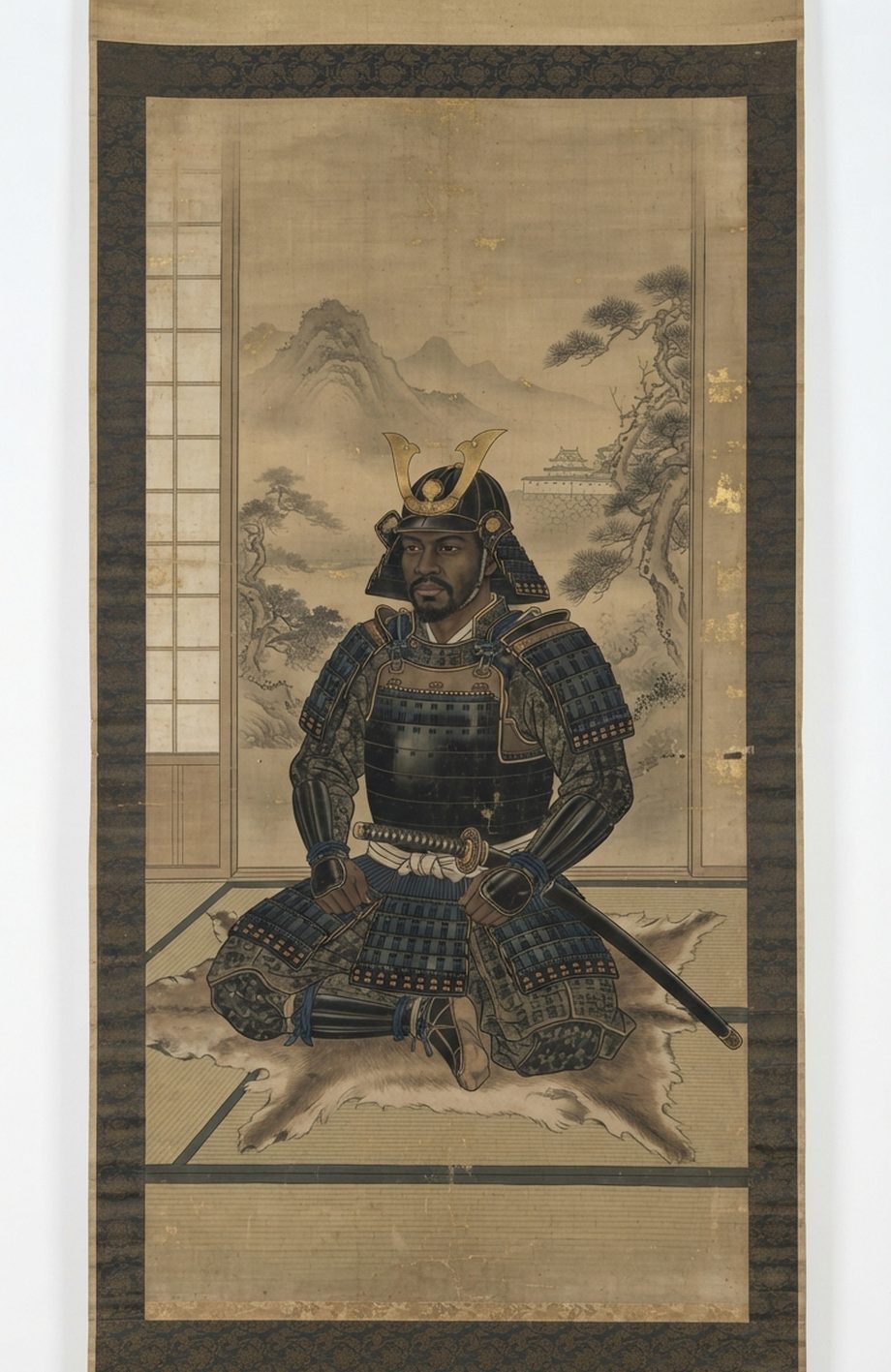
AI-assisted Portrait of Yasuke
The Man History Barely Kept
He arrives in the record like a rumor and leaves it like one. In 1579 a tall African man walked into Kyoto in the retinue of the Jesuit visitor Alessandro Valignano—probably brought from Mozambique or the coast near it—and the capital had never seen anything like him. Crowds pressed in to look. The warlord Oda Nobunaga, the most powerful man in Japan, is said to have refused to believe the color of his skin was real and had him scrubbed to be sure. Within a short time Nobunaga had taken him into his service, given him a stipend, a residence, and a sword, and raised him to the rank of samurai—one of the only foreign-born men ever to hold it. His name, as the Japanese rendered it, was Yasuke.
And that is nearly all we can say with confidence. Almost nothing of Yasuke's own voice survives—no letters, no reported speech beyond a few lines, no interior at all. What we have is a handful of notices from Jesuit chroniclers and Japanese sources: that he was strong and very tall, that he could speak with Nobunaga and carried the lord's weapons, that he was present in 1582 when Akechi Mitsuhide turned on Nobunaga at the Honnō-ji temple. Yasuke fought, went on to defend Nobunaga's son, and after the defeat surrendered. Mitsuhide, reportedly dismissing him as a beast rather than a Japanese man, declined to kill him and sent him back to the Jesuits. After that, he vanishes from the record entirely. Any reading of his mind has to be offered as a careful guess, not a claim.
On the little we have, Yasuke reads as an ISTP: a capable, unshowy man of action who mastered an utterly foreign world by doing—Ti's quiet, private competence wedded to Se's physical readiness. But the evidence is so thin that even this should be held lightly.
The Quiet Mastery of an Alien World
Ti — dominant
The one detail the sources dwell on—besides his height and his skin—is that Yasuke could talk with Nobunaga. That is a small line with a large implication. A man carried across the Indian Ocean and up into the interior of Japan, dropped into a court whose language, weapons, dress, and ferociously codified etiquette were unlike anything he had known, learned enough of that world quickly enough to converse with its most demanding master and to serve at his side. Nobunaga did not keep fools or novelties close for long; he kept useful men. That Yasuke became one so fast points to a mind that takes an unfamiliar system apart and works out how it runs.
That is the ISTP's dominant Ti as it shows up in a man of few recorded words: not theory spoken aloud but a private, practical intelligence that figures things out by handling them. Language, the discipline of arms, the unspoken grammar of a lord's household—Yasuke seems to have absorbed each the way this type absorbs anything, quietly and from the inside, until he could operate the machine well enough to be trusted with a sword and a lord's weapons. We should be honest that this is inference: the record shows the result, not the process. But composure inside a wholly foreign order, mastered fast and without visible strain, is exactly what Ti competence looks like from the outside.
Present in the Body, Ready in the Moment
Se — auxiliary
Whatever else Yasuke was, he was physical. The sources are unanimous on his great height and strength, and it was his sheer bodily presence that first made him a sensation in Kyoto and drew Nobunaga's eye. Everything he is recorded as doing is done with the body: carrying the lord's arms, keeping at his side, and—at the end—fighting. When the world he had mastered collapsed at Honnō-ji in 1582, he did not flee or freeze. He fought, then went to defend Nobunaga's son at Nijō, and only surrendered when the cause was plainly lost. That is auxiliary Se serving the ISTP: a readiness to meet the present moment head-on with decisive action, and a nerve that holds when the situation turns violent.
The pairing is the type's signature—the analytic detachment of Ti with the Se warrior's ease in the here and now. It is worth resisting the pull to make more of this than the record allows. We do not know what he felt as he fought, or whether he chose that fight out of loyalty, calculation, or simply because it was the fight in front of him. What survives is the shape of the behavior: a man who met each situation, however strange or lethal, by acting competently within it. That much is on the page. The interior behind it is not.
Why ISTP Over ESTP
Why not ESTP?
The bold, adaptable outsider who thrives on a strange new stage is an easy ESTP reading, and it may be right. The honest problem is that it rests on the same thin handful of notices as the ISTP reading—and on none of the interior evidence that would tell the two apart. We never see whether Yasuke led the room or worked quietly at its edge, whether he sought the crowd's eye or merely endured it. Lacking that, the composed, self-contained competence in the record tilts, gently, toward the introverted version.
So the verdict here is deliberately soft. Both types share the Se readiness that the sources actually attest; they diverge on whether the driving function is inward Ti or outward, and Yasuke left us almost nothing of his inward life to judge by. ISTP is the better fit for the man the deeds imply—private, capable, undemonstrative, mastering a foreign world by doing rather than declaiming. But it is a light reading of a figure known only by his actions and his calm, and it should be worn loosely.
Connected Figures
Further Reading
- African Samurai: The True Story of Yasuke — Thomas Lockley & Geoffrey GirardThe fullest attempt to reconstruct his life — expansive where the sources are thin, and best read alongside its critics for where fact ends and inference begins.
- History of Japan (Historia de Japam) — Luís FróisThe contemporary Jesuit chronicle — one of the handful of primary notices that record Yasuke's arrival, his height, and Nobunaga's astonishment.
- The Samurai: A Military History — Stephen TurnbullA standard survey of the samurai world Yasuke entered — useful for the arms, ranks, and warfare of the Sengoku age he was drawn into.
