 Historical Figure MBTI
#615 · 5-7-26 · The Reformation
Huldrych Zwingli
Reformer of Zurich · The Militant Preacher · Rival of Luther
1484 — 1531
6 min read
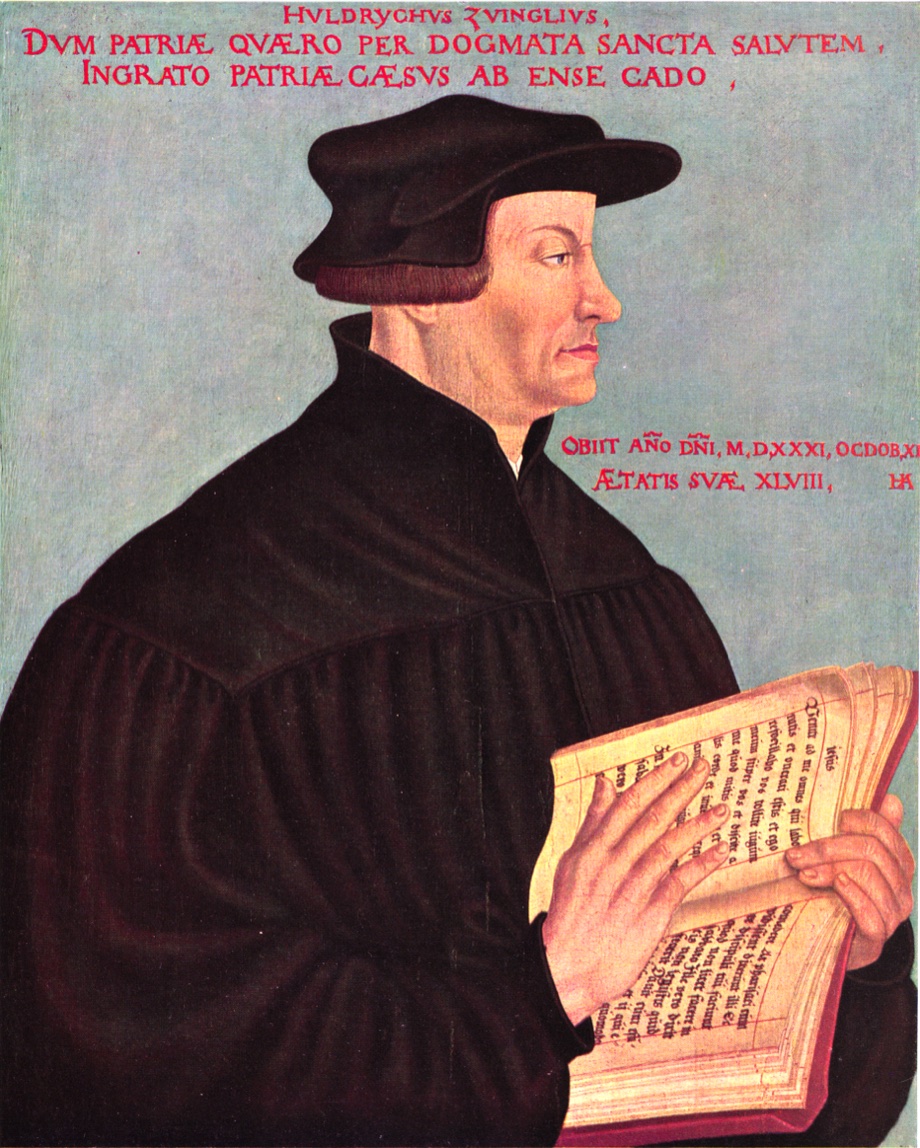
Portrait of Huldrych Zwingli
The Priest Who Went to War
Most reformers preached. Zwingli preached — and then he armed the city that listened. As the people's priest at the Grossmünster in Zurich, he did not merely denounce the old church from a pulpit. He reorganized an entire city-state around a new faith: stripped its sanctuaries bare, placed its clergy under the magistrates, rewrote its worship by ordinance, and finally marched it into a war he fully expected to win. He died in 1531 on the field at Kappel, cut down in armor — a fitting end for a man who had always understood belief as something to be executed, not merely confessed.
Born in 1484 and trained as a humanist in the orbit of Erasmus, Zwingli reached his reforming convictions on his own, out of scripture and study, before Luther's revolt had fully reached the Swiss cantons. But where others agonized, he built. He is the ENTJ reformer — the theologian as commander, who treated the remaking of a church the way a general treats a campaign: as a problem of will, organization, and decisive execution.
Zwingli is the ENTJ in the pulpit: a driving Ni vision of a wholly purified church, carried out by a Te that would reorganize a whole city — its worship, its clergy, its laws — and then take up arms to defend the result.
The Reordering of a City
Te — dominant
Dominant Te reorganizes the outer world to match a decision already made, and Zwingli did not reform Zurich so much as re-engineer it. He led the city to break decisively with Rome and rebuilt what remained by ordinance: the Mass abolished, images and relics carried out of the churches, the walls whitewashed, clerical celibacy ended (he married), the whole apparatus of the church placed under the city magistrates. This was not the slow drift of conscience but administration — reform enacted as policy, item by item, until the old order stood dismantled.
The signature Te move was to convert theology into law. In the public disputations of 1523, Zwingli argued his reforming program before the Zurich council and won its formal authority, so that what began as scriptural conviction became civic statute binding on the whole canton. He grasped what a purely religious reformer might miss: that a faith is only as durable as the institutions carrying it. He did not wait for Rome's permission or a prince's protection — he captured the machinery of the state and used it.
The Vision Driven to Its End
Ni — auxiliary
Auxiliary Ni gave Te its single, uncompromising target: a church purified down to its scriptural bones. The difference from Luther is instructive. Luther kept whatever scripture did not forbid — images, music, the trappings of worship. Zwingli removed whatever scripture did not command. The organs of Zurich fell silent; the images came down; the walls went white. It is the mark of Ni to see an idea whole and follow it to its logical extreme, indifferent to the comfort of half-measures.
The same refusal to soften the vision destroyed the one alliance that might have unified the Reformation. Zwingli held that the bread and wine of the Eucharist were purely symbolic — that Christ's “this is my body” meant only “this signifies my body.” At the Marburg Colloquy of 1529, the two great reformers met precisely to settle their differences and present a united front, and they agreed on nearly everything — except this. Neither would yield the point. The movement split there and stayed split, Lutheran and Reformed, permanently. It is a very ENTJ failure: the Ni conviction that the vision must not be diluted, even for the sake of the larger cause, holding firm at the exact moment a compromise would have served the strategy better.
The Field at Kappel
Se — tertiary
Tertiary Se is what separated Zwingli from every reformer who fought only with words. He was militant and political to the core, and when the Catholic Swiss cantons refused his gospel, he did not merely argue — he drove Zurich toward armed confrontation, willing to settle the question of faith by force. This was no scholar retreating to his study; he was ready to reach for the sword when the pulpit reached its limit.
It killed him. At the Battle of Kappel in 1531 the Zurich forces were routed, and Zwingli was there on the field — not safely behind the lines but among the soldiers as chaplain and combatant, in armor, and he was cut down with them. The victors, finding the reformer's body, quartered and burned it. There is something wholly characteristic in the manner of his death: the man who had reorganized a city's worship as an act of will was equally prepared to stake his own body, in the immediate violence of the moment, on the outcome. The Se was a tertiary weapon, but he did not flinch from using it, and it cost him everything.
Why ENTJ Over ESTJ
Why not ESTJ?
The organizing energy, the command of institutions, the reform-by-ordinance — all of it can look like the ESTJ, the great administrator of the given system. But the ESTJ reveres the inherited order and works to run it well; Zwingli set out to shatter it. His reform sprang from a driving theological vision that demanded a radical break with the entire received tradition — stripping the churches bare, abolishing the Mass, tearing down what centuries had built. That is Te placed in the service of an Ni vision, not the Te–Si stewardship of an ESTJ, who conserves and administers rather than razes and rebuilds.
The tell is the direction the will points. An ESTJ Zwingli would have been a formidable administrator within the church, tightening its discipline while keeping its structure intact. The real Zwingli wanted no such continuity. He had seen a wholly different church — austere, scriptural, purged — and bent every institution he could seize toward making that vision real, at the cost of the Mass, the images, the unity of the Reformation, and finally his own life. That is the ENTJ: Te executing a future Ni has already fixed, and refusing every compromise that would blur it.
Connected Figures
Further Reading
- Zwingli — G. R. PotterThe standard scholarly biography in English — thorough on both the theology and the politics of the Zurich reformation.
- The Swiss Reformation — Bruce GordonThe authoritative modern account of the movement Zwingli launched, setting him within the wider Swiss and civic context.
- The Reformation: A History — Diarmaid MacCullochThe sweeping single-volume history of the whole Reformation — places Zwingli, Luther, and Calvin in relation to one another and to the century they remade.
