 Historical Figure MBTI
#613 · 5-7-26 · The Reformation
John Calvin
Reformer of Geneva · Author of the Institutes · Architect of Predestination
1509 — 1564
10 min read
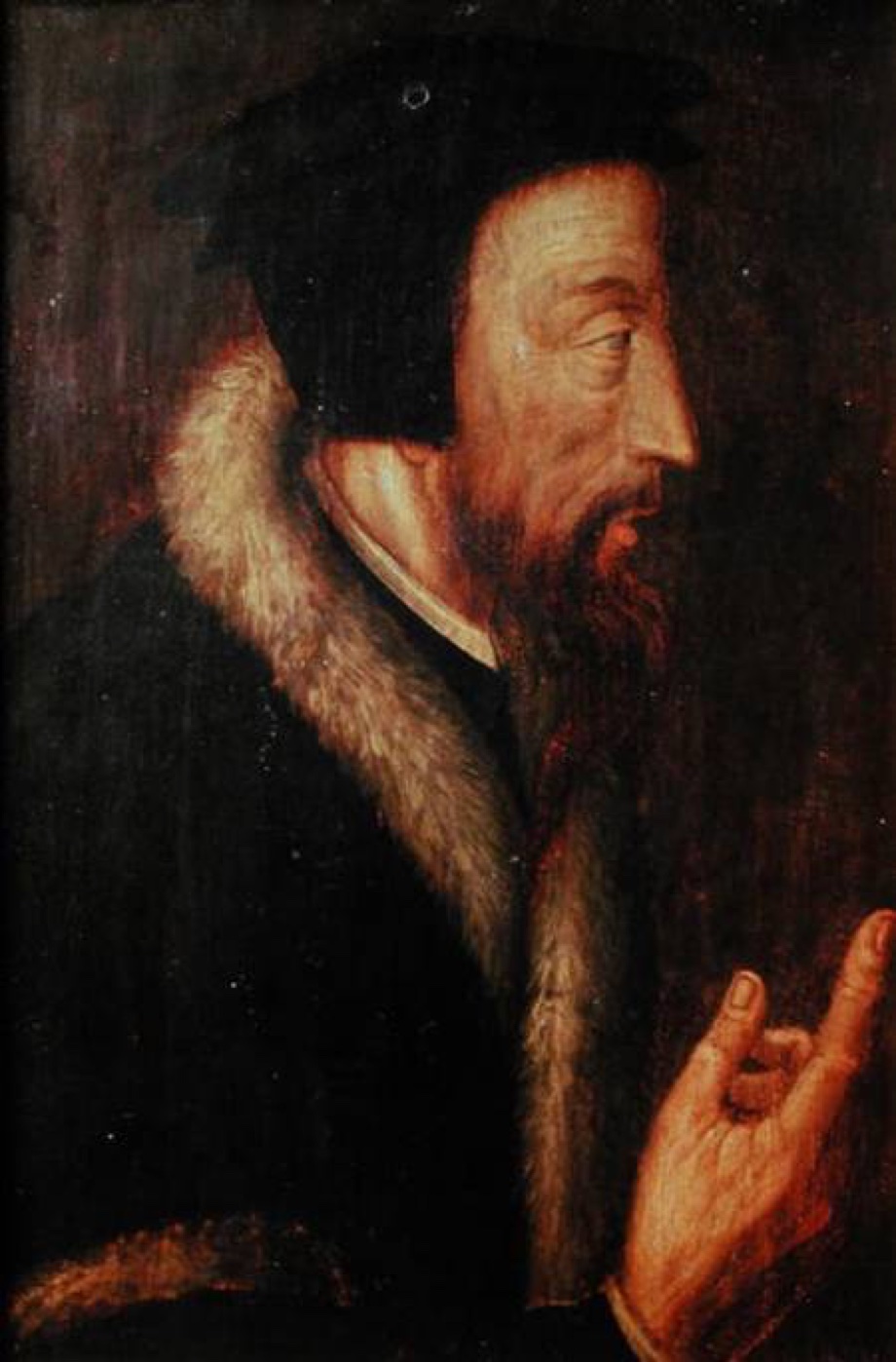
Portrait of John Calvin
The Man Who Built a City Out of an Idea
He did not want the job. When a hot-tempered preacher named Guillaume Farel cornered the young French exile passing through Geneva in 1536 and demanded he stay to reform the city, Calvin longed only for a quiet scholar's life among his books; Farel threatened him with the wrath of God, and the terrified Calvin stayed. It is the one decision of his life made against his own temperament—and once he had accepted that a city must be built, he built it the way he did everything: from a single idea, carried without flinching to its furthest logical end.
A lawyer by training and a humanist by education, Calvin was a Frenchman of cold intellect and frail body who fled Catholic France after a “sudden conversion” to the Reformation. Where Martin Luther had rebelled—a volcanic, contradictory man who broke the old church open with the force of his own conscience—Calvin systematized. He forged the scattered energies of the Protestant revolt into a single, seamless architecture of doctrine, discipline, and government. His masterwork, the Institutes of the Christian Religion, was not a cry of the heart but a cathedral of logic, built on one load-bearing pillar—the absolute sovereignty of God—from which he deduced everything else, including the doctrine that would forever bear the mark of his mind, predestination.
This is the INTJ in its most austere and world-changing form: the architect who does not merely believe a truth but constructs an entire order upon it and imposes that order on a whole society, without sentiment and without retreat.
Calvin is the INTJ as system-builder: a mind that grasped one absolute vision through Ni—the total sovereignty of God—and then used Te to pour that vision into concrete institutions, a codified theology and a disciplined city run, as he saw it, like the mind of God itself.
One Idea, Followed to the End of the World
Ni — dominant
Dominant Ni seizes a single organizing vision and subordinates all reality to it, and Calvin's vision was as simple to state as it was terrifying to follow: God is sovereign over everything, absolutely and without remainder. Most believers hold that idea and then quietly soften it at the edges, where it grows uncomfortable. Calvin refused every softening. If God is truly sovereign, he reasoned, then nothing—not a sparrow's fall, not a soul's salvation—can lie outside His will. And so he arrived, by remorseless deduction, at predestination: the doctrine that God has already chosen, from eternity, who will be saved and who will be damned, and that no human effort can alter the decree. He called it, with characteristic unflinching honesty, the decretum horribile—the dreadful decree—and he taught it anyway, because his logic left no room to do otherwise.
That is Ni: not the accumulation of doctrines but the derivation of them all from one first principle. The Institutes is the monument to this mind. It began in 1536 as a slim handbook and grew, across edition after edition, into a vast, seamlessly interlocking system, every part supporting every other, the whole edifice resting on the sovereignty of God. Calvin did not gather scattered insights the way an empiricist collects data; he saw the shape of the whole and worked outward from the center, so that theology, church order, and the moral life all fell into place as consequences of the one vision.
What makes this Ni rather than mere intellect is its indifference to consequence. A warmer mind would have flinched at a God who elects some and damns the rest; a more political mind would have buried the doctrine to spare the flock. Calvin held it up to the light precisely because it followed—describing not the world he wished were true but the one his vision compelled him to see, trusting the vision over his own comfort or anyone else's.
A City Run Like the Mind of God
Te — auxiliary
A vision that stays inside a book is only philosophy. What separates Calvin from every other theologian of his age is auxiliary Te—the drive to take the idea and build it, in stone and statute, into the working machinery of a society. He did not merely write about the church; he designed one. Recalled to Geneva in 1541 after an earlier expulsion, he returned with a fully drafted blueprint—the Ecclesiastical Ordinances—laying out a four-fold order of pastors, doctors, elders, and deacons, an entire administrative architecture for governing souls. Then he spent the rest of his life making it run.
The instrument of that discipline was the Consistory, a body of pastors and lay elders that supervised the doctrine and morals of the whole city—summoning citizens for drunkenness, dancing, blasphemy, or theological error, and enforcing the reformed life with a thoroughness Geneva had never known. This is Te at its coldest and most effective: not the sermon that moves a congregation but the standing institution that outlasts the preacher and grinds on without him. Calvin built the second thing on purpose, wanting a city that would remain reformed whether or not any particular man was there to inspire it.
His most far-reaching engine was the Academy he founded in 1559, a school to train pastors and export them—and export them it did. The graduates of Geneva carried Calvin's system across a continent, to the French Huguenots, the Dutch Reformed, the Presbyterians of Scotland, and the Puritans who would sail to New England. Calvin turned a doctrine into a movement, and a movement into a transmissible institution—the most characteristically INTJ achievement of all: not to be followed, but to build a structure that keeps producing followers long after the founder is gone.
The Private Conviction Beneath the System
Fi — tertiary
Beneath the machinery there was a man of deep and guarded private conviction—tertiary Fi, the inner moral certainty that fueled the whole enterprise and that Calvin rarely let anyone see. He was famously reticent about himself; his letters and treatises pour out theology while disclosing almost nothing of the interior life. The one great exception is his account of his conversion, where he describes God subduing his stubborn heart to teachableness by a “sudden conversion.” That was the private earthquake—a personal, unshareable certainty of having been seized by God—and everything public he built was its outward expression.
Tertiary Fi in an INTJ tends to fuse personal conviction so completely with the impersonal system that the man can no longer tell the difference between his conscience and his logic. Calvin was sure—not with the warmth of Fe that reads a room, but with the sealed inner certitude of Fi—that his reading of scripture was simply the truth, and that opposition to it was opposition to God. This is why he could be so immovable and, at times, so pitiless: he was not defending a preference but, as he experienced it, reality itself, and a man defending reality feels no obligation to compromise.
It also explains the strange austerity of his self-denial—the frail, pain-wracked body driven to exhaustion, preaching and lecturing and writing at a punishing pace under a private sense of calling that needed no audience to validate it. The Fi did not make him gentle. It made him certain, and certainty in the service of a total system is a formidable and dangerous thing.
The Fire He Could Not Master
Se — inferior
Inferior Se is the INTJ's blind side—the physical, sensory, present world that the system-builder holds at arm's length, and that erupts, when it does, in ways he cannot govern. In Calvin it shows first as neglect: an ascetic indifference to his own body, which he drove without mercy through insomnia, migraine, and chronic illness, with little appetite for the concrete pleasures of the world the Consistory existed to police.
But the great and permanent stain on his record is inferior Se in its darkest form—the abstract system meeting the physical world at the point of a flame. In 1553 the Spanish physician and anti-Trinitarian Michael Servetus, a man who had baited Calvin for years, arrived in Geneva and was arrested. Convicted of heresy, he was burned at the stake with Calvin's approval. Calvin had argued for the sword rather than the fire, but he did not oppose the death; he believed the purity of the doctrine required it. Here the terrible logic of the system—which knew, absolutely, who was right and who was in error—collided with a living human body, and the body burned.
It is the classic shadow of the type: a mind so committed to the rightness of its architecture that it could sacrifice a man to preserve the integrity of an idea and feel the act as duty rather than cruelty. The same unflinching consistency that made the Institutes magnificent made the Servetus affair possible.
Why INTJ Over ISTJ or INTP
Why not ISTJ?
The disciplinarian in Calvin—the codes, the Consistory, the tireless administration—tempts one toward ISTJ, the dutiful keeper of order. But the ISTJ preserves and maintains an inherited tradition; Calvin demolished the inherited order and rebuilt Christian doctrine and society from the ground up on a single organizing principle he had reasoned out for himself. That is Ni-driven architecture, not Si-driven preservation. He was not conserving the past—he was engineering a future that had never existed, and imposing it in the face of a thousand years of custom.
Why not INTP?
The systematic logic and the love of a seamless argument suggest INTP, the pure theorist. But the INTP analyzes, refines, and questions—endlessly turning the system over rather than committing it to the world. Calvin did not merely analyze. He built and he imposed, running a movement and a city through hard Te discipline, drafting ordinances, staffing institutions, and enforcing them. The INTP would have written the Institutes and kept revising it; Calvin wrote it and then went out and made Geneva obey it.
What settles it is the fusion of vision and construction. Calvin was neither a caretaker of the old faith nor a detached philosopher of the new one. He was the rare mind that first sees the entire system whole—Ni deriving a total order from the sovereignty of God—and then possesses the cold executive will to force that order into the world—Te turning theology into statute and city into church. Tradition-keepers preserve; theorists analyze; the INTJ architect conceives and imposes. Calvin conceived and imposed, and a portion of the modern world still bears the shape of his mind.
Connected Figures
Further Reading
- Calvin — Bruce GordonThe leading modern biography — a rich, unsparing portrait of the man and his Geneva, alert to both the genius and the coldness.
- A Life of John Calvin — Alister E. McGrathA lucid intellectual biography that situates Calvin's thought within its cultural and theological world.
- Institutes of the Christian Religion — John CalvinThe system itself — the great systematic masterpiece of Reformed theology, built outward from the sovereignty of God.
- The Reformation: A History — Diarmaid MacCullochThe definitive one-volume history of the age, placing Calvin and Geneva within the whole sweep of the European Reformation.
