 Historical Figure MBTI
#692 · 5-24-26 · The Age of Exploration
Ferdinand II of Aragon
King of Aragon · Machiavelli's Model Prince · Architect of the Spanish State
1452 — 1516
8 min read
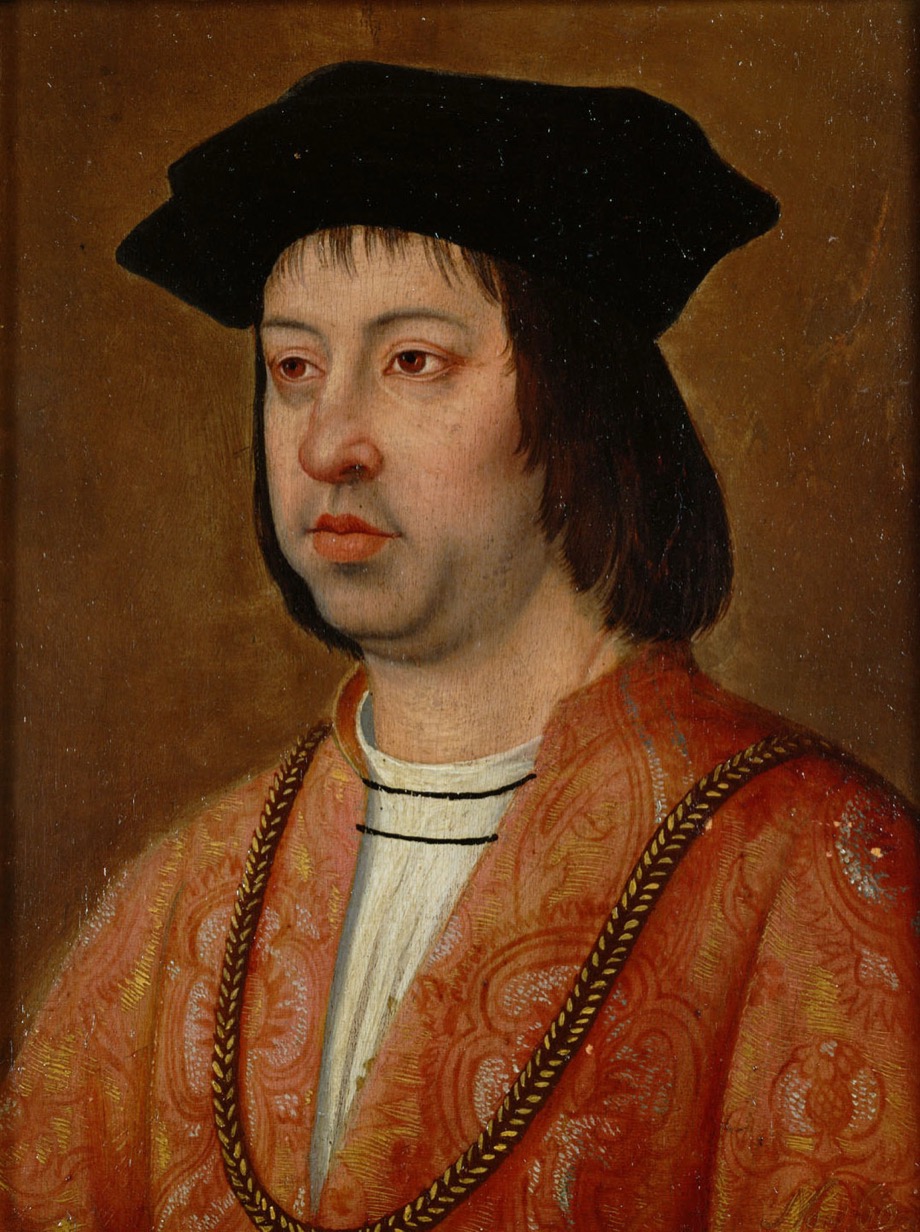
Portrait of Ferdinand II of Aragon
The Prince Who Was Never Building the Same Thing Twice
In 1513, in exile outside Florence, Niccolò Machiavelli wrote a short book about how power actually works, and he needed a living example. He found one still on the throne. Chapter 21 of The Prince opens by naming Ferdinand of Aragon — "he may almost be called a new prince, because from a weak king he has become, for fame and glory, the first king in Christendom" — and then describes a method rather than a man: a ruler who began with the Granada war, used it to occupy his nobles while he quietly fixed his own authority, then turned on Africa, then Italy, then France. Machiavelli admired this. He also noticed the trick underneath it. The enterprises never resolved into a single design. Each was cover for the next.
That is the correct read of Ferdinand, and it is not the flattering one. He inherited Aragon in 1479 and held it until 1516, and in nearly every year of that reign he was engaged in some fresh venture — a marriage treaty, a partition, a claim revived from a dusty genealogy, a league formed and then abandoned. He divided Naples with Louis XII by the secret Treaty of Granada in 1500 and had taken the whole kingdom from him by 1504. Louis reportedly complained that Ferdinand had deceived him twice; Ferdinand's answer, as the story goes, was that he had deceived him ten times and more.
But cynicism is a moral description, not a psychological one. A cynic can still be a planner, and what distinguishes Ferdinand is that he was not executing a plan at all. He read the board each season and took whatever it offered. The empire that resulted was less a building than an accumulation.
Ferdinand was an ENTP: a dominant Extraverted Intuitive who saw every treaty as a hypothesis, every alliance as reversible, and every settled situation as an unexploited opening.
Ne — A New Enterprise Every Year
Extraverted Intuition cannot stop seeing what a situation could become. Its characteristic genius and characteristic failure are the same thing: it will always rather open a new front than finish the old one. Machiavelli described this without the vocabulary. Ferdinand kept his subjects and rivals "in suspense and admiration, occupied with the outcome" of one venture after another, and never gave anyone time to work against him — because there was never a stable configuration to work against.
Consider Naples. Ferdinand's claim ran through his own Trastámara cousins, but rather than press it he offered France a partition, watched the joint occupation collapse into a quarrel over the middle provinces, let Gonzalo Fernández de Córdoba win at Cerignola and Garigliano in 1503, and ended holding all of it — less a betrayal planned from the start than an opening he took, then took further when it kept opening. The same pattern governs Navarre in 1512: a papal quarrel produced a pretext, the pretext produced an army, and a kingdom independent for centuries was inside Spain within a season.
Ne is also why the Columbus decision looks uncharacteristic of a careful monarch and entirely characteristic of this one. Portuguese experts had rejected the westward proposal on sound arithmetic, and they were right about the arithmetic. Ferdinand and Isabella funded it anyway, cheaply, at the exact moment Granada fell and capital came free — a low-cost option on an improbable payoff, the Ne bet in its purest form.
Ti — The Treaty as a Disposable Instrument
Introverted Thinking is a private logic. It tests whether a thing is coherent and useful, and is indifferent to whether the surrounding world regards that thing as sacred. A treaty, to Ferdinand, was a mechanism with a function; when the function was discharged or the mechanism jammed, it was an object he no longer needed. He did not rage against his obligations or agonise over them. He set them down the way one sets down a tool.
The Treaty of Granada is the cleanest specimen. Two Christian kings agree in secret to divide a third Christian kingdom, obtain papal blessing for the arrangement, and then fall out over the boundary — and Ferdinand's response is not indignation but a cool assessment that the instrument has become inconvenient and Córdoba's infantry has become the better argument. The same logic runs through a religious policy never devotional the way Isabella's was: the Inquisition arrived in Aragon over serious local resistance, and the expulsion of 1492 was governed less by conviction than by what the crown needed the church to accomplish. That the terms guaranteed to Boabdil's Muslims in the Granada capitulations were abandoned within a decade fits the pattern precisely.
What keeps this from being mere unscrupulousness is its analytical quality. The fiscal reorganisation of Aragon and the use of the Castilian hermandades as a standing instrument of order show a mind interested in how a machine works — which levers do what, which institutions can be repurposed. Ti reasons about systems. Only the Fe-ordered world of honour and given word finds this monstrous.
Fe — The Most Catholic King
Tertiary Extraverted Feeling in an ENTP is not warmth; it is fluency — the capacity to read what an audience requires and produce it convincingly, without the commitment that would make the performance costly to abandon. The title Ferdinand obtained from Alexander VI in 1496 — los Reyes Católicos, the Catholic Monarchs — is the proof. He acquired the public identity of Christendom's defender at the moment it was worth most, then used it to justify the Italian wars, the African campaigns, and the seizure of Navarre.
Machiavelli saw the mechanism rather than the piety. He observed that Ferdinand "always made use of religion" as a cloak, invoking it to fund armies and license the expulsions, and called the treatment of the Moriscos a "pious cruelty" — a phrase aimed at exactly this function. The Fe was real in the sense that it worked. It was simply deployed rather than felt.
Its underdevelopment shows in the personal register. Ferdinand could win a room and could not, in the end, hold Castile after Isabella died in 1504: the grandees preferred his son-in-law Philip the Handsome, and Ferdinand was manoeuvred out of the regency and withdrew to Aragon, returning in 1506 only because Philip died. A ruler with stronger Fe would have built a base of affection that did not evaporate the moment the legal claim weakened. Ferdinand had reputation, not love.
Si — The Old King and the Heir Who Never Came
Inferior Introverted Sensing surfaces late and clumsily. It is the function of continuity and precedent, and in an ENTP it tends to arrive not as wisdom but as anxiety — a sudden, disproportionate grip on the thing that must be preserved, after a lifetime of treating everything as negotiable. In Ferdinand it arrived as dynastic panic.
His only surviving legitimate son, John, died in 1497. His daughter Juana was married to a Habsburg, which meant the crown of Aragon — a distinct kingdom with its own fueros, cortes, and Mediterranean empire — would pass through her to a foreign house. Ferdinand's answer, in 1505, was to marry the eighteen-year-old Germaine de Foix, niece of Louis XII, explicitly to produce a male heir who would take Aragon back out of the union his own life's work had created. Their son was born in 1509 and lived hours. He is said to have taken remedies to improve his chances at fifty-three, and the attempts continued to the end.
It is the most revealing episode of his life: the instrumental logic of the treaties, now turned inward on his own family. A marriage was a device; the union of Spain history credits to him was itself reversible once the terms stopped suiting Aragon. But the emotional temperature is different. This is not opportunism — it is a man clutching at an inheritance he suddenly cannot bear to lose. Si arrived, and it arrived as grief.
Why ENTP Over ENTJ
Why not ENTJ?
The ENTJ reading is the obvious one and the wrong one. ENTJ leads with Extraverted Thinking: it forms a single objective, imposes structure to reach it, and drives toward a defined end state. Ferdinand never had one. He entered Italy in partnership with France and left it as France's enemy; he built the Spanish union, then spent his last decade engineering Aragon back out of it. An ENTJ does not dismantle his own principal achievement because the succession turned out inconvenient. The unifying architecture of the Catholic Monarchs — the reorganised Castilian administration, the Inquisition as a permanent institution, the religious settlement pursued to its conclusion — belongs far more to Isabella, whose INTJ mode did have a fixed design and executed it without deviation for thirty years. Ferdinand supplied the opportunism; she supplied the plan.
The confusion is understandable, because outcomes flatter intentions. Looking back from 1516 at a Spain holding Granada, Naples, Navarre, and an ocean's worth of new territory, it is natural to infer an architect. Each acquisition was taken because it became available, not because a blueprint required it. What Ferdinand had instead was an extraordinary tolerance for open situations and an eye for the seam in any arrangement — the ENTP's real weapon, which is not force but the perception that nothing is as fixed as everyone assumes.
Connected Figures
Further Reading
- The Prince (1513) — Niccolò MachiavelliChapter 21 names Ferdinand outright as the model new prince — the primary text for this entry.
- Ferdinand and Isabella (Longman, 2004) — John EdwardsThe standard short English study of the joint reign; good on where their aims diverged.
- Imperial Spain 1469–1716 (Penguin, 1963; rev. 2002) — J. H. ElliottStill the best single narrative of how the union of the crowns actually worked — and how provisional it was.
- La España de los Reyes Católicos (Alianza, 1999) — Miguel Ángel Ladero QuesadaSpanish-language institutional history: finance, the hermandades, the machinery beneath the diplomacy.
