 Historical Figure MBTI
#989 · 7-21-26 · The Pacific War
Orde Wingate
Brigadier · Chindits · Guerrilla Zealot
1903 — 1944
7 min read
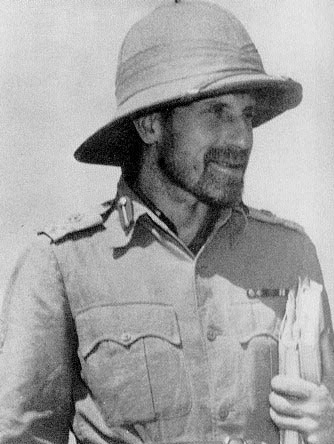
Portrait of Orde Wingate
A Prophet in Uniform, Convinced of His Own Method
Orde Wingate ate raw onions like apples, received visitors in his tent stark naked while scrubbing himself with a rubber brush, wore an alarm clock on a string around his neck instead of a wristwatch, and once threatened to resign, or worse, if his superiors did not fund an operation everyone else in the chain of command considered reckless to the point of suicidal. None of this was affectation. It was simply what it looked like when a mind this restless, this convinced of its own unconventional insight, and this indifferent to how it appeared to others, was let loose with a brigade and a war.
He is ENTP, and the diagnosis explains both his gifts and his catastrophes in the same breath. Dominant extraverted intuition generated, at a pace few of his contemporaries could match, an unbroken stream of unconventional operational possibilities — long-range penetration deep behind enemy lines, columns supplied entirely by air, guerrilla forces operating for months inside territory the enemy considered secure. Auxiliary introverted thinking then defended each of those possibilities with a combative, airtight internal logic that brooked no argument from anyone who had not already arrived at the same conclusions.
Wingate is the ENTP evangelist: dominant Ne throwing off unconventional possibilities faster than anyone could vet them, auxiliary Ti defending each one as though disagreement were simply a failure of the listener's reasoning.
It made him, by turns, the most visionary irregular-warfare commander Britain produced in the Second World War and one of the most difficult men in the British Army to manage — a combination his superiors never fully resolved before he died in a plane crash in the Burmese hills in 1944, at the height of his second and most ambitious Chindit operation.
Warfare Reimagined From First Principles
Wingate's dominant extraverted intuition had already produced one radical departure from convention before Burma: in Mandate Palestine in the late 1930s, he organized the Special Night Squads, mixed British-Jewish units that struck Arab insurgent bands by night using tactics no textbook in the British Army sanctioned, drawing on an intense, unconventional personal sympathy for Zionism that he arrived at largely on his own and defended against colleagues who found it, at best, eccentric.
In Burma, the same faculty produced the Chindits — the idea that an entire brigade could operate for months deep inside Japanese-held territory, resupplied purely by parachute drop, striking rail lines and outposts and then vanishing back into the jungle rather than holding ground in the conventional sense. Nobody else in the theater was proposing anything like it; Wingate did not so much propose it as insist on it, repeatedly, past every objection about feasibility, until Churchill personally intervened to fund the second, larger Chindit expedition in 1944.
This is Ne at full throttle: a mind that treats the accepted framework of a problem — how armies fight, how supply lines work, who counts as a legitimate ally — as simply one possibility among many, and that generates alternatives faster than institutions can absorb them.
An Internal Logic That Would Not Bend
Auxiliary introverted thinking gave Wingate's improvisations their combative rigor. He did not simply float ideas; he built closed, self-consistent operational arguments for them — on air supply tonnages, march rates through jungle, the psychological effect of an enemy discovering it had no secure rear area — and defended those arguments with a ferocity that read, to superiors who had not done the same internal work, as arrogance bordering on insubordination.
That same Ti rigor made him genuinely difficult to argue with on the merits: officers who challenged the Chindit concept on logistical grounds often found Wingate had already worked through the objection in more detail than they had. It also made him nearly impossible to redirect once he had reasoned his way to a conclusion — a trait that served the initial Chindit concept brilliantly and served his personal relationships, and eventually his own physical health under the strain of relentless self-conviction, far less well.
Evangelism as a Form of Charisma
Wingate's tertiary extraverted feeling surfaces as genuine, if erratic, evangelical charisma — a capacity to inspire fierce personal loyalty in the men he led, and to sell an entire theater command on ideas that had no precedent, purely through the intensity of his own conviction communicated outward. Chindit veterans who found him bizarre in private still followed him into terrain most soldiers would have refused, because he made the mission feel, in the moment, like the only thing that mattered.
It was also the least controlled of his functions: his advocacy for Zionism, his public contempt for officers he considered unimaginative, his willingness to threaten his own superiors, all read as Fe conviction running without Fi's private check on how the conviction would land. He persuaded as often as he alienated, sometimes in the same conversation.
A Body Ignored, Habits Treated as Irrelevant
Wingate's inferior introverted sensing shows up precisely where one would expect it to be weakest: bodily maintenance and the quiet, private routines most people never think about. His eccentric personal habits — the raw onions, the alarm clock, indifference to nudity in front of visitors, self-treating illness with folk remedies rather than seeking proper medical care — read as a dominant-Ne mind that has never developed a settled relationship with its own physical, sensory routine, and doesn't especially value one.
It cost him. He suffered from depression and attempted suicide once during a low period in the war, and he pushed his own body relentlessly through malaria and exhaustion in Burma without the self-preserving caution a stronger Si would have imposed — the same disregard for established, comfortable habit that made him so effective at reimagining warfare made him nearly incapable of taking care of himself.
Why ENTP Over INTP
Why not INTP?
An INTJ or INTP quietly develops an unconventional plan and reveals it fully formed, avoiding confrontation until the idea can defend itself. Wingate did the opposite: he argued for his ideas loudly, publicly, and repeatedly, to anyone in earshot including officers well above his rank, treating persuasion of the room as part of the work itself rather than a distasteful necessity. That outward, combative evangelism is extraverted Ne and Fe operating in the world, not an introvert's private theorizing.
The line between the two is precisely the difference between having unconventional ideas and needing everyone else to accept them immediately. Wingate could not simply be right in private; he had to convert his superiors, publicly and combatively, and his career is a record of exactly how much friction that generated even when — especially when — he turned out to be correct.
Connected Figures
Further Reading
- Wingate: Irregular Soldier — Trevor RoyleA full biography addressing both his tactical brilliance and his volatile personality.
- The Chindit War — Shelford BidwellA detailed operational history of the two Chindit expeditions.
- Defeat Into Victory — William SlimSlim's own account of the Burma campaign, including his working relationship with Wingate.
- Burma: The Longest War 1941–45 — Louis AllenBroader theater history situating the Chindits within the wider campaign.
