 Historical Figure MBTI
#688 · 5-23-26 · The Age of Exploration
Philippa of Lancaster
English Princess · Queen of Portugal · Mother of the Illustrious Generation
1360 — 1415
7 min read
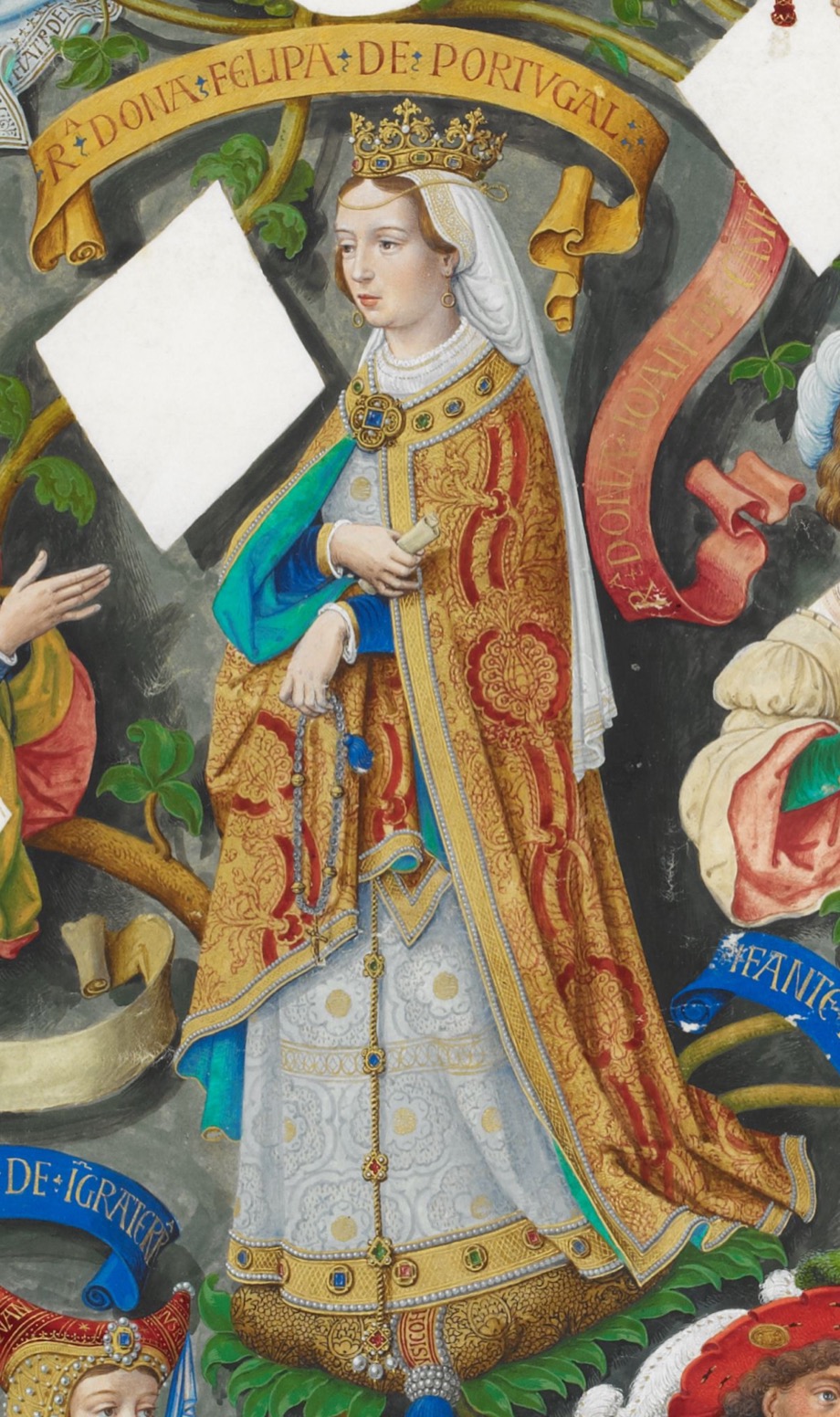
Portrait of Philippa of Lancaster
A Household Built to Last
History remembers Philippa of Lancaster, if it remembers her at all, as a bridge — the daughter of John of Gaunt who crossed the sea in 1387 to marry João I of Portugal and seal an alliance that has outlasted every dynasty involved in making it. That is accurate, and it is also the least interesting thing about her. What made Philippa consequential was not the treaty she embodied but the household she ran afterward: a court reorganized around English notions of order, piety, and daily discipline, in which princes were raised less like ornaments of a throne and more like men who would eventually have to justify their existence through competence.
She was, by the available evidence, an ISFJ — a temperament built for stewardship rather than spectacle. Nothing about her surviving record suggests appetite for center stage; everything suggests a woman who understood that a dynasty's future is decided in the nursery and the household ledger long before any battlefield. Her sons became known collectively as the Illustrious Generation, and historians tend to agree this was not an accident of good genetics but the product of a specific upbringing — hers.
Her influence is invisible in the way successful infrastructure is invisible; no one credits the foundation for the building standing. But trace the austere, methodical, duty-bound cast of mind that later defined Prince Henry the Navigator's decades of patient maritime administration, and the line runs backward through his childhood, straight to his mother's table.
Philippa of Lancaster was an ISFJ whose dominant Si turned a foreign court into a household run on memory, precedent, and unbroken duty.
Precedent as a Governing Principle
Philippa's dominant Si shows up not as nostalgia but as method. She arrived in Lisbon carrying the administrative habits of the English royal household — fixed hours, catechized observance, a literate court where reading and record-keeping were expected rather than exceptional — and installed them wholesale. This was the instinct of a mind that trusts what has already been tested over what merely sounds promising.
That same instinct governed how she raised her children. Accounts of the Illustrious Generation describe a nursery organized around structure: fixed devotions, rigorous instruction, discipline that did not bend for royal birth. Si does not indulge exceptions; it builds systems so exceptions become unnecessary. Prince Henry's later career — decades spent methodically cataloguing coastlines from the same fixed base at Sagres, rather than chasing single dramatic conquests — reads like her temperament translated into maritime policy a generation later.
Even her death carries the signature. Dying of plague in 1415, she spent her final hours in the deliberate act of blessing her sons on the eve of the Ceuta campaign — discharging one more duty, according to established form, because that is what a life organized around precedent asks of a person even at its end.
Warmth Spent on the Family Enterprise
If Si supplied Philippa's method, Fe supplied its purpose. Her auxiliary Fe did not express itself as public charisma — there is little in the record of a queen performing affection for a crowd — but as a steady channeling of relational energy into the maintenance of her family as a collective project. She bound her sons to one another and to a shared sense of obligation, producing brothers who cooperated rather than fractured into the rivalries common among royal siblings.
The literacy and piety she instilled were relational as much as personal — a shared language and shared devotion that gave her sons a common identity even after she was gone. The Anglo-Portuguese alliance she had been sent to secure through marriage, she ended up securing more permanently through the household culture she built inside it.
Her final act made the priority explicit: facing death, she used what time remained to bless her sons before their departure for Ceuta — Fe's instinct to tend the people who matter most, exercised right up against its own limit.
A Quiet Insistence on Getting It Right
Philippa's tertiary Ti surfaces less as visible argument than as an unhurried standard she held her household to — the sense that things ought to be done correctly, not merely done. Her attention to her children's literacy was practical in this way: education mattered to her not as a status marker but as a tool that let a person reason things through for themselves.
This tertiary logic also explains why her influence produced a prince like Henry the Navigator rather than a court of mere traditionalists. Si without any Ti calcifies into ritual for its own sake; paired with modest Ti, precedent becomes a starting point for careful, internally consistent expansion. Henry's methodical accumulation of navigational knowledge — testing, correcting, building a coherent body of expertise voyage by voyage — has the shape of a mind trained early to value getting the internal logic right, not just following the form.
The Unlikely Seed of an Age of Exploration
Inferior Ne rarely announces itself in an ISFJ, and Philippa's is no exception — it appears not as personal restlessness but as the one large, speculative gamble her steady life ultimately underwrote. A woman devoted to precedent and structure raised the son who would spend a career chasing what lay past the known edge of the map. That is a strange inheritance for a dominant-Si mother to leave: she did not chase horizons herself, but she built the disciplined, secure foundation from which someone else finally could.
There is a case that her blessing on the eve of the Ceuta expedition is the single visible moment where her buried Ne surfaces directly — an endorsement, at the threshold of death, of a leap into the unknown that everything else in her temperament would ordinarily counsel against. She did not live to see where that leap led; the Age of Exploration that opened in the following decades is, in no small part, the deferred expression of a possibility she made room for without ever seeking herself.
Why ISFJ Over ESFJ
Why not ESFJ?
ESFJ leads with Fe, projecting warmth and social coordination outward as its first move — a temperament that would show up in the sources as visible charm, hospitality, public presence. Philippa's record shows the opposite ordering: structure and precedent come first, and the warmth follows only in service of that structure, expressed through household discipline rather than sociable display. An ESFJ raising the Illustrious Generation would likely have left behind stories of a beloved, magnetic court hostess. What the sources describe instead is a queen who built systems and let the systems carry the relational weight — the signature of dominant Si over dominant Fe.
The distinction matters because it explains the texture of her legacy, not just its existence. An ESFJ's imprint tends to be remembered in anecdote — the warmth people felt in her presence. Philippa's imprint survives instead in outcomes: a functioning alliance, a literate court, and sons whose collective temperament so closely mirrors the disciplined structure she imposed that historians treat her household regime as a documented cause, not a charming footnote.
Connected Figures
Further Reading
- Prince Henry 'the Navigator': A Life — Peter RussellYale University Press, 2000 — the definitive biography of her son, with substantial coverage of Philippa's formative influence on his temperament.
- A History of Portuguese Overseas Expansion, 1400–1668 — Malyn NewittRoutledge, 2005 — situates the Ceuta campaign and the household that preceded it within the broader arc of Portuguese expansion.
- Philippa of Lancaster: Queen of Portugal — Bertha Coolidge SladeAn older but still useful biographical study, drawn from Portuguese and English chronicle sources.
