 Historical Figure MBTI
#689 · 5-23-26 · The Age of Exploration
João II of Portugal
The Perfect Prince · Absolutist Reformer · Rejecter of Columbus
1455 — 1495
6 min read
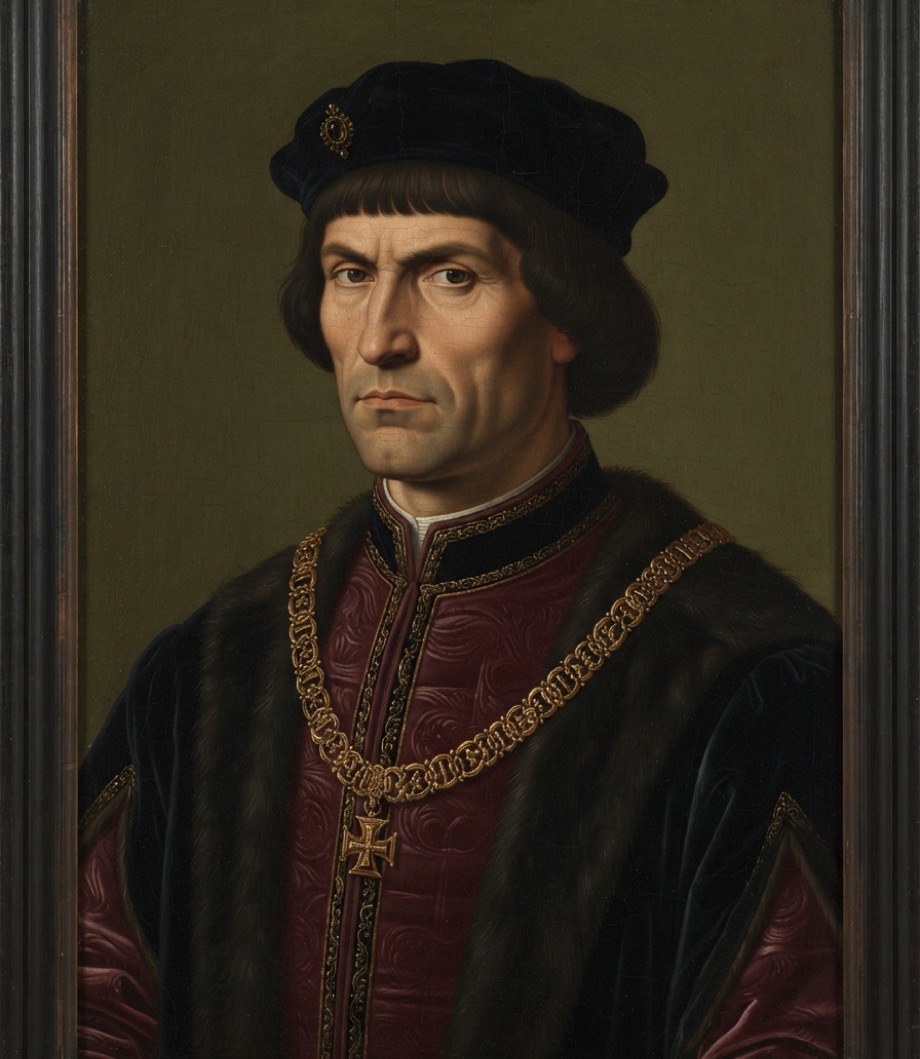
AI-assisted Portrait of João II of Portugal
The Prince Who Struck First
On a spring afternoon in 1484, João II summoned his brother-in-law the Duke of Viseu to a private chamber, accused him of conspiracy, and killed him with his own hand. The year before, the Duke of Braganza had gone to the block on João's order, his estates folded into the crown. These were not the acts of a paranoid tyrant flailing at shadows — they were the calculated moves of a king who had studied Portugal's overmighty nobility and decided the problem needed solving in his lifetime, not his heirs'. Everything else João did — the caravels sent down the African coast, the spies dispatched toward a legendary Christian king, the merchant from Genoa turned away at the palace door — followed the same instinct: see the field clearly, and act on it now.
This is the temperament of an ENTJ. João is often folded into the same mold as his great-uncle Henry the Navigator, as if the House of Aviz produced one unbroken line of visionaries building an empire from behind a map table. But João did not work in the dark for decades waiting for a payoff. He inherited a half-finished project, judged its weaknesses in real time, and removed them — a duke here, a rival claim there, a foreign pitch he had the arithmetic to disprove on the spot. Where his great-uncle planned, João executed.
João II ruled less like an architect than like a foreman — the vision was already on the table; his gift was making it happen, immediately, over anyone who stood in the way. That is ENTJ Extraverted Thinking at the height of its power.
The Ledger and the Blade
Extraverted Thinking organizes the world by results, and João organized Portugal the way a general clears a battlefield: identify the obstacle, apply overwhelming force, move on. The nobility had spent his father's reign accumulating private armies loyal to dukes before the crown. João tried the Duke of Braganza for treason in 1483, had him executed, and confiscated his estates outright. When a second conspiracy surfaced the following year, implicating his own brother-in-law the Duke of Viseu, João did not wait for a trial — he confronted the man directly and killed him himself.
The same logic ran through his management of the exploration project he inherited. He restructured the crown's monopoly on African trade, commissioned Bartolomeu Dias's voyage on concrete, dated terms, and pushed for verifiable results: a rounded cape, a measurable step closer to the Indies. He even ran geography like a business, maintaining cosmographers to check other men's claims against Portugal's own data — a habit that paid off decisively in 1485, when a Genoese sailor with a westward proposal walked into his court.
The Man Who Rejected Columbus
Introverted Intuition gave João's Te something worth executing on: a coherent, long-range read of where the world was going, held with enough conviction to override a tempting shortcut. This is nowhere clearer than his dismissal of Christopher Columbus in 1485. History often flattens that refusal into shortsightedness — the king who said no to the man who found America. The record says otherwise: João's cosmographers checked Columbus's distance estimate against Portugal's own data and judged it badly wrong. Their skepticism was correct; only the accident of an intervening continent saved Columbus's voyage from disaster.
João's refusal was Ni backing a bet already placed. Portugal was deep into a methodical eastward project, and the same year he turned Columbus away, Bartolomeu Dias was three years from rounding the Cape of Good Hope. Parallel to the caravels, João sent men like Pêro da Covilhã overland, hunting both the spice markets and the legendary kingdom of Prester John — a second channel confirming the same picture before Portugal staked everything on it. That is auxiliary Ni: a settled internal picture deployed to justify hard decisions Te could then execute without hesitation.
A Blade, Not a Signature
Tertiary Extraverted Sensing shows up in João as an appetite for the physical, immediate register of power — comfort being present at the point of consequence rather than issuing decrees from a distance. It explains why the Duke of Viseu's death happened the way it did. João could have had him arrested and tried at leisure, executed by proxy weeks later. Instead he did it himself, in person, the moment the plot became undeniable — decision translated directly into physical action, with no intermediary step.
The same current runs through João's hands-on interest in the caravels themselves, the ships and instruments his court turned into hard numbers. He was not a monarch content to read reports of the Atlantic from a throne room; he wanted concrete, measured proof to weigh against a foreign sailor's optimistic guesswork.
What the Blade Cost Him
Inferior Introverted Feeling is where an ENTJ's fluency runs thinnest, and João's own family history supplies the clearest evidence. The man he killed in 1484 was not a stranger conspirator but his wife's brother, a relation that should have carried private weight against the political logic demanding his removal. João's decision suggests that weight was real but subordinate — felt, perhaps, but never allowed to govern the outcome. Chroniclers describe a king capable of personal loyalty to servants who had earned it, so the capacity for attachment was there; it simply never won when it collided with the throne's requirements.
That asymmetry is the mark of Fi sitting last in the stack rather than absent from it. A king whose Fi ran stronger, or higher in the function order, does not kill his brother-in-law in a private chamber and keep governing the next morning as though the matter were closed.
Why ENTJ Over INTJ
Why not INTJ?
João's résumé looks INTJ at a glance — a monarch reshaping institutions around a decades-spanning project he did not originate. But INTJ's dominant Ni works patiently and indirectly, content to let a design unfold over years before intervening. João intervened constantly and personally: trying a duke in open court, confronting a conspirator face to face, dating and pushing individual voyages rather than administering the program from a remove. That is Te leading, not Ni leading — a man who needed to see the obstacle fall in front of him, not merely calculate that it eventually would.
The comparison matters because João is so often narrated alongside Henry the Navigator, whose own INTJ temperament really did work the way legend imagines João's did — a single mind quietly assembling a project over half a century, rarely at the center of the action himself. João finished the project's hardest phase in a single reign, the way an ENTJ does everything: in the room, in person, with the outcome settled before he left it.
Connected Figures
Further Reading
- A History of Portuguese Overseas Expansion, 1400–1668 — Malyn NewittTraces João's centralizing reforms alongside the crown's exploration strategy.
- The History of Portugal — Peter PiersonCovers the Braganza and Viseu conspiracies and João's consolidation of royal power.
- Columbus — Felipe Fernández-ArmestoDetails the 1485 Portuguese court rejection and the cosmographers' distance calculations.
