 Historical Figure MBTI
4 min read
#23 · 2-8-26 · Scientific Paris
Pierre Curie
Physicist · Ethical Counterweight of Modern Science
1859 — 1906
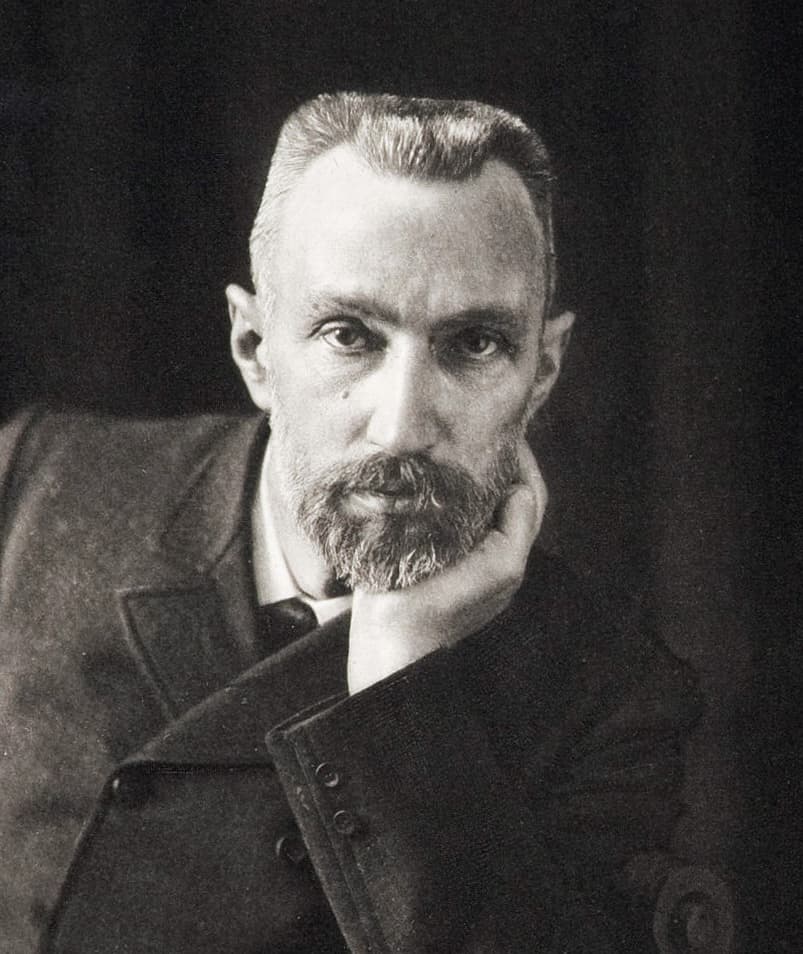
Portrait of Pierre Curie.
The Man Who Refused the Center
Pierre Curie lived during a time that increasingly rewarded certainty, authority, and scale. He embodied none of these — by choice.
He was brilliant, but uninterested in prominence. Morally alert, but resistant to assertion. He did not shape himself into a leader or a symbol. Instead, he remained inwardly governed, allowing his work and relationships to emerge from alignment rather than ambition.
In a century that hardened people into systems, Pierre stayed permeable.
The psychological consensus on Pierre typically splits between INFJ (the quiet visionary) and INTP (the detached logician). Both have merit. But when we look at the primary driver of his life — how he judged reality and where he found his limits — a different structure emerges. Pierre was not driven by the convergence of a vision, nor by the distance of a model. He was driven by moral resonance. For this reason, we type Pierre Curie as INFP.
In a century that hardened people into systems, Pierre stayed permeable.
Fi — Dominant
Pierre's life was governed by an internal value system he never compromised.
He evaluated people not by competence or hierarchy, but by sincerity and integrity. He recoiled from ambition without conscience and expressed deep discomfort with science divorced from ethics. Unlike the strategic thinkers of his time, he did not treat values as variables; they were his foundation.
Crucially, Pierre did not seek to impose his values on others. He lived them quietly, withdrawing rather than confronting when misalignment arose. This is dominant Fi: inwardly absolute, outwardly non-coercive.
His devotion to Marie Curie followed the same pattern. He did not frame her as a muse or extension of himself. He recognized her integrity and aligned with it — freely, without the need to lead.
Ne — Auxiliary
Pierre's intellect moved through possibility and resonance, not through the singular "must-be" of Ni or the "must-work" of Ti.
His scientific interests gravitated toward symmetry, proportionality, and the hidden beauty of relational patterns. He didn't narrow his focus to solve a problem; he expanded his awareness to see how things correlated.
This is auxiliary Ne: exploring the "what if" in service of the internal "what matters." His work remained open-ended, marked by a characteristic caution that favored refinement over definitive resolution.
Si — Tertiary
Pierre preferred continuity over disruption. He lived modestly, avoided spectacle, and trusted what felt ethically stable. His resistance to institutional politics was not anxiety-driven, but a preference for the familiar territory of his own conscience over the unpredictable arena of public role-playing.
Once bonded — to Marie, to his work — he showed deep loyalty and consistency. He did not seek to expand his territory; he sought to preserve the sanctity of his process.
Te — Inferior
Pierre struggled with external structure and institutional maneuvering. He avoided confrontation, disliked bureaucracy, and showed little interest in leveraging power. Recognition arrived around him, not through him.
He guarded conscience, not outcomes.
Why Not INFJ or INTP?
Why not INFJ?
The INFJ case rests on Pierre's idealism. But INFJs are ultimately vision-oriented (Ni) — they tolerate social complexity and strategic assertion when it serves a guiding insight. Pierre did not. He did not consolidate influence or direct people. When misalignment arose, he withdrew rather than restructured. His decisions prioritize inner rightness over external effect — the hallmark of Fi-dominance over Ni-vision.
Why not INTP?
An INTP approach (Ti) prioritizes logical distance and system-coherence. While Pierre was a rigorous physicist, his response to the world was always personal and ethical. He didn't reject honors because they were illogical; he rejected them because they were insincere. He wasn't looking for a perfect model; he was looking for a life that didn't violate his spirit. For Pierre, truth was not a detached abstraction — it was a moral obligation.
Pierre Curie in Relation to Marie
Pierre's INFP structure becomes clearest beside Marie Curie.
Marie (INTJ) carried the vision and the endurance of execution. Pierre provided the moral grounding. He recognized her necessity and aligned with it, insisting on her credit and allowing her vision to define their shared work.
Marie ensured truth was finished.
Pierre ensured truth remained human.
Connected Figures
Further Reading
- Marie Curie: A Life — Susan QuinnThe most thorough English-language biography of the Curie partnership, richly attentive to Pierre's role and character.
- Pierre Curie — Marie Curie (trans. Charlotte and Vernon Kellogg)Marie's own memoir of her husband, written shortly after his death — an intimate portrait from his closest collaborator.
- Obsessive Genius: The Inner World of Marie Curie — Barbara GoldsmithDraws on previously sealed laboratory notebooks and letters to examine how the Curie dynamic shaped the science.
- Radioactive: Marie & Pierre Curie, A Tale of Love and Fallout — Lauren RednissA visually innovative biography that renders the Curie partnership with both scientific accuracy and emotional depth.
