 Historical Figure MBTI
#572 · 4-30-26 · The Ottoman Zenith
Selim I
Sultan of the Ottoman Empire · Conqueror of the Mamluks · The Grim
1470 — 1520
9 min read
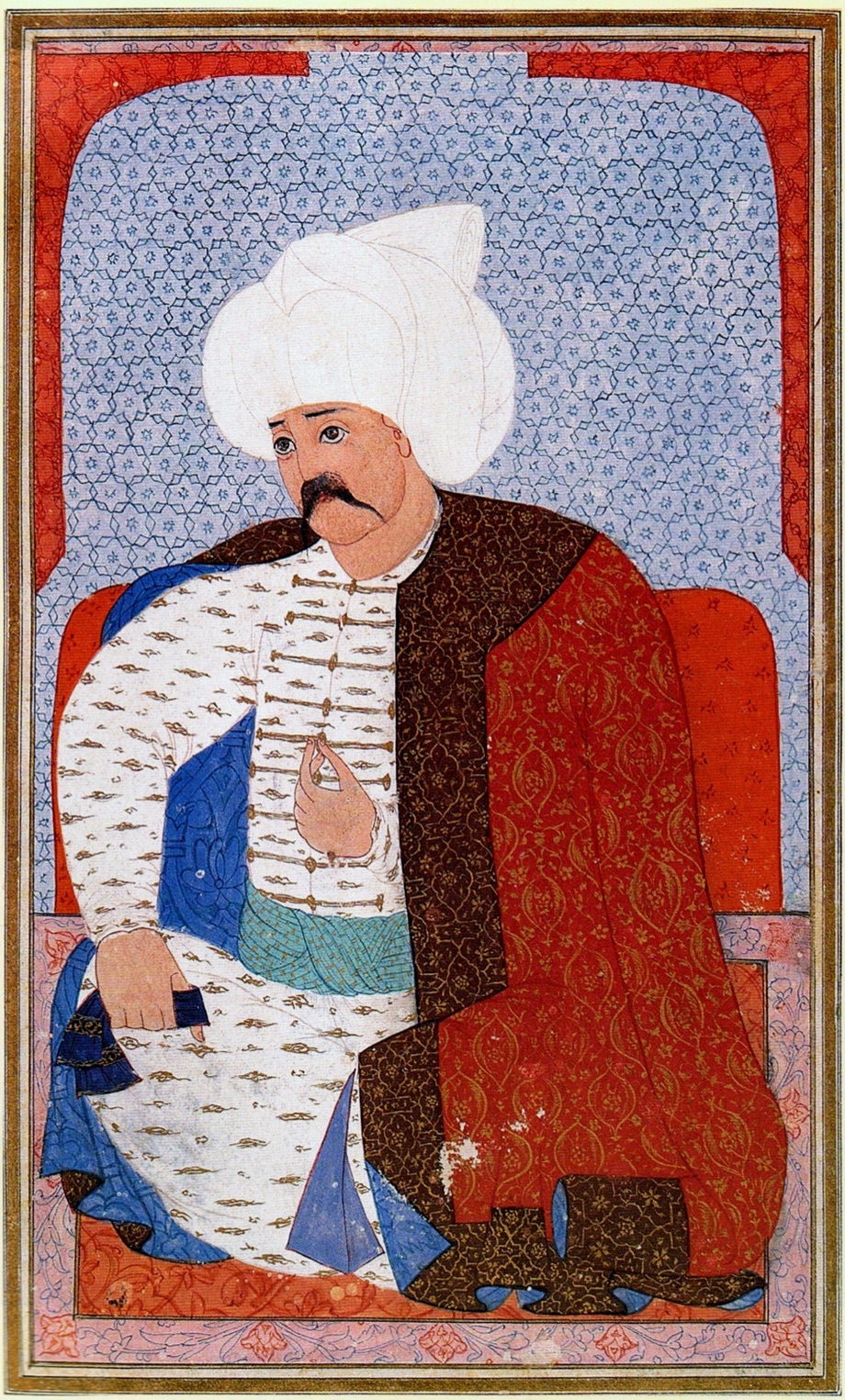
Portrait of Selim I
Eight Years to Remake the World
He reigned for eight years and doubled an empire. Nothing about Selim I was patient except his ambition, which was total. He came to the throne in 1512 by force — pressing his own father, Bayezid II, off the seat of the Osmanli and out of Istanbul, then methodically eliminating the brothers and nephews whose survival might one day cost him the throne. It was not cruelty for its own sake; it was the removal of every variable that could threaten the objective. The Ottomans called this the price of order, and Selim paid it without visible hesitation. The men who would later tremble before him understood from the first that they were serving a will that did not negotiate with obstacles — it deleted them.
What he did with the throne is the reason he matters. In under a decade he checked the rising Shia power of Safavid Persia at Chaldiran in 1514, then turned south and swallowed the Mamluk Sultanate whole — Syria, Egypt, the Hejaz — at Marj Dabiq and Ridaniya. With Egypt came guardianship of Mecca and Medina and, by tradition, the title of Caliph. In a handful of campaigns the Ottoman sultan went from being one power among several to being the protector of the holy cities and the foremost sovereign of the Sunni world. Selim did not stumble into this. He built it, in sequence, the way an engineer assembles a machine: first neutralize the threat to the east, then absorb the wealth and legitimacy of the south. He is the ENTJ as world-remaker — the will to command married to a single, fixed picture of the empire that had to exist.
Selim is the ENTJ at maximum intensity: Te's overwhelming, unnegotiable will in service of a Ni vision so clear it needed only eight years to execute — a dominant Sunni Ottoman superpower, straddling the Muslim world, assembled conquest by conquest in exactly the order the design required.
Grim, austere, terrifying to the officials who served him, and — incongruously — a refined poet in Persian, Selim died as suddenly as he had lived, of an infection in 1520. The golden age everyone remembers belonged to his son. The machine that made it possible was Selim's.
The Will That Deleted Obstacles
Te — dominant
Dominant Te bends the external world toward an outcome and treats everything — men, institutions, its own scruples — as material for the task. Selim's outcome was Ottoman supremacy, and he pursued it with a ruthlessness that even his own era found extreme. The seizure of the throne set the tone: he moved against a living father and a field of brothers not from passion but from a cold reading of the succession problem. The Ottoman house had no fixed rule of inheritance, which meant every surviving prince was a future civil war. Selim solved the equation by subtraction. The same logic governed his court. His grand viziers served in genuine fear for their lives — so much so that "may you be a vizier of Selim's" entered Turkish as a curse. He did not want to be loved by his ministers; he wanted to be obeyed by them, instantly and without friction.
In the field the same instrument was turned on empires. Selim understood force as a problem of logistics and timing as much as valor. He marched an army across the punishing Anatolian plateau to reach Chaldiran and made ruthless use of the new technology of the age — massed gunpowder artillery and the disciplined arquebus-fire of the janissaries — against a Safavid host that still trusted in the cavalry charge. At Marj Dabiq and Ridaniya he broke the Mamluks the same way: their celebrated horsemen, the finest heavy cavalry in the Islamic world, shattered against cannon and organized musketry. This is Te's signature in war — not the pursuit of glory but the pursuit of what actually works, adopting the decisive tool and applying it without sentiment for the older, nobler way of fighting.
And Te does not stop at conquest; it consolidates. Selim did not merely raid Egypt, he annexed it — seizing the Mamluk treasury, redirecting the wealth of the eastern spice trade, and carrying the shadow-Caliph of Cairo back to Istanbul so the prestige of the office would attach to the Ottoman house. That is the deep ENTJ move — to win the battle in a way that also builds the state the battle was for.
The Map He Could Already See
Ni — auxiliary
Auxiliary Ni supplies Te with its direction — a single, fixed image of the future toward which all the force is aimed. What separates Selim from a mere warlord is that his eight years form a sequence, not a spree. He did not simply attack whoever was nearest. He grasped, before he moved, that two threats bounded the Ottoman future and that they had to be dealt with in the right order. To the east, Shah Ismail's Safavid revolution was radiating Shia militancy into Anatolia itself, subverting Selim's own frontier populations; it was the more urgent danger and had to be checked first. To the south lay the Mamluk Sultanate — older, richer, guardian of the holy cities and the caliphal prestige — the prize that would make the Ottoman sultan the leader of Sunni Islam. Chaldiran before Marj Dabiq was not accident but architecture.
This is why the ESTP reading fails. Selim was not seizing targets of opportunity; he was executing a grand design whose end state he could already picture — a unified, dominant Sunni empire straddling the Muslim world from the Balkans to the Hejaz. The famous savagery against the Anatolian Qizilbash before the Persian campaign reads, in this light, as strategic rather than merely bloody: he was clearing his rear of a fifth column before committing to the eastern war. Every violent act served the picture, and the picture never wavered.
Ni is also what let Selim value the intangible. He understood that Egypt's deepest asset was not its grain or its gold but its symbolic weight — the caliphal mantle, the custodianship of Mecca and Medina. A tactician takes the treasury; a strategist takes the meaning, because he can see how it will legitimize a dynasty for centuries. Selim took both, converting a Turkish frontier state into the acknowledged center of the Sunni world — a transformation that outlived him by four hundred years.
The Sultan Who Marched
Se — tertiary
Tertiary Se gives the ENTJ strategist a taste for the front line — the nerve to act physically and to move faster and harder than caution would advise. Selim had it in abundance. He was a campaigning sultan who led his armies in person across some of the most hostile terrain in the world, driving them through the Anatolian highlands to Chaldiran and across the Sinai desert to Ridaniya, marches that broke lesser hosts before a shot was fired. The seizure of the throne carried the same physical audacity — moving directly against a reigning father, striking first while rivals were still calculating. Selim did not wait to inherit; he took, in the present tense, with force.
But in Selim the Se is a servant, not a master. The boldness was always harnessed to the design; he took the risks the plan required and declined the ones it did not. That is the line between him and the pure adventurer — the ESTP charges because the moment is electric; Selim marched because the sequence demanded that this enemy fall now, in this place, so the next objective could follow. The daring was real, and always instrumental.
The Poet Behind the Grim Mask
Fi — inferior
Inferior Fi is the ENTJ's buried interior — a private world of feeling that the commanding, instrumental self keeps out of public view. In Selim it is almost hidden, and that is the point. To his court he was Yavuz, "the Grim," a face of stone that showed no softness; the officials around him never glimpsed a man who wavered, and he cultivated the terror that came with it.
Yet the same man wrote poetry — a substantial body of refined verse, most of it in Persian, the very language of the Safavid enemy he had crushed. It is one of the strangest juxtapositions in the sultanate: the conqueror who broke Shah Ismail composing delicate ghazals in the Shah's own literary tongue. This is inferior Fi's characteristic form — not absent but sequestered, pouring its intensity into a private channel walled off from the public role. There was a devotional strain to it as well: Selim took the guardianship of Mecca and Medina with evident seriousness, a genuine sense of himself as champion of Sunni orthodoxy and not merely its beneficiary. The buried values were real — a poet's sensibility and a believer's zeal — kept behind a mask so complete that history remembers only the grimness, and forgets the verses.
Why ENTJ Over ESTP
Why not ESTP?
The case for ESTP is easy to make: Selim was a fighting sultan who led from the front, seized his throne by naked force, and marched into hostile deserts on a nerve that bordered on recklessness. That is real Se boldness. But the ESTP is an opportunist of the moment — a superb tactician who reads the live situation and strikes at whatever is in front of him. Selim was executing a coherent grand design. He checked the Safavids first because they were the more urgent threat, then swallowed the Mamluks for their wealth and their caliphal prestige — a planned sequence, not a run of improvised seizures. That is Te–Ni architecture, a strategist building toward a pictured end state, not Se–Ti playing the hand in front of him.
The tell is the shape of the whole reign. An ESTP conqueror leaves a trail of brilliant, disconnected victories; Selim left something built — a full treasury, a secured frontier, the caliphal title, an institution engineered to keep running after his death. That is the ENTJ signature at its most concentrated: the will to command, aimed by a single clear picture of the future, spending eight years to seize a world it had already decided to own.
Connected Figures
Further Reading
- God's Shadow: Sultan Selim, His Ottoman Empire, and the Making of the Modern World — Alan MikhailAn ambitious revisionist biography that places Selim at the center of the early modern world — sweeping, controversial, and the fullest recent account of the man.
- The Making of Selim: Succession, Legitimacy, and Memory in the Early Modern Ottoman World — H. Erdem ÇıpaA close scholarly study of how Selim seized and legitimized power, and how later Ottoman memory reshaped the grim conqueror into legend.
- The Ottoman Empire: The Classical Age, 1300–1600 — Halil İnalcıkThe classic survey of the empire at its height — indispensable for situating Selim's conquests within the institutions and grand strategy of the Ottoman state.
