 Historical Figure MBTI
6 min read
#275 · 3-25-26 · Catherinian Russia
Sergei Saltykov
Count · Chamberlain · Catherine the Great's First Lover
1726 — c. 1782
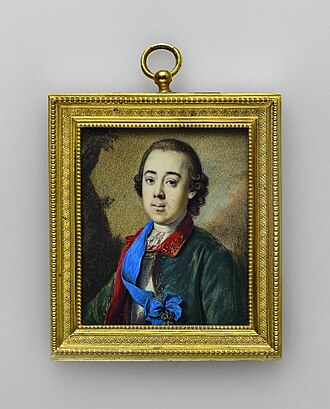
Portrait of Sergei Saltykov
The Most Handsome Man at Court
Catherine herself supplied the verdict. In her memoirs she described Count Sergei Vasilievich Saltykov as "the most handsome man at court" — and then documented, with the unsentimental precision she brought to everything, how thoroughly he had disappointed her. He was charming, beautiful, and almost entirely without depth. He seduced a grand duchess under her husband's nose, and when his usefulness expired, disappeared into minor diplomatic postings, fading from history as completely as a flame snuffed by the wind.
Saltykov entered Catherine's orbit around 1752 — she was married to the unstable Peter III, politically precarious, emotionally starved. He moved into that gap with the easy confidence of a man who has always been the most attractive person in any room. Their affair lasted two years. When Catherine gave birth to the future Paul I in 1754, the question of paternity became one of Russian history's enduring speculations — a question Saltykov, characteristically, neither confirmed nor clarified.
That's the ESTP signature: dominance of the present moment, a gift for reading and working the room, and a blind spot that stretches as far as tomorrow.
He was dispatched to Hamburg and Paris — the usual method of removing inconvenient courtiers — and spent the remainder of his career in comfortable irrelevance. He had been close to the woman who would become Catherine the Great, and used that proximity for nothing more than the pleasure of the moment. For an ESTP, that is less a tragedy than a definition.
Presence as Power
The dominant function of the ESTP is extroverted sensing — the ability to read and inhabit the immediate environment with exceptional precision. In mid-eighteenth-century Russian court life, where status was performed through clothing, posture, wit, and timing, Se was the entire game. Saltykov played it masterfully.
Catherine's memoirs are a first-person account of an ESTP at work. She describes how he contrived private conversations, managed logistics without arousing suspicion, read the moods of her household and adjusted. No long game, no strategic architecture — just tactical genius moment by moment. He moved through the court the way water finds the lowest path: not through calculation but through an almost physical sensitivity to the environment.
Saltykov offered presence — a man who was actually, fully there. For an isolated young woman in a hostile court, that was irresistible.
The Calculation Beneath the Charm
The ESTP's auxiliary function is introverted thinking — Ti — a cold analytical process beneath the social surface. In Saltykov's case it expressed as court-political analysis: he understood exactly what the affair meant in terms of risk and leverage, even if he lacked the Ni to see where it was going.
He knew Grand Duke Peter was unstable, making Catherine's long-term prospects better than her husband's. He knew Empress Elizabeth would not scrutinize an heir's paternity too closely. Ti read: upside enormous, downside manageable if he remained deniable — correct as far as it went. What Ti cannot supply is foresight into a future where Catherine rules alone and he is an afterthought.
How little the affair's end affected him speaks to this. Catherine moved on to other lovers, then to power. Saltykov moved to Hamburg. No resentment, no scene. The Ti registered the new reality and adapted.
The Charming Mask
Fe — extroverted feeling — is the ESTP's tertiary function: available but not deeply mature. In Saltykov's case it manifested as social fluency — mirroring a room's atmosphere, projecting warmth when useful. His Fe served Se and Ti; it did not lead them.
Catherine's memoirs describe him as attentive, witty, and considerate, but she gradually perceived the attention had limits. He was responsive to her moods without being interested in them — producing the emotional effect she wanted without the understanding she needed. That gap between performed warmth and genuine depth is the ESTP's signature in romantic contexts: excellent seducers, difficult long-term partners, not from malice but from a fundamental orientation toward the present.
The Blind Spot That Swallowed His Future
The ESTP's inferior function is Ni — introverted intuition, the capacity for long-range pattern recognition. Inferior Ni is the characteristic weakness: treating the moment as self-contained rather than as a link in a chain. Saltykov had access to one of the great trajectories of the eighteenth century, and he saw none of it.
He was intimate with Catherine as she was preparing to become Catherine the Great. The information he held — emotional, political, potentially biological — could have given him leverage in the regime that followed. An ENTJ would have been mapping the succession from day one. Saltykov was enjoying himself. When the moment passed, he had no vision, no plan B.
He fades from the record around 1760 — present at the beginning of something enormous, gone before it became anything at all.
Why ESTP Over ISTP
Why not ISTP?
An ISTP would have been less visible, less socially dominant, less hungry for the performance of charm. ISTPs lead with Ti — cool observers who engage when problems interest them, not seducers who construct atmospheres. Saltykov's entire strategy — the contrived encounters, reading the court, the orchestrated intimacy — requires Se as the primary driver. ISTPs don't work a room; they endure it.
His seduction of Catherine was a continuous improvisation across months of court life, responsive to every shift in the social weather — not a project executed in isolation. That kind of sustained, extroverted, physically present campaign is the ESTP's natural mode. The tragedy is that Se mastery of the present is not the same as wisdom about where the present is going.
Connected Figures
Further Reading
- Catherine the Great: Portrait of a Woman — Robert K. MassieThe fullest modern biography of Catherine; reconstructs the Saltykov affair from her own memoirs with careful attention to court politics.
- The Memoirs of Catherine the Great — Catherine II, ed. Monika GreenleafCatherine's own account, the primary source for the affair — written in her own words, decades later, with unsentimental precision.
- Catherine the Great and Potemkin: The Imperial Love Affair — Simon Sebag MontefioreCovers the full arc of Catherine's romantic life, with Saltykov as the first in a long sequence of consequential lovers.
