 Historical Figure MBTI
4 min read
#92 · 3-6-26 · The Founding Generation of USA
Aaron Burr
American politician, soldier, and third Vice President of the United States.
1756 — 1836
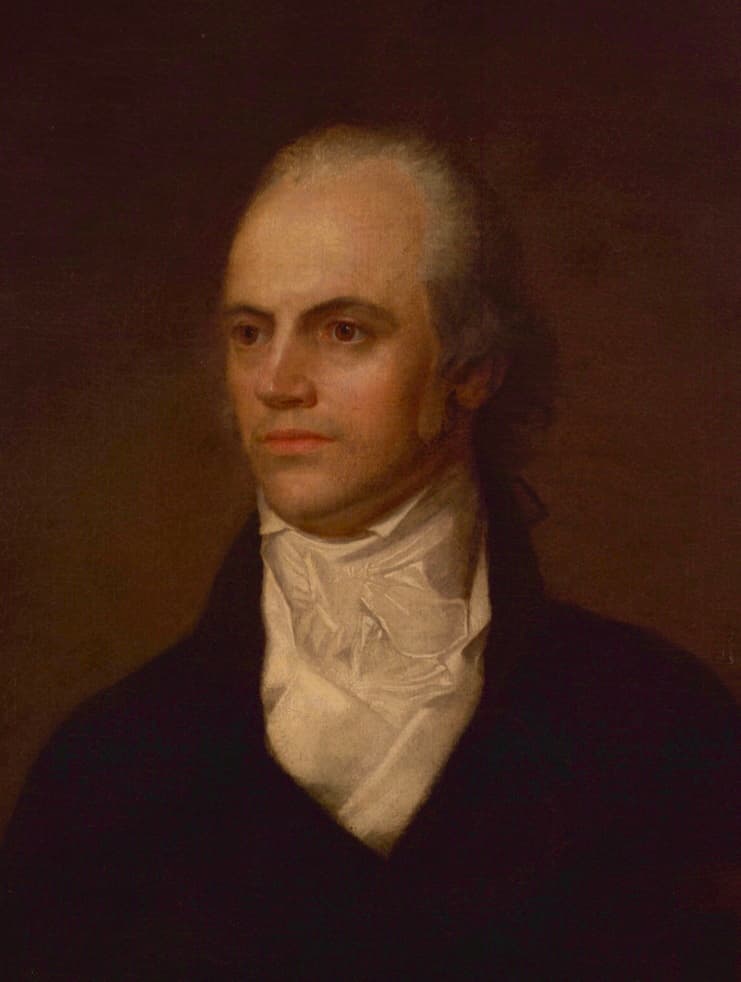
Portrait of Aaron Burr.
The Political Operator
Born in 1756 in Newark, New Jersey, Aaron Burr entered the world with a pedigree that suggested a future among the intellectual elite of the American colonies. His father was the president of the College of New Jersey (now Princeton University), and his maternal grandfather was the renowned theologian Jonathan Edwards.
Instead, he became something very different. From an early age Burr demonstrated a sharp instinct for action rather than abstraction. During the American Revolution he served as an officer in the Continental Army, where contemporaries noted both his personal courage and his composure under pressure. War introduced Burr to the world in which he would ultimately thrive: one defined by rapid decisions, shifting alliances, and the necessity of reading people quickly and accurately.
In the turbulent political environment of New York City, Burr distinguished himself not as an ideological theorist but as an extraordinarily effective political organizer. Rather than publishing political treatises or philosophical manifestos like Alexander Hamilton or Thomas Jefferson, Burr focused on the mechanics of politics itself: networks, persuasion, and real-world outcomes.
That's the ESTP signature: Se-driven political awareness paired with Ti analysis — reading rooms others barely noticed and acting before the opening closed.
Jefferson once complained that Burr seemed to have “no principle,” while Hamilton famously warned that Burr possessed ambition without a guiding ideology. Yet this criticism may reveal less about Burr's character than about the expectations of the men around him. Hamilton and Jefferson were political philosophers. Burr was something else entirely — a tactician.
Se — Dominant
Aaron Burr's life strongly reflects dominant Se.
Accounts from contemporaries consistently emphasize his personal presence, charm, and situational awareness. Burr excelled in environments that required rapid judgment, social intuition, and the ability to read the motivations of others in real time. Whether in military service during the Revolution, political organizing in New York, or high-level political negotiation, Burr demonstrated a capacity to act decisively within dynamic circumstances. His focus was not on abstract visions of what politics should be — it was on what could be accomplished in the moment.
Ti — Auxiliary
Supporting this action-oriented approach was strong auxiliary Ti.
Burr appears to have approached political situations analytically, evaluating alliances and opportunities with a detached, tactical mindset. Rather than committing to a rigid ideological doctrine, he assessed circumstances case by case and adjusted his strategy accordingly. This flexibility frustrated ideological figures like Hamilton and Jefferson, who believed political power should be anchored to philosophical principles. But Burr's reasoning seems to have been guided less by doctrine and more by practical internal logic.
Fe — Tertiary
Burr's social reputation reflects the influence of tertiary Fe.
He was widely described as charming, personable, and capable of winning people over in conversation. His ability to form alliances and build political networks relied heavily on interpersonal awareness and emotional intelligence. At the same time, Burr remained personally guarded, revealing little about his deeper motivations. His social warmth functioned as a political instrument rather than a window into his private beliefs.
Ni — Inferior
Compared with ideological contemporaries like Hamilton and Jefferson, Burr showed little interest in constructing long-range philosophical visions for the republic.
He rarely engaged in abstract political theorizing and left behind few writings outlining a coherent ideological framework. This relative absence of future-oriented ideological vision suggests inferior Ni. Where others sought to define the destiny of the nation, Burr preferred to navigate the unfolding present.
Connected Figures
Further Reading
- Burr: A Novel — Gore Vidal (1973)A historical novel that put Burr's voice at center stage — still one of the most penetrating portrayals of his tactical mind and cynical view of the Founders.
- A Fatal Friendship: Alexander Hamilton and Aaron Burr — Arnold A. Rogow (1998)Psychobiographical study of the rivalry that ended in the duel; draws on period correspondence to reconstruct both men's motivations.
- Aaron Burr: A Biography — Milton Lomask (1979–1982, 2 vols.)The most thorough scholarly biography, covering both the rise and the post-duel exile in meticulous detail.
- The Heartbreak of Aaron Burr — H. W. Brands (2012)A compact, readable account centered on Burr's relationship with his daughter Theodosia and the personal losses that shadowed his long exile.
