 Historical Figure MBTI
5 min read
#73 · 2-26-26 · The Founding Generation of USA
Alexander Hamilton
Financial Architect of the United States and Engineer of the Federal State
1755 — 1804
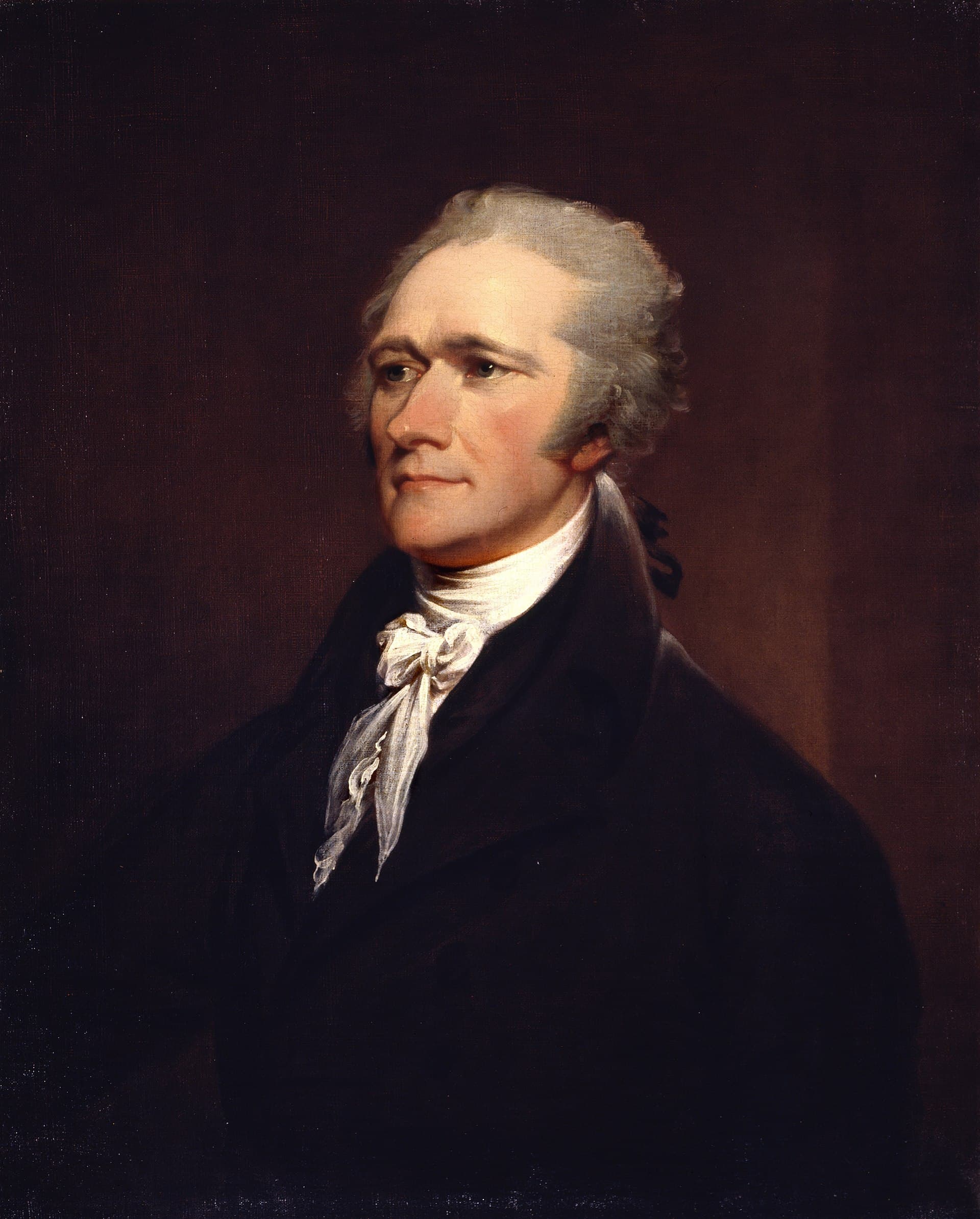
Portrait of Alexander Hamilton.
The Architect of the Republic
Born in the Caribbean island of Nevis around 1755, Alexander Hamilton entered the world with little of the privilege that defined many of his future peers. Orphaned in adolescence and raised in poverty, he rose through intellect, discipline, and ambition alone. By his early twenties he had already distinguished himself as a writer and revolutionary thinker, eventually attracting the attention of George Washington, who made him a trusted aide during the American Revolution.
Hamilton’s historical importance, however, lies less in wartime heroics than in what followed. As the first Secretary of the Treasury, he confronted a fragile republic drowning in debt and political uncertainty. His response was not incremental reform but systemic transformation. Through a series of sweeping financial plans, Hamilton created a functioning national credit system, established the foundations of federal taxation, and proposed the creation of a national bank.
These policies reshaped the trajectory of the United States. They turned a loose confederation of states into a financially credible nation capable of sustaining government, commerce, and international influence.
Hamilton’s productivity during this period was staggering. He authored the majority of the essays in the The Federalist Papers, wrote extensive Treasury reports that still read like modern policy blueprints, and dominated the intellectual battles surrounding the Constitution.
If the American founding was a moment of political imagination, Hamilton was among the few who attempted to turn that imagination into a functioning system.
The Psychological Verdict
Hamilton’s personality is sometimes interpreted as INTJ due to his strategic thinking and long-range vision. Yet the broader pattern of his life suggests a different cognitive orientation.
Hamilton was not a distant strategist working quietly behind the scenes. He was a public architect of institutions, an aggressive political debater, and a relentless executor of policy.
His cognition appears fundamentally oriented toward structuring the external world according to a strategic vision.
The most convincing interpretation is ENTJ.
Te — Dominant
Hamilton’s mind was fundamentally executive. His writings consistently focus on practical structures: taxation systems, credit markets, banking institutions, administrative authority.
Where many political thinkers debate ideals, Hamilton built mechanisms.
His Treasury reports did not simply describe economic theory; they outlined operational frameworks for how a nation should function. Each proposal connected to a broader system designed to stabilize the republic and expand its long-term capacity.
Hamilton approached politics not as philosophical speculation but as institutional engineering.
Ni — Auxiliary
Supporting this executive drive was a remarkably coherent long-term vision.
Hamilton believed the United States would eventually become a major commercial and geopolitical power. His financial system was designed not merely to solve immediate problems but to prepare the country for that future.
Industrial development, centralized fiscal authority, and strong executive governance were all components of this trajectory.
Where others saw a fragile republic, Hamilton saw the early stages of a powerful nation-state.
Se — Tertiary
Hamilton’s public life also revealed a comfort with confrontation and rapid engagement.
Contemporaries frequently described him as electrifying in conversation—quick, forceful, and relentless in debate. He participated enthusiastically in the pamphlet wars that defined early American politics and was rarely hesitant to challenge opponents directly.
This ability to act decisively in the immediate political arena suggests a tertiary relationship with Extraverted Sensing: a readiness to engage the unfolding moment when defending a strategic objective.
Fi — Inferior
Hamilton’s personal life reveals the more volatile side of his character.
His loyalty to close relationships, particularly to his wife Elizabeth Schuyler Hamilton and her sisters Angelica and Peggy, was genuine and deeply felt. Yet he also demonstrated moments of personal impulsivity that clashed with his public discipline.
The scandal involving Maria Reynolds illustrates this tension. When political rivals later accused him of financial corruption, Hamilton responded by publicly confessing the affair in the Reynolds Pamphlet in order to defend his professional integrity.
The decision protected his reputation for financial honesty but devastated his personal life—an example of inferior Fi erupting in defense of honor and principle.
Why not ENTP?
Hamilton’s intellectual brilliance and rhetorical energy can make him appear ENTP at first glance. He debated constantly, wrote prolifically, and displayed formidable verbal agility in political argument.
Yet the underlying pattern of his work reveals a more focused orientation.
ENTPs tend to explore possibilities across multiple directions, generating ideas and theories through open-ended discussion. Hamilton’s writing rarely functions this way. Instead, his arguments consistently move toward implementation: concrete policies, institutional frameworks, and structured solutions.
Hamilton did not treat ideas as intellectual play. He treated them as blueprints for governing reality.
That difference—between exploring possibilities and enforcing systems—is the clearest distinction between ENTP and ENTJ cognition.
The Founding Ecosystem
Hamilton played a different role compared to his peers:
- • George Washington provided stabilizing leadership and national legitimacy.
- • Thomas Jefferson articulated philosophical visions of republican liberty.
- • James Madison refined constitutional theory and institutional balance.
- • Alexander Hamilton was the builder—the figure who attempted to transform revolutionary ideals into durable structures.
Where others described what the republic should be, Hamilton focused on how it would actually function.
Connected Figures
Further Reading
- Alexander Hamilton — Ron ChernowThe definitive modern biography — sweeping, deeply researched, and the source for the musical.
- The Federalist Papers — Alexander Hamilton, James Madison, John JayHamilton wrote 51 of the 85 essays; the essential primary text for understanding his constitutional vision.
- Alexander Hamilton: A Biography — Forrest McDonaldA shorter, more skeptical scholarly biography that emphasizes Hamilton's economic thought.
- The Hamilton Affair — Elizabeth CobbsA historical novel that weaves together Hamilton's ambition, his marriage, and the Reynolds scandal.
