 Historical Figure MBTI
4 min read
#104 · 3-12-26 · The Founding Generation of USA
James Madison
Statesman, political theorist, and principal architect of the United States Constitution.
1751 — 1836
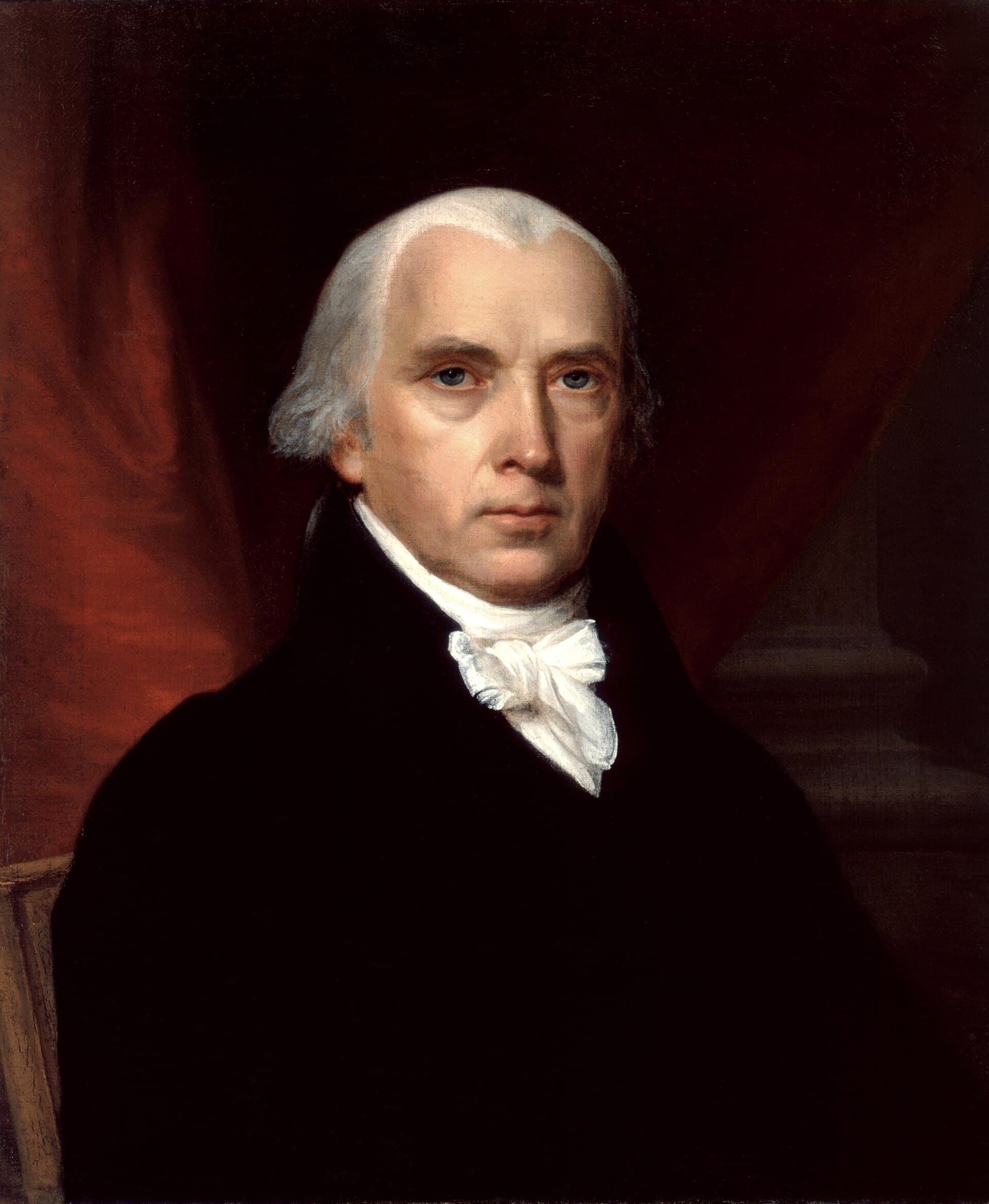
Portrait of James Madison.
The Quiet Architect
Born on March 16, 1751, in Orange County, Virginia, James Madison would become one of the most intellectually influential figures of the American founding. Though small in stature and soft in voice, his impact on the structure of American government was immense. Later generations would call him the “Father of the Constitution,” not because he commanded armies or dominated the political stage, but because he understood something deeper: how political systems work.
Madison's early life was shaped by education and intense study. He immersed himself in the works of Enlightenment thinkers and studied ancient republics, European confederacies, and the failures of past governments with obsessive interest. By the time the young United States began to falter under the weak structure of the Articles of Confederation, Madison had already spent years analyzing the structural flaws of republican governments.
At the Constitutional Convention, Madison arrived unusually prepared. His Virginia Plan laid the conceptual foundation for the Constitution itself. In the essays now known as The Federalist Papers, written with Alexander Hamilton, he articulated a theory that still shapes modern democratic thought: liberty must be protected not by trusting leaders to be virtuous, but by designing institutions that restrain power.
That's the INTP signature: Ti structural reasoning paired with Ne pattern-seeking — he didn't need the stage, he just needed the blueprint.
Madison would later serve as Secretary of State under Thomas Jefferson and become the fourth President of the United States. Yet his presidency remains secondary to his intellectual legacy. Madison's true achievement was architectural: the design of a political system capable of surviving the ambitions, conflicts, and factions of ordinary human life.
Ti — Dominant
Madison's thinking consistently centered on internal logical frameworks — reflecting dominant Ti.
His most famous writings read almost like theoretical models of political behavior. In Federalist No. 10, he analyzed factions as an inevitable consequence of human nature and explored how different constitutional structures would affect their behavior. Rather than appealing to patriotic emotion or moral ideals, Madison approached politics as a system to be understood and engineered logically. He wanted to know not simply what should happen, but how the underlying mechanics of government actually functioned.
Ne — Auxiliary
Madison's intellectual method relied heavily on comparison and possibility exploration — reflecting auxiliary Ne.
He studied ancient Greece, the Roman Republic, the Swiss confederation, and the Dutch Republic, constantly searching for patterns across different political systems. These historical comparisons allowed him to explore multiple constitutional arrangements and predict their likely outcomes. Madison's mind moved outward through examples and possibilities, testing different governmental structures against the realities of human behavior.
Si — Tertiary
Despite his theoretical orientation, Madison relied strongly on historical precedent — reflecting tertiary Si.
His political arguments often drew from detailed knowledge of past republics. Rather than inventing ideas in isolation, he examined how previous governments succeeded or failed and used that historical record to support his reasoning.
Fe — Inferior
Madison's weakest dimension appears in the realm of emotional influence and social dominance — reflecting inferior Fe.
Contemporaries frequently described him as reserved, soft-spoken, and physically unimposing. He lacked the theatrical presence of many of his peers. Figures such as Alexander Hamilton commanded attention through powerful rhetoric, while Madison preferred careful reasoning and written argument. He was capable of persuasion through logic and collaboration, but uncomfortable with dramatic emotional leadership.
Why INTP Over INTJ
Why not INTJ?
INTJ is a common typing for Madison because he helped design the American constitutional system. However, the cognitive style behind that design appears more theoretical than visionary. INTJs typically lead with singular strategic vision and decisive direction. Madison, by contrast, behaved more like a scholar of governance — constantly studying historical examples, debating alternative possibilities, and refining theoretical models. He also relied heavily on collaboration with other thinkers such as Jefferson and Hamilton, suggesting a more exploratory intellectual process than the focused Ni certainty typical of INTJs.
Connected Figures
Further Reading
- James Madison: A Biography — Ralph KetchamThe standard scholarly biography — comprehensive on Madison's intellectual formation and political career.
- The Quartet: Orchestrating the Second American Revolution, 1783–1789 — Joseph J. EllisFocuses on the four founders — including Madison — who engineered the Constitutional Convention.
- The Federalist Papers — Alexander Hamilton, James Madison, and John JayThe primary source: Madison's Federalist Nos. 10 and 51 are essential reading for understanding his political theory.
- James Madison and the Struggle for the Bill of Rights — Richard LabunskiA focused account of Madison's drive to attach a bill of rights to the Constitution he had designed.
- The Summer of 1787: The Men Who Invented the Constitution — David O. StewartA narrative account of the Constitutional Convention with Madison as its central intelligence.
