 Historical Figure MBTI
4 min read
#105 · 3-12-26 · The Founding Generation of USA
Dolley Madison
First Lady, political hostess, and social architect of the early American republic.
1768 — 1849
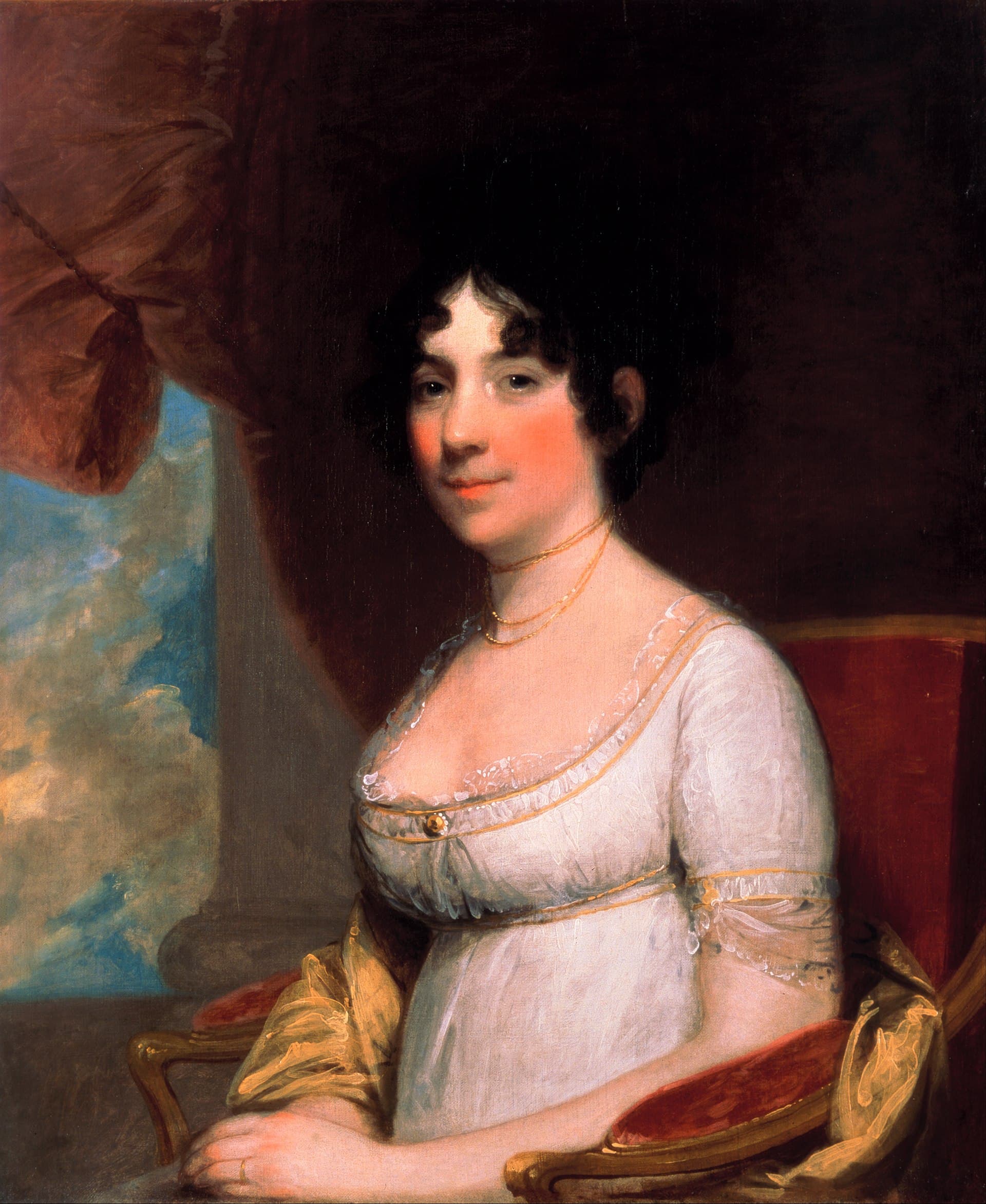
Portrait of Dolley Madison.
The Social Architect
Born Dolley Payne on May 20, 1768, in North Carolina, Dolley Madison would become one of the most influential social figures of the early United States. Though she never held formal office, her role in shaping the culture of Washington politics was profound. In an era when the institutions of the new republic were still fragile, Dolley helped create the human connections that allowed those institutions to function.
Raised in a Quaker family that later moved to Philadelphia, Dolley grew up in a community that valued kindness, hospitality, and social cohesion. Not long after her first husband died in the 1793 yellow fever epidemic, she met the reserved Virginia congressman James Madison. The two married in 1794, forming one of the most complementary partnerships in the founding generation. Where Madison was quiet, analytical, and absorbed in political theory, Dolley possessed an extraordinary ability to bring people together.
Her famous weekly gatherings — known as the “Wednesday squeezes” — brought together politicians, diplomats, journalists, and social elites across party lines. In these rooms, conversations happened that could not occur in Congress itself. Disputes softened, relationships formed, and the social fabric of the new capital began to take shape.
That's the ENFJ signature: Fe social intelligence paired with Ni vision — she didn't just host the conversation, she designed the room where history got made.
In many ways, Dolley Madison invented the modern role of the First Lady.
Fe — Dominant
Dolley Madison's defining trait was her remarkable social intelligence — reflecting dominant Fe.
Observers consistently noted that she had an uncanny ability to make people feel personally welcome and valued. She remembered names, families, and personal stories, often introducing guests in ways that fostered connection rather than competition. More importantly, she instinctively managed the emotional atmosphere of political gatherings — redirecting conversations or introducing humor to restore harmony. Her social presence created a rare neutral ground in a politically divided capital.
Ni — Auxiliary
Dolley's hosting was not merely spontaneous kindness. It had a larger purpose — reflecting auxiliary Ni.
She seemed to intuit that the success of the young republic depended not only on laws and institutions but on relationships among those who governed. By creating regular gatherings where rival factions interacted socially, she helped stabilize the political environment of Washington. This reflects Ni supporting Fe: an awareness of the long-term importance of social cohesion and the foresight to cultivate it deliberately.
Se — Tertiary
Dolley Madison also demonstrated a clear appreciation for presentation and atmosphere — reflecting tertiary Se.
Her distinctive turbans, elegant clothing, and lively gatherings contributed to the visual culture of early Washington society. She enjoyed the sensory energy of large social events and was comfortable at the center of attention. This confident engagement with the social environment reflects healthy Se working in service of her broader vision.
Ti — Inferior
Dolley was not known for theoretical argument or political philosophy — reflecting inferior Ti.
That domain belonged to her husband and to figures such as Alexander Hamilton or Thomas Jefferson. Yet she clearly understood the practical realities of politics through social experience. Her influence operated through emotional intelligence and relational awareness rather than through formal analysis.
Why ENFJ Over ESFJ
Why not ESFJ?
ESFJ is often proposed because Dolley was famously hospitable and community-oriented. However, ESFJ social behavior typically centers on maintaining traditions and fulfilling established social roles. Dolley Madison, by contrast, was creating a new political role that had not previously existed. The institution of the First Lady as national hostess — a figure who mediates social relationships within government — largely began with her. That level of role creation and social vision suggests Ni influence beyond the more tradition-anchored Si typical of ESFJ.
Connected Figures
Further Reading
- A Perfect Union: Dolley Madison and the Creation of the American Nation — Catherine AllgorThe definitive biography of how Dolley Madison built the social architecture of the early republic.
- Parlour Politics: In Which the Ladies of Washington Help Build a City and a Government — Catherine AllgorShows how Dolley's Wednesday gatherings functioned as real political machinery, not mere hospitality.
- Founding Mothers: The Women Who Raised Our Nation — Cokie RobertsSituates Dolley among the founding-era women whose influence rarely appeared in official records.
- Revolutionary Backlash: Women and Politics in the Early American Republic — Rosemarie ZagarriExplains the political culture Dolley navigated as a woman wielding real influence without formal office.
