 Historical Figure MBTI
#429 · 4-9-26 · The Mali Empire
Abu Bakr II
Mansa of Mali · The King Who Sailed into the Atlantic
fl. early 1300s
9 min read
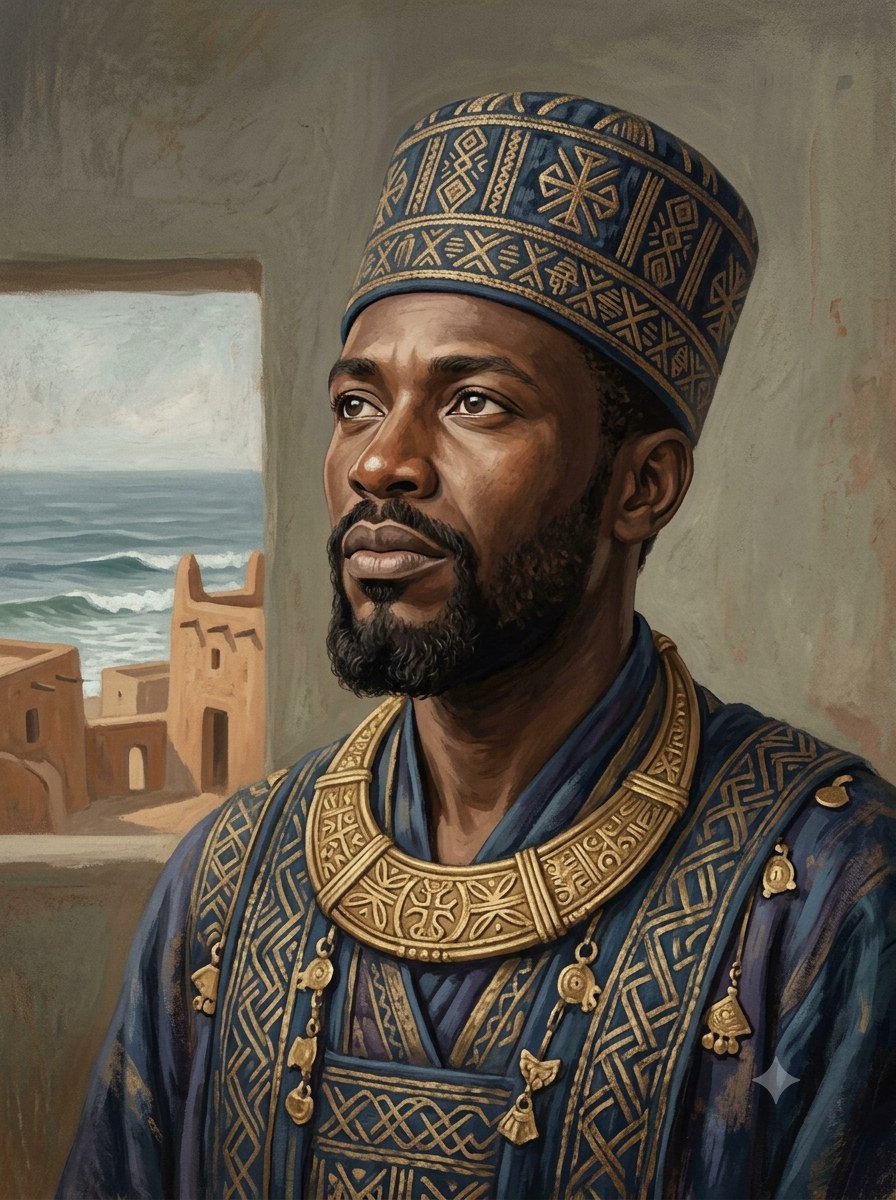
AI-assisted Portrait of Abu Bakr II
The King Who Gave Up an Empire to Find the Edge of the World
We know almost nothing about Abu Bakr II. He ruled the Mali Empire at the height of its wealth and power, sometime in the early fourteenth century, and he was the predecessor of Mansa Musa, the richest man in recorded history. Yet no monument, no chronicle of his reign, and no portrait survives. He exists for us through a single story—and it is one of the strangest stories any ruler has ever told about a predecessor.
The story comes secondhand, from Musa himself. In 1324, passing through Cairo on his pilgrimage to Mecca, Musa was asked how he had come to the throne. He answered that the king before him had refused to believe the surrounding ocean had no end. That king fitted out two hundred ships, filled them with men and provisions enough for years, and sent them west to find the ocean's far shore. Only one vessel returned. Its captain reported a current in the open sea “like a river,” a violent flow that swallowed the rest of the fleet. The king was not deterred. He fitted out a second expedition—far larger, two thousand ships by Musa's account—and this time he sailed at its head. He appointed Musa as his deputy, sailed into the Atlantic, and was never seen again. The Egyptian scholar al-Umari wrote it all down, and that single passage is essentially everything posterity has of the man.
We should be honest about what that means. Abu Bakr II is less a documented reign than a single luminous anecdote, told by the man who inherited his throne. But if we take the anecdote on its own terms—as the portrait Musa chose to paint—it describes a very particular kind of mind: one that could not accept a limit it had been told was real, and would stake an empire on the chance of seeing what lay past it.
That is the ENFP in its rawest form—dominant possibility-seeking yoked to private conviction, a wonder so total it outweighs a throne. Abu Bakr did not merely dream of what lay beyond the horizon. He pointed his ships at it and went.
The Refusal to Accept the Horizon
Ne — dominant
Dominant extraverted intuition is a hunger for what might be there. It looks at any edge and asks what lies past it; it treats a stated limit not as a fact but as a provocation. The single trait the story attributes to Abu Bakr is exactly this. He was told the ocean had no far shore—and he refused to believe it. The unknown did not frighten him; it magnetized him. Where another ruler would have heard “the sea is endless” and turned inland, Abu Bakr heard a question that demanded an answer.
What separates dominant Ne from idle daydreaming is that the possibility is generative—it produces action in the outer world. The first returning captain's report would have ended most schemes. A river in the sea, a current that drowned a fleet: that is precisely the kind of evidence that confirms a limit is real. To dominant Ne, it did the opposite. The danger meant something extraordinary was out there, something worth the cost of finding. So the king did not scale the plan down. He scaled it up—ten times larger—and, unwilling to delegate the most interesting question of his life, put himself aboard.
This is the dreamer at imperial scale: a man with the resources of the wealthiest realm on earth, spending them not on conquest or monument but on a possibility. The voyage answered no strategic need. Mali had gold, salt, and a continent at its back; it gained nothing material from the Atlantic. The expedition existed only because Abu Bakr could not bear not to know. That is Ne in its purest expression—curiosity as a force strong enough to move two thousand ships.
The Private Conviction That Outweighed a Crown
Fi — auxiliary
Ne supplies the pull of the unknown, but pull alone does not make a king abdicate. What turned curiosity into renunciation was auxiliary introverted feeling—the deeply personal conviction that some quests matter more than anything practical weighed against them. Fi does not justify itself by external logic. It knows what it values, privately and absolutely, and it will pay almost any price to be true to that value. Abu Bakr's price was the throne itself.
Consider the sheer asymmetry of the choice. He held the most powerful position in West Africa. Every external incentive—duty, security, dynasty, common sense—argued for staying. He could have funded a third expedition and watched from shore, as he had the first. Instead he handed the empire to a deputy and climbed aboard, choosing a private obsession over public power. That is the Fi pattern at its most extreme: the inner conviction is so authoritative that the grandest external rewards simply do not register against it.
It is worth saying plainly that we cannot read his heart; the story gives us an act, not a confession. But the act is the kind of evidence Fi leaves. A purely strategic mind does not trade an empire for a horizon. Only someone answering to a private compass—a personal certainty about what his one life was for—sails west knowing he may never return, and counts the throne a fair thing to leave behind.
The Logistics of a Dream
Te — tertiary
A vision is not a voyage. Someone had to provision hundreds, then thousands, of ships—crews, water, food, gold for trade, the timber and shipwrights to build the fleet in the first place. That organizing capacity is tertiary extraverted thinking: the ENFP's ability, when a dream becomes urgent enough, to marshal real resources and impose order on them. In Abu Bakr it served the dream rather than ruling it—Te as the engine room beneath Ne's and Fi's command.
The scaling between the two voyages shows a mind that did learn from the world even as it refused the world's conclusion. The first fleet failed; the second was an order of magnitude larger. That is a Te response—more ships, more provisions, more redundancy—applied in service of a goal that Te, left to itself, would never have chosen. Tertiary functions tend to work like this: competent, even impressive, but harnessed to the aims of the dominant pair rather than setting the agenda.
And tertiary Te has a characteristic blind spot. It can build the apparatus to pursue an aim without ever subjecting the aim itself to cold cost-benefit scrutiny. A dominant-Te ruler would have asked what the empire stood to gain and, finding nothing, stayed home. Abu Bakr asked instead how to get there, and answered the question brilliantly—then sailed his whole project off the edge of the record.
The Settled World He Could Not Stay In
Si — inferior
Inferior introverted sensing is the function that anchors a person to the known, the established, the safely continuous—and in the ENFP it is the weakest seat in the stack. Si is the voice of precedent and consolidation: tend what you have, secure the succession, govern the realm your fathers built. It is everything Abu Bakr's story shows him overriding. He had inherited a stable, fabulously rich empire, the very picture of an Si achievement—and he left it to chase the one thing that offered no security at all.
When inferior Si surfaces in an ENFP, it tends to appear as a late, almost grudging gesture toward order—a will written, a deputy named, the house put in some kind of sequence before the dreamer bolts. We can see exactly that in the single administrative act the story records: he appointed Musa to rule in his absence. It is a flicker of the inferior function doing its duty—a man arranging continuity for a kingdom he has already, in his heart, sailed away from.
That appointment is also the hinge of everything that followed. Because Abu Bakr made his provision before vanishing, the throne passed cleanly to Musa rather than collapsing into a succession crisis. The dreamer's one concession to settled order is the reason the empire survived his disappearance—and the reason there was a Mansa Musa at all.
Why ENFP Over INFP
Why not INFP?
The INFP shares Abu Bakr's wonder and his private conviction, but turns them inward. An INFP imagines the far shore, writes about it, longs for it—and rarely commissions a fleet. Abu Bakr did the opposite of inward: he externalized his wonder at imperial scale, building and launching expeditions, then climbing aboard the second himself. That is dominant extraverted intuition acting on the world, not introverted feeling contemplating it. The INFP dreams of the ocean; the ENFP sails into it.
The order of the functions is the whole argument. In Abu Bakr's story, the possibility-seeking comes first and reaches outward—ships built, sailors hired, horizons pursued in the physical world—with the private conviction in support of it. That is Ne-dominant, Fi-auxiliary: the extravert who acts on his wonder. Reverse the pair, and you get the INFP, for whom the inner idealism leads and the world is engaged reluctantly. Abu Bakr engaged the world with two thousand ships. Whatever else the legend leaves uncertain, it does not leave that in doubt.
Connected Figures
Further Reading
- Corpus of Early Arabic Sources for West African History — N. Levtzion & J. F. P. Hopkins (eds.)Contains al-Umari's account — the single primary source in which Abu Bakr's Atlantic voyage is recorded, via Mansa Musa's own telling in Cairo.
- African Dominion: A New History of Empire in Early and Medieval West Africa — Michael A. GomezThe leading modern scholarly history of Mali; sets Abu Bakr and Musa in the political world of the fourteenth-century Sahel and weighs the voyage soberly.
- UNESCO General History of Africa, Vol. IV — D. T. Niane (ed.)The standard reference survey of medieval Africa, with the Mali Empire and its mansas treated in continental context.
