 Historical Figure MBTI
#428 · 4-9-26 · The Mali Empire
Sundiata Keita
Founder of the Mali Empire · The Lion King
c. 1217 — c. 1255
9 min read
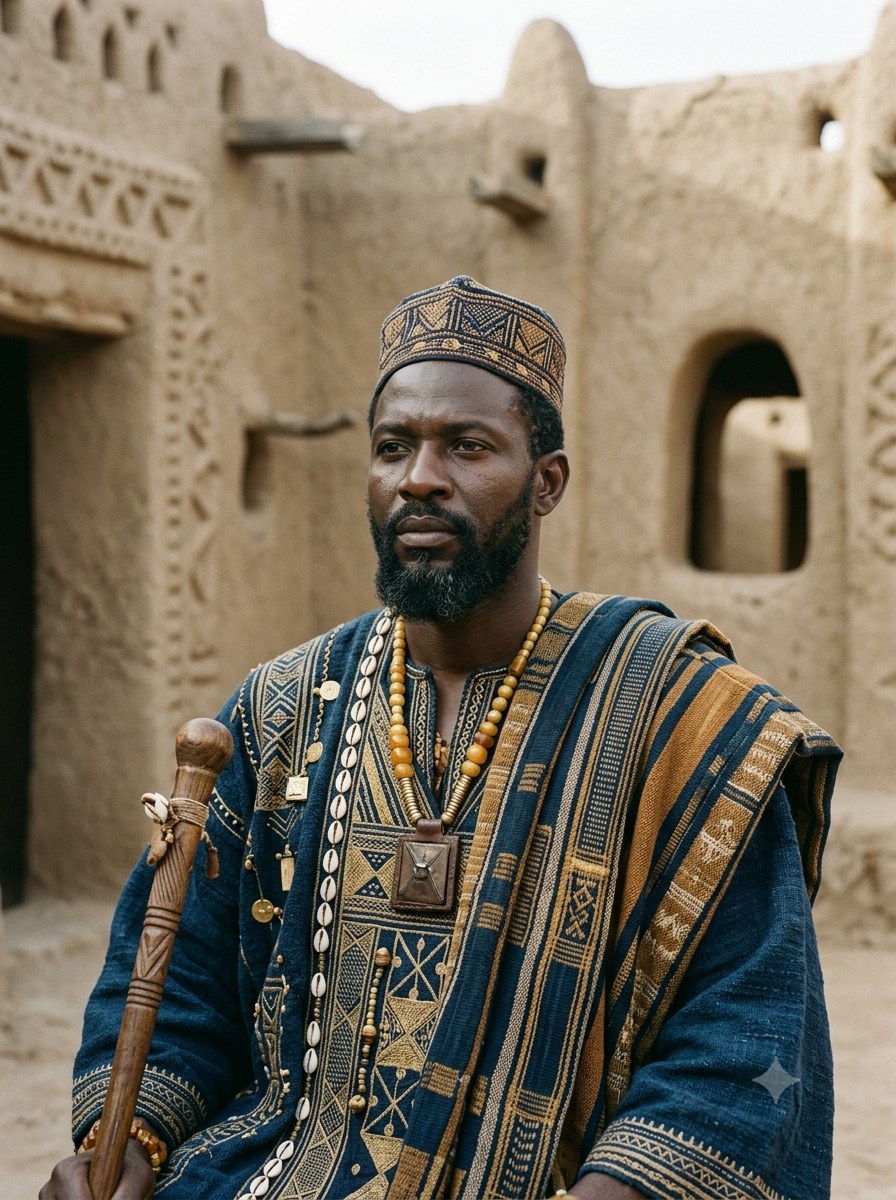
AI-assisted Portrait of Sundiata Keita
The Boy Who Could Not Walk
The story begins with a humiliation. According to the oral Epic of Sundiata—the founding legend of the Mali Empire, carried for seven centuries by the West African bards called griots—the future king was a disabled child who could not stand, dragging himself across the ground while the court mocked him and rival wives schemed to ensure he never ruled. Then, in the epic's pivotal scene, the boy seizes an iron rod, bends it into a bow under his own weight, and rises to his feet. From that moment Sundiata Keita becomes the “Lion King” (Sun-Jata, “the lion's thief” or “the hungering lion”): the exiled prince who would return to forge an empire out of conquered clans.
History and legend are braided together here, and honesty requires admitting it. Almost everything we know about Sundiata comes from oral tradition first written down centuries after his death, supplemented by the fourteenth-century Arab historian Ibn Khaldun, who names Mari Djata as the king who broke the power of the Soso and founded Mali. What is not in doubt is the outcome: around 1235 a coalition of Mandinka clans under his leadership shattered the tyrannical sorcerer-king Soumaoro Kanté of Sosso at the Battle of Kirina, and from that victory rose the largest and richest empire West Africa had ever seen—an empire that would still be standing, ruled by his heirs, when his descendant Mansa Musa made his gold-scattering pilgrimage to Mecca a century later.
Strip the magic from the epic and a recognizable kind of person remains: the organizer-conqueror who does not merely win battles but builds the machinery of a state designed to outlast him. Sundiata is the ENTJ as empire-founder—the commander who sees the long arc, assembles the coalition, wins the decisive field, and then, crucially, writes the constitution.
That is the ENTJ signature: dominant Te marshaling armies and offices and clans into a working order, fused with the Ni vision of a structure built to endure—a king who cared less about the battle than about the empire the battle made possible.
The Architect of an Empire
Te — dominant
Dominant Te is the drive to impose order on the external world—to take a chaos of people, resources, and territory and organize it into a system that produces results. Sundiata's entire career is a study in it. When he returned from exile, the Mandinka lands were a scatter of feuding clans crushed under Soumaoro's heel. He did not rally them with mysticism or charisma alone; he built an alliance—negotiating with clan after clan, absorbing defectors from the enemy, and assembling a cavalry-backed army capable of meeting Soumaoro in open battle. The coalition that won Kirina was an engineering achievement before it was a military one.
But the decisive Te act came after the victory, not during it. A battlefield conqueror takes the spoils and goes home; Sundiata convened the assembly traditionally remembered as the Gbara at Kurukan Fuga and promulgated what the tradition calls the Manden Charter—an oral constitution that defined the empire's constituent clans, fixed the great offices of state, set out social ranks and the relations between them, and laid down rules touching everything from the treatment of captives to the protection of women and the environment. He distributed hereditary roles: certain lineages would furnish the bards, others the smiths, others the soldiers, others the kings. This is Te at its most far-reaching—not a single ruler's decree but a durable institutional architecture, a framework that could run without him.
That is why Mali survived. Empires built on one strongman's force tend to die with him; Sundiata's lasted for three centuries because he externalized his authority into offices and law rather than hoarding it in his own person. The mansa's court, the provincial governors, the army's structure, the trade routes in gold and salt that later made Mansa Musa the richest man in the world—the scaffolding for all of it was laid by the founder who understood that conquest is the easy half, and that the hard, lasting work is administration.
The Long Vision
Ni — auxiliary
Auxiliary Ni gives Te its direction. Where pure Te can build relentlessly without knowing what for, Ni supplies the singular vision of where it is all going—the ability to see, behind present chaos, the shape of the future state. Sundiata's exile years are the Ni years. Driven out as a boy, he spent his formative time wandering among foreign courts, and the tradition presents this not as aimless flight but as gestation: the prince in waiting, watching, learning the politics of the region, biding his time until the moment to return was right. He grasped that Soumaoro's tyranny was creating its own enemies, and that those scattered grievances could be gathered into a single force aimed at a single point.
Kirina itself is remembered as a battle won by strategic insight as much as arms. In the epic, Soumaoro is invulnerable until Sundiata divines the secret of his power and the one thing that can break it—an arrow tipped with a white cockerel's spur. Stripped of its sorcery, the story encodes a real cognitive pattern: the leader who wins not by superior force but by perceiving the hidden weakness in an apparently unbeatable system, and striking precisely there. That is Ni—pattern-recognition that reaches past the surface to the load-bearing flaw.
Most of all, Ni is visible in what Sundiata chose to build. The Manden Charter is not the work of a man thinking about next season; it is the work of a man thinking about the next three hundred years. To design an order intended to govern peoples not yet born, to fix roles and laws meant to bind a society long after its author is dust—this requires seeing the empire not as it was in 1235 but as it could become. Te laid the bricks; Ni drew the plan for a cathedral the founder knew he would never see completed.
The Lion on the Field
Se — tertiary
For all his architect's mind, Sundiata is remembered first as a warrior—the Lion King who could bend iron and lead a charge. Tertiary Se is the capacity for decisive physical action in the moment, the willingness to meet the world head-on with force, and in the founder it provides the muscle that Te and Ni direct. The whole arc of his legend turns on bodily transformation: the crippled boy who rises, grows into a hunter and soldier of legendary strength, and personally commands the cavalry at Kirina. The vision and the administration would have meant nothing without a man able and willing to win on the actual battlefield.
As the tertiary function, Se serves the dominant rather than ruling it. Sundiata was not a thrill-seeker who lived for the fight; he fought because the fight was the gate to the empire. The boldness was instrumental, harnessed to the long plan. This is exactly the balance that distinguishes the empire-builder from the warlord—the Se gives him the physical command and battlefield presence to take power, but it never runs the show. The charge at Kirina was a means; the charter at Kurukan Fuga was the end.
The Wound and the Code
Fi — inferior
Inferior Fi is the ENTJ's most private and least developed dimension—the buried wellspring of personal conviction and feeling that a Te-dominant figure tends to hold at arm's length, expressing it through action rather than introspection. In Sundiata the wound runs underneath everything: the mocked child, the exile, the years of being told he was unfit. The epic dwells on the humiliation precisely because it is the source of the man—the slow-burning resolve of someone who was counted out and means to prove the world wrong. That is inferior Fi speaking through Te's preferred language: not a confession of hurt, but an empire built as the answer to it.
Where the inferior function reaches toward something larger than grievance is in the Manden Charter's moral content. The tradition credits Sundiata's order with principles that sound startlingly humane for any era—injunctions on the dignity of the person, the treatment of captives, the protection of the vulnerable. For a Te-dominant conqueror, encoding a sense of justice into the very structure of the state is how inferior Fi finds its highest expression: values made durable not by being felt and spoken, but by being institutionalized. He could not always say what he believed in. He could legislate it—and so make it outlast him.
Why ENTJ Over ESTP
Why not ESTP?
The Lion King is an obvious candidate for ESTP—the bold, physical, fearless warrior who bends iron and wins the field is exactly the ESTP's natural register. But the ESTP lives in the decisive present; its genius is improvisation, the brilliant read of the immediate situation, not the construction of permanent systems. Sundiata is defined by the opposite habit. His signal achievement was not Kirina but Kurukan Fuga — an oral constitution engineered to govern for centuries, the long-game work of Te-Ni, not the live-wire tactics of Se-dominance. A pure tactician fights and moves on; Sundiata fought in order to legislate.
The distinction is between the warlord and the empire-founder, and it is a distinction of time horizon. An ESTP of Sundiata's gifts would have been a magnificent battlefield commander—and would likely have left a kingdom that dissolved at his death, as so many conqueror-states do. What sets Sundiata apart, and what marks the ENTJ, is that the battle was never the point. The point was the structure the battle made possible: the clans assigned their roles, the offices fixed, the law written down, the whole apparatus designed to run without him. He was a builder who happened to fight, not a fighter who happened to win. That orientation toward the durable order—Te organizing the world, Ni aiming it at the long future—is the ENTJ verdict in a sentence.
Connected Figures
Further Reading
- Sundiata: An Epic of Old Mali — D. T. NianeThe classic prose rendering of the griot Mamadou Kouyaté's recitation — the essential gateway to the legend itself.
- African Dominion: A New History of Empire in Early and Medieval West Africa — Michael A. GomezThe major modern scholarly history of Mali and its neighbors — rigorous on what can and cannot be reconstructed about Sundiata.
- Ancient Ghana and Mali — Nehemia LevtzionA foundational study drawing on the Arabic sources, including Ibn Khaldun, that anchor the empire in documented history.
