 Historical Figure MBTI
#427 · 4-9-26 · The Mali Empire
Mansa Musa
Emperor of Mali · The Richest Man Who Ever Lived
c. 1280 — c. 1337
11 min read
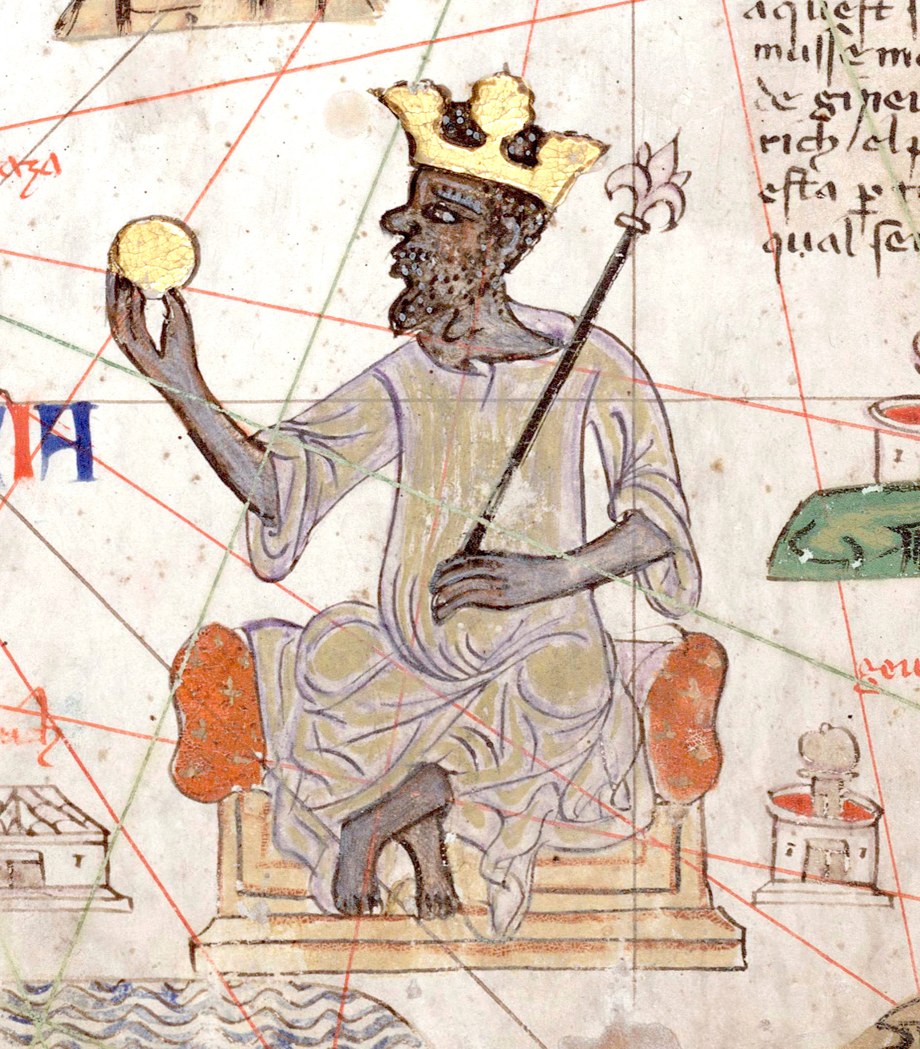
Portrait of Mansa Musa
The Man Who Spent So Much He Broke the Market
In the spring of 1324 a caravan crossed the Sahara from the south and entered Cairo, and the city had never seen anything like it. By the chroniclers' reckoning it ran to tens of thousands of people—courtiers, soldiers, servants, slaves—with five hundred outriders said to bear staffs of gold and a baggage train of camels loaded with the metal. At its center, mounted and robed, rode the emperor of Mali, mansa Musa, on pilgrimage to Mecca. He stayed three months in Egypt, and in those three months he gave away and spent so much gold—to officials, to the poor, to anyone who came near the imperial camp—that he flooded the Cairo market and sent the price of gold into a slump it would not recover from for more than a decade. A single man, passing through, had moved the economy of the Mediterranean world.
The ruler who did this was almost certainly the wealthiest individual who has ever lived, though the sum is finally unmeasurable; his fortune flowed from Mali's near-monopoly on the West African gold that the medieval world ran on. But to read him as merely rich is to miss what he was. Musa reigned over Mali for roughly a quarter-century, from about 1312 to 1337, and he governed an empire that stretched across the western Sudan—from the Atlantic to the great bend of the Niger, taking in Walata, Gao, and Timbuktu. A devout Muslim, he ruled the way he gave: through magnificence, piety, and a generosity so overwhelming it functioned as a kind of statecraft. The hajj was not a private act of devotion. It was the moment a sub-Saharan kingdom announced itself to the entire known world—and the announcement landed.
Musa is the ENFJ on the scale of empire: a ruler who bound a civilization to himself through warmth, faith, and staggering largesse, and who understood—before anyone else in his world—that gold spent in the right place, in front of the right audience, was worth far more than gold kept.
What he built with that instinct outlasted him by centuries. He turned Timbuktu from a trading post into a beacon of Islamic learning, raised mosques that still stand in mud-brick form, and left an image of African wealth so vivid that European mapmakers were still drawing it fifty years after his death.
Rule by Generosity
Fe — dominant
Dominant Fe governs through the bond it creates between a leader and the people who follow him. It reads a room, a crowd, a court, and it asks what will move them—what gesture will make them feel seen, included, indebted, devoted. Musa wielded this on the scale of an empire and across a continent. The gold he scattered through Cairo and along the pilgrim roads of the Hejaz was not carelessness; it was the dominant function doing what it does, converting wealth into goodwill, awe, and reputation. He bound merchants, scholars, and rulers to him by giving until they could not forget him, and the legend that traveled back across the desert ahead of his caravan was itself the product. An Fe sovereign understands that loyalty is something you cultivate, and Musa cultivated it lavishly.
That same instinct shaped how he ruled at home. He did not project Mali as his personal possession but as a single Islamic-imperial community, held together by a shared faith he actively promoted and a prosperity he visibly distributed. He patronized religion and learning the way another ruler might fund an army—because a community of believers and scholars was a community knit to the throne. He built mosques, endowed the institutions that became the Sankore learning complex at Timbuktu, and welcomed jurists and architects into his orbit, drawing the prestige of the wider Muslim world toward Mali and his own person at its head. Leadership, for Musa, was magnificence performed in public and felt personally.
The danger of dominant Fe is that the performance can outrun the purse, and Musa is the textbook case. He spent so freely on the hajj that, by some accounts, he had to borrow at ruinous rates from Cairo merchants for the return journey—the generosity overshooting the resources behind it. But even that overreach is revealing. The point of the gold was never the gold. It was the impression the gold made, the bond it forged, the story it wrote. He valued the relationship and the reputation above the treasure, which is the clearest possible signature of a feeling function at the wheel.
For Musa, gold was a language, and he spoke it more fluently than any ruler of his age—every nugget given away was a sentence addressed to the watching world, binding its hearers to Mali and to him.
The Empire as a Statement
Ni — auxiliary
Auxiliary Ni gives the ENFJ's warmth a direction—a long horizon, a singular vision of what all this generosity is for. Without it Musa would have been merely a spendthrift king with a taste for display. With it, the spending became strategy. The hajj of 1324 was not only an act of piety and not only a gold-giving spree; it was a civilizational statement, calculated to place Mali permanently on the mental map of the Islamic and Mediterranean worlds. Musa grasped that a single, overwhelming gesture, made at the center of the Muslim world and witnessed by everyone who mattered, would do what decades of ordinary diplomacy could not. He was projecting Mali onto a stage it had never stood on—and he was right about the effect.
Timbuktu is the same foresight built in stone. Musa did not merely capture the city; he saw what it could become and willed it into being—a node where trans-Saharan trade and Islamic scholarship would meet and compound. He invested in it as an idea of the future, importing scholars and books, funding the institutions that would draw students from across the Sudan for generations. The mosque commissions belong to the same vision: they were not just places to pray but durable declarations that Mali was a seat of Islamic civilization, meant to be read as such for centuries. Ni works in symbols and long arcs, and Musa thought in both.
The proof of the vision is that it survived its author so completely. The Catalan Atlas of 1375—drawn in Majorca, half a century after Musa's death and a continent away—depicts him enthroned in the western Sudan, crowned, holding aloft a great nugget of gold. A Catalan cartographer who had never crossed the Sahara had absorbed, as established fact, the image Musa engineered in Cairo in 1324. That is auxiliary Ni's triumph: he saw the picture before it existed, and then he made the world see it too.
The Theatre of Splendor
Se — tertiary
Tertiary Se gives the visionary an eye for the concrete and the spectacular—a sense that a thing must be seen, in the flesh and in the world, to land. Musa's grand statements were never abstract; they were sensory events staged at scale. The caravan was pure Se: the gold loaded on camels, the robed riders, the sheer physical mass of it moving across the desert and into the streets of Cairo. He understood that splendor only persuades when it can be touched and counted, and so he made his power tangible—the metal itself, handed across, weighed in the palm. The reason the price of gold actually moved is that the generosity was not symbolic but material, real bullion entering a real market in overwhelming volume.
The same appetite for the concrete shows in how he built. He did not commission a civilization in the abstract; he came home with an architect. On the return from his pilgrimage Musa brought back Abu Ishaq al-Sahili, the Andalusian poet and builder credited with the Djinguereber Mosque at Timbuktu and other works—a man who could turn vision into walls, courtyards, and minarets you could walk through. Se wants the idea made physical, and Musa repeatedly reached for the people and materials that would make it so. His reign is a record of grand designs translated into stone, mud-brick, and the visible furniture of empire.
The Blind Spot in the Ledger
Ti — inferior
Inferior Ti is the ENFJ's weak point: the cold, impersonal logic of systems, costs, and consequences, the part of the mind that asks not “what will this do for the bond?” but “does this actually add up?” In a leader governed by warmth and vision, it is the function most likely to be overruled—and Musa overruled it spectacularly. The hajj that won him the world also, by the chroniclers' accounts, drained him: he gave and spent past the point of prudence, depressed an entire region's gold price to his own long-term disadvantage, and reportedly had to borrow heavily to get home. A more analytical sovereign would have metered the generosity, calculated the market effect, and kept reserves in hand. Musa, moved by the gesture and the impression it would make, did not stop to run the numbers.
This is not a flaw layered onto his greatness so much as its inseparable shadow. The very feeling-and-vision engine that produced the legend was the engine that ignored the ledger. When inferior Ti does surface in such a person, it tends to arrive late and under pressure—the reckoning with cost coming only after the grand gesture is already made. Musa's genius was never systematic efficiency; it was the ability to make people and nations feel something and remember it forever. He paid, in literal gold, for the privilege—and counted it a price worth paying.
Why ENFJ Over ESFJ or ENTJ
Why not ESFJ?
The ESFJ shares Musa's warmth, his communal instinct, and his concern with how he is seen—but it leads with concrete tradition and present duty rather than a long visionary arc. An ESFJ emperor would have governed devoutly and generously within the inherited forms of his court. Musa did something larger: his generosity served a grand design—putting Mali on the map of the world, building Timbuktu into a center of civilization for generations to come. That future-facing projection is auxiliary Ni, not the ESFJ's grounding in established custom.
Why not ENTJ?
The ENTJ—the type of the empire's founder, Sundiata Keita—commands through cold strategy, hierarchy, and the impersonal logic of power. Musa ruled by warmth instead: through faith actively shared, a community knit to his person, and a largesse that bound people to him emotionally rather than by force or calculation. His decisive feeling function is extraverted, not the suppressed inferior Fi of a Te commander. He did not conquer his subjects into loyalty; he gave and believed them into it.
The distinction is one of motive. A Te-led ruler organizes the world to achieve an end; an Fe-led ruler organizes people to share one. Musa's whole reign—the gold given away, the faith promoted, the scholars welcomed, the mosques raised—was an exercise in creating a shared identity and binding a civilization to it, with himself as its radiant center. The vision was vast and the foresight real, but the engine underneath was always the bond between the leader and the led. That is the ENFJ at the scale of empire.
Connected Figures
Further Reading
- Sundiata: An Epic of Old Mali — D. T. NianeThe classic retelling of the Mande founding epic — essential background to the empire Musa inherited and the oral tradition that preserved it.
- Ancient Ghana and Mali — Nehemia LevtzionThe standard scholarly history of the medieval West African empires; authoritative on Musa's reign, his hajj, and the structure of the Mali state.
- African Dominion: A New History of Empire in Early and Medieval West Africa — Michael A. GomezA major modern reinterpretation that places Mali and Musa within the long arc of Sahelian statecraft and Islamic political culture.
- Corpus of Early Arabic Sources for West African History — Nehemia Levtzion & J. F. P. HopkinsThe indispensable collection of the medieval Arabic accounts — including the Cairo chroniclers who recorded the hajj and its effect on the gold price.
