 Historical Figure MBTI
#430 · 4-9-26 · The Mali Empire
Abu Ishaq al-Sahili
Andalusi Poet & Architect · Builder of Timbuktu's Mosque
c. 1290 — 1346
7 min read
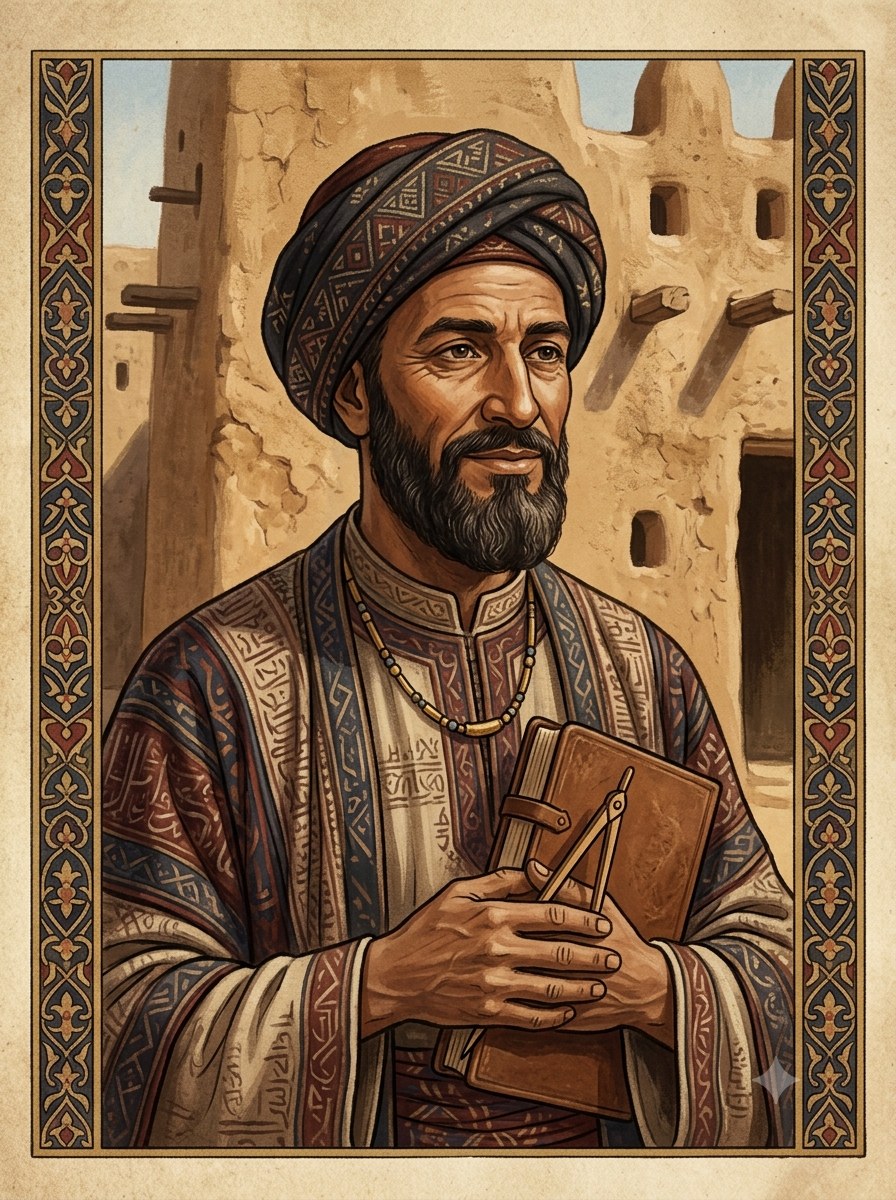
AI-assisted Portrait of Abu Ishaq al-Sahili
The Artist Who Crossed the Sahara
He was a poet from Granada who ended his life in a mud-brick city on the edge of the desert, an emperor's favorite, the man traditionally credited with raising the most famous mosque in West Africa. Abu Ishaq Ibrahim al-Sahili—born in al-Andalus around 1290, dead in Timbuktu in 1346—is one of the strangest and most appealing minor figures of the fourteenth century: a cultured Andalusi aesthete who met Mansa Musa on the pilgrimage roads of Arabia and chose to follow him home across the Sahara, trading the gardens of Spain for a new life under an African sun.
What he carried with him was not an army or a treasury but a sensibility—an eye for form, a poet's feeling for beauty, and a craftsman's hands. He found patronage at Musa's court and settled in Timbuktu, where the chroniclers say he designed a royal audience hall and the Djinguereber Mosque, and where later tradition made him a father of the sculptural mud-brick style that still defines the Sudano-Sahelian skyline. He married, he stayed, he died there. Whatever the historians eventually decide about how much of that architecture is truly his, the shape of the man comes through clearly: an artist who went looking for somewhere to make beautiful things, and built them for an emperor.
Al-Sahili is the ISFP as wandering artist—a private aesthetic feeling (Fi) made tangible in stone and verse (Se), crossing a desert not for conquest or doctrine but for the chance to build beauty on his own terms.
The Poet's Private Compass
Fi — dominant
Dominant Fi is an inner ledger of value that answers to nothing outside itself. It does not ask what is expected, profitable, or doctrinally correct; it asks what feels true and beautiful, and it organizes a life around that quiet verdict. Al-Sahili was, first and last, a poet—a man whose vocation was the precise rendering of feeling into form. The chroniclers remember him not as a courtier or a cleric but as a maker of verse and shapes, and that is the Fi tell: the work flows from a personal aesthetic conviction rather than an institutional role.
The decision that defines him is itself an Fi decision. To meet a foreign king on the hajj and then uproot a whole life—leaving Granada, crossing the Sahara, settling in a town at the desert's edge—is not a strategic career move or a mission of conquest. It is the choice of someone following an inward pull: here, at last, is a place where I can make what I want to make, and a patron who will let me. Fi is famously difficult to argue out of its quiet certainties, and al-Sahili's certainty carried him farther than most ambitions ever travel. He did not go to Mali to win anything. He went because something in him said yes.
Beauty You Can Touch
Se — auxiliary
If Fi supplied the conviction, auxiliary Se supplied the hands. Se is the function of direct sensory engagement—of material, texture, mass, and proportion grasped not in theory but in the doing. The ISFP's gift is to translate an inner feeling into something you can stand inside or hold in your hand, and al-Sahili's reputation rests precisely on that translation. The audience hall and the Djinguereber Mosque attributed to him are not arguments; they are objects—walls of packed earth, the rhythm of buttresses, the play of light across a sunbaked surface.
The Sudano-Sahelian style he is said to have shaped is the most Se architecture imaginable: a building method bound entirely to its place, made of the local earth, worked by hand, replastered season after season so that the structure is never quite finished and never quite the same. Whatever the precise extent of his authorship—and scholars rightly caution that a living mud-brick tradition cannot belong to one imported architect—the figure tradition assigns to him is unmistakably an Se craftsman: a man who met a new landscape with his senses, found out what its material would do, and built accordingly. He did not import a Spanish blueprint. He worked with what the desert gave him.
A Style, Not Just a Building
Ni — tertiary
Tertiary Ni in an ISFP is the faculty that lets the sensory craftsman occasionally see past the single object to the deeper pattern—to glimpse where a form is heading and to commit to a unifying vision. It is the quiet undercurrent beneath the hands-on work: not the dominant driver, but the thing that turns a beautiful structure into the seed of a style. The tradition that credits al-Sahili with founding an entire architectural idiom is, in effect, crediting his Ni—the claim that one mosque became a template, that a single builder's instinct propagated into a way of building that outlived him by centuries.
That same tertiary Ni shows in the convert's certainty of his whole trajectory. To sense, on a pilgrimage road, that your future lies in a kingdom you have never seen—and to be right—is an intuition about the shape of a life, not a calculation. But Ni sits third in the stack for a reason. Al-Sahili was no grand systematizer or empire-builder of ideas; his vision served the work in front of him rather than the other way around. The intuition was real, but it was always in the service of something he could touch.
The Emperor Handled the Logistics
Te — inferior
Inferior Te is the ISFP's least native register: the world of systems, budgets, organization, and external metrics of success. It is the part that does not come easily, and that the artist often prefers to leave in other hands. Al-Sahili's career is, in a sense, a portrait of inferior Te outsourced. The vast machinery that made his work possible—the gold, the labor, the imperial scale, the administration of an empire that stretched across the Sahel—belonged to Mansa Musa, not to him. The poet supplied the vision and the hands; the emperor supplied the Te.
There is a familiar shape to the bargain. The aesthete attaches himself to a powerful patron who can convert feeling into reality at a scale no individual craftsman could command. It is a deeply ISFP arrangement: keep your hands on the beautiful thing, and let someone else run the numbers. By all accounts al-Sahili was richly rewarded—Musa was famous for his generosity to learned men—and he spent the rewards not on building a dynasty or a power base but on a settled, comfortable life in the city he had helped adorn. Money, for him, was a means to keep making and keep living well, never the point.
Why ISFP Over ISTP
Why not ISTP?
The ISTP shares the same hands-on Se, and a master builder is an easy ISTP read—but the ISTP is a detached technical problem-solver led by Ti, the engineer who optimizes structure and mechanism for their own sake. Al-Sahili was something else entirely: a poet before he was a builder, an aesthete whose architecture and verse were acts of expression, not feats of engineering. His Fi-driven pursuit of beauty—the willingness to cross a continent simply because a place felt right—is values-led, not logic-led. The ISTP builds the better mechanism; the ISFP builds the more beautiful thing.
The distinction is the whole man. An ISTP architect would be remembered for solving the problem of building in earth—the technique, the load, the clever adaptation to climate. Al-Sahili is remembered for raising something lovely and for being a poet who did it: the feeling came first, the form served the feeling, and the engineering was simply how you get feeling to stand up in the desert wind. He did not cross the Sahara to optimize anything. He crossed it to make beauty, and that motive—personal, aesthetic, unargued—is pure ISFP.
Connected Figures
Further Reading
- Ancient Ghana and Mali — Nehemia LevtzionThe foundational modern study of the medieval West African empires — the standard account of Mansa Musa's reign and the world al-Sahili entered.
- African Dominion: A New History of Empire in Early and Medieval West Africa — Michael A. GomezA sweeping reassessment of Ghana, Mali, and Songhay that situates the imported scholars and architects within Mali's golden age.
- The Meanings of Timbuktu — Shamil Jeppie & Souleymane Bachir Diagne (eds.)Essays on Timbuktu's intellectual and architectural heritage, including the Sudano-Sahelian mud-brick tradition and the al-Sahili legend.
