 Historical Figure MBTI
#431 · 4-9-26 · The Mali Empire
Mansa Suleyman
Mansa of Mali · The Careful Brother
fl. 1341 — 1360
8 min read
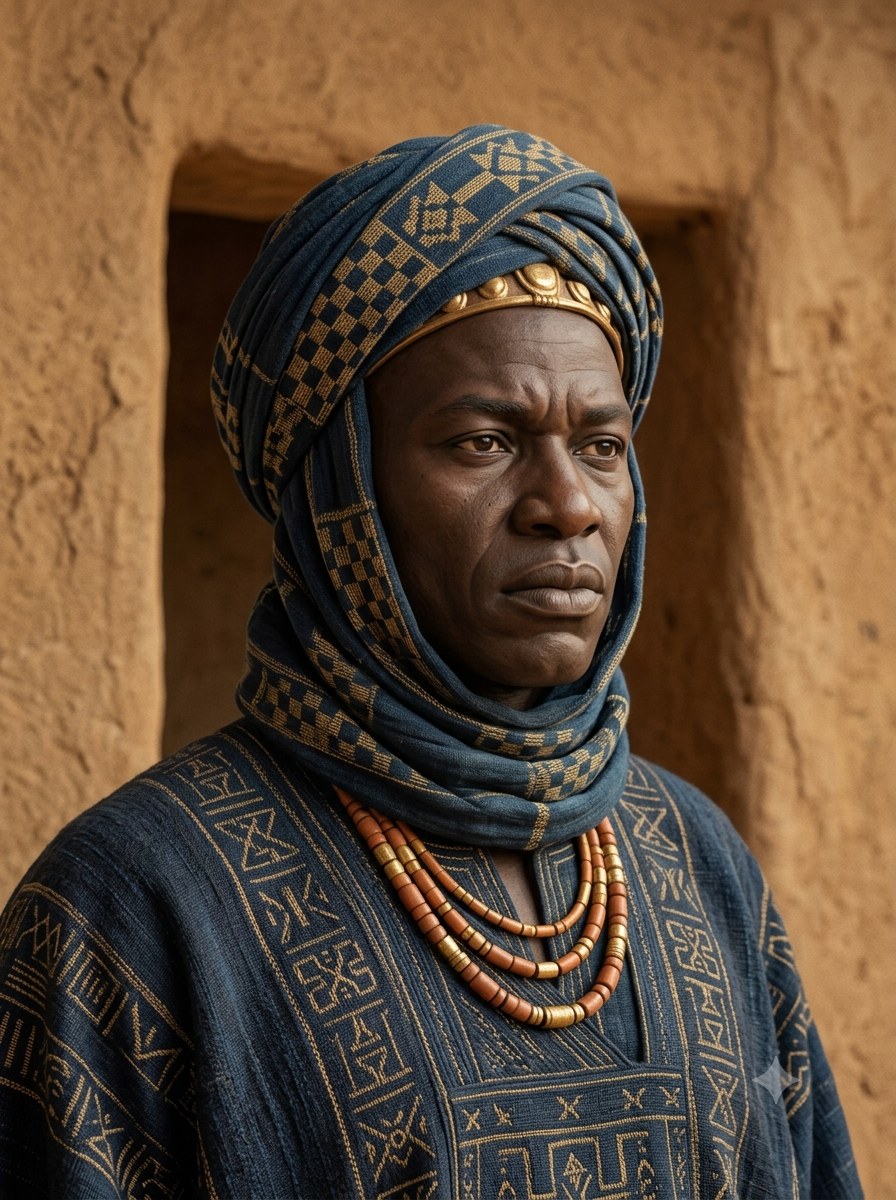
AI-assisted Portrait of Mansa Suleyman
The Steward Who Followed the Showman
To rule after a legend is its own kind of trial. Mansa Suleyman of Mali came to the throne in 1341 in the long shadow of his brother Mansa Musa—the pilgrim-king whose gold had dazzled Cairo and whose hajj had put Mali on the maps of a wondering world. Where Musa had spent, dazzled, and expanded, Suleyman counted, consolidated, and kept. He was not the architect of Mali's greatness but its custodian, and over nearly two decades he proved that the harder imperial task is not the building of an empire but the holding of one.
His reign followed a wobble. Musa's son Maghan I had held the throne only briefly and weakly, and Suleyman's accession was, in part, a course correction—a return to discipline after a slackening. He restored order to the treasury, kept the trans-Saharan trade routes secure, and ran a court so visibly just that the empire's reputation for safety became the thing foreign travelers remarked on first. He was frugal to the point of stinginess, austere where his brother had been magnificent, and beloved by no one in particular. He was, in the deepest sense, a conservator: a man whose genius was for maintenance.
We see him so clearly because of an accident of timing. In 1352 the Moroccan traveler Ibn Battuta arrived at his court and stayed the better part of a year, leaving behind the single greatest eyewitness portrait of the medieval Mali empire. What Ibn Battuta found was a realm of striking order—and a sovereign whose tight-fistedness he could not forgive.
Suleyman was the ISTJ on a throne: dominant Si bent on preserving an inherited order, paired with the administrative Te that made the order run. His virtue was the steward's virtue—steadiness, thrift, and the patient guarding of what already existed.
The Keeper of the Established Order
Si — dominant
Dominant Si is the function of continuity—a deep trust in what has been tested by time and a corresponding wariness of the new and the extravagant. It governs the figure who asks not “what could this become?” but “what has worked before, and how do we preserve it?” Suleyman is almost a textbook of the type. His entire reign was an exercise in maintenance: he inherited the apparatus Musa had built—the mosques, the trade infrastructure, the administrative reach to Timbuktu and the Niger bend—and his ambition went no further than keeping all of it intact and running smoothly.
The contrast with his brother is the whole story. Musa was an expansive, outward projector who spent gold so freely on his pilgrimage that he reportedly depressed its value in Egypt for years. Suleyman was his exact temperamental opposite: thrifty, careful, conserving. Where Musa enlarged, Suleyman guarded. He rebuilt no empire and conquered no new provinces; he balanced the books, secured the roads, and saw to it that the structure of Mali stood as he had received it. This is Si as governance—the steward's instinct that the inheritance is a trust to be protected, not a fund to be drawn down.
Even his famous parsimony reads as Si in its shadow. The dominant Si type is reluctant to part with resources precisely because it feels, viscerally, the value of what is held in hand against the uncertainty of what might come. Suleyman's court ran lean by design. The treasury was full because the mansa did not believe in emptying it for show—a discipline his subjects and his guests experienced, fairly or not, as coldness.
The Order Ibn Battuta Could Not Deny
Te — auxiliary
If Si supplied Suleyman's reverence for the inherited order, auxiliary Te supplied the machinery that kept it functioning. Te is the executive function—the drive toward efficient systems, clear rules, and impartial administration. In a sovereign it produces sound law, secure infrastructure, and a state that actually works. And here we have an unusually reliable witness, because Ibn Battuta, who arrived predisposed to find a marvel and left disappointed in his host, could not stop praising the way the realm was run.
What impressed the traveler was precisely the Te accomplishment: order and justice. He marveled at the security of the roads—a man could travel the length of Mali, he reported, without fear of robbery or violence, which in the fourteenth century was no small thing. He praised the fairness of the courts and the people's abhorrence of injustice. This was an administered peace, the visible product of a ruler who valued competence and predictability over spectacle. Suleyman's Mali was safe and just not by accident but because the man at the top ran it like an institution.
Ibn Battuta came for the gold of Musa's legend and found instead the order of Suleyman's rule—secure roads, honest courts, a state that simply worked. The showman's brother had quietly built the better-run kingdom.
The Private Conscience and the Closed Hand
Fi — tertiary
Tertiary Fi in an ISTJ is a quiet, inward thing—a personal code of right and wrong held privately rather than projected warmly outward. It tends to express itself as integrity and conviction more than as charm, and in Suleyman it shows in a justice that was principled but not gracious. He plainly held firm standards; the order of his realm rested on a genuine intolerance of wrongdoing. But the same inwardness that anchored his sense of duty left him short on the public generosity a king was expected to perform.
This is where Ibn Battuta's grievance bites. Hospitality-gifts were the currency of royal honor, and the traveler had arrived expecting the legendary open-handedness associated with Musa's name. What he received from Suleyman was meager—a gift so paltry the indignant Moroccan mocked it in his account, contrasting this mansa's stinginess with the bottomless generosity of his predecessor. To the ISTJ steward, the lavish gift to a passing stranger was a needless drain; to the world watching, it was a failure of largesse. Suleyman's conscience told him to be just, not magnanimous, and he could not see why the distinction should cost him anything.
The court was not without its undercurrents. His reign saw real intrigue—his senior queen, Qasa, was implicated in a conspiracy against him—and even there the response was the dutiful man's: the matter was handled, the order restored. He governed by principle and procedure, and was respected for it without ever being loved.
The Roads Not Taken
Ne — inferior
The inferior function is the blind spot, the weakest seat in the stack, and for the ISTJ it is Ne—the appetite for novelty, expansion, and unproven possibility. Suleyman's reign is defined almost as much by what he did not attempt as by what he achieved. He launched no grand pilgrimage to rival his brother's, opened no bold new ventures, gambled on no untested designs. The visionary, world-startling gesture was simply not in him. He held the line he was given.
Whether that is a limitation or a wisdom depends on the vantage. The expansive, possibility-chasing temperament that built Mali's fame was also the one that strained its treasury; the consolidating temperament that held Mali together was also the one that gave its travelers nothing memorable to praise but order. Suleyman chose the road of the steward over the road of the visionary, again and again—and the empire he handed on, intact and solvent, was the dividend of that choice. The cost was that history remembers the brother who dazzled, not the brother who lasted.
Why ISTJ Over ESTJ
Why not ESTJ?
The ESTJ shares the same SJ devotion to order and the same commanding Te, and the temptation is real—Suleyman was, after all, a competent administrator. But the ESTJ leads with Te: it projects outward, organizes the world, enlarges and asserts. That is Musa's register, not Suleyman's. Suleyman led with Si—reserved, frugal, internal, a guarder rather than a builder. His instinct was to conserve what existed and stay tight-fisted, not to expand his domain or perform his authority for the world. The withholding hand and the inward steadiness are Si-first signatures.
The distinction is the difference between the projector and the preserver. An ESTJ in Suleyman's seat would likely have looked more like his brother—mounting the grand gesture, expanding the reach, spending freely to make the state's power felt. Suleyman's genius ran the other way: steady internal order, thrift held as principle, the patient maintenance of an inheritance. His was the quiet, conserving competence of dominant Si married to a Te that administered rather than aggrandized. He guarded what he was given, and that is the truest mark of the type.
Connected Figures
Further Reading
- The Travels of Ibn Battuta — Ibn Battuta (trans. H. A. R. Gibb)The Mali section is the indispensable primary source — the only sustained eyewitness portrait of Suleyman's court, order, and famous stinginess.
- Ancient Ghana and Mali — Nehemia LevtzionThe classic scholarly history of the West African empires; the standard reconstruction of the Mali succession and Suleyman's place in it.
- African Dominion: A New History of Empire in Early and Medieval West Africa — Michael A. GomezThe leading modern synthesis, re-reading the sources to situate Suleyman's consolidating reign within the longer arc of Mali's power.
