 Historical Figure MBTI
#432 · 4-9-26 · The Mali Empire
Inari Kunate
Senior Wife of Mansa Musa
fl. c. 1324
7 min read
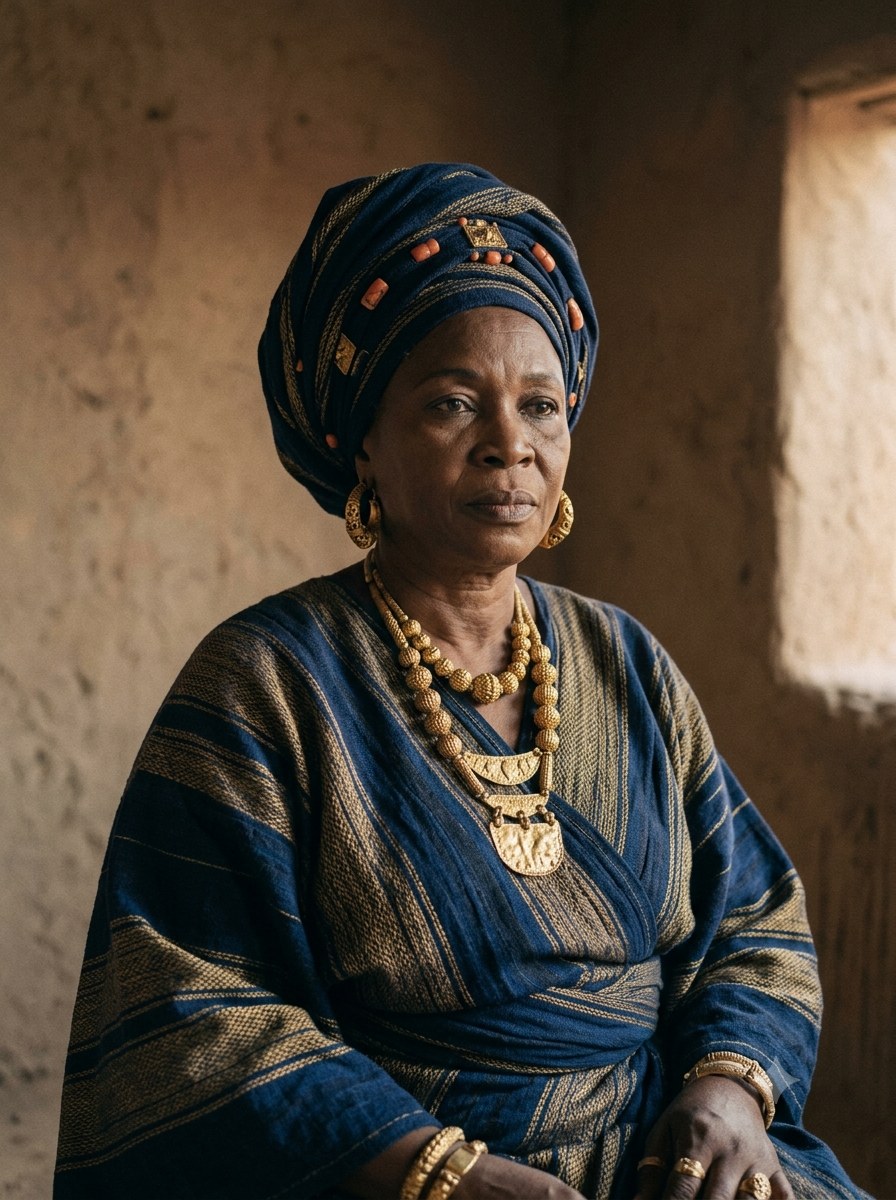
AI-assisted Portrait of Inari Kunate
The Queen on the Island in the Sand
History keeps her in a single sentence. Inari Kunate was the senior wife—the queen—of Mansa Musa, ruler of the Mali Empire at the height of its gold and its reach, and she rode with him in 1324 on the most famous pilgrimage in West African history: the hajj that crossed the Sahara to Mecca with a caravan so laden with gold that Musa's spending is said to have depressed the price of the metal in Cairo for years. Of the woman who travelled at the center of that procession, the Arab chroniclers preserved almost nothing—her name, her rank, and one shining anecdote.
The anecdote is this. Somewhere in the desert crossing the queen wished to bathe. So Musa ordered his servants to dam and divert a stretch of water and build her an artificial island or pool in the sand—a private bathing place conjured out of nothing for a single afternoon, then abandoned to the desert. The story survives because it flattered Musa: proof of a devotion and a wealth so total that he could rearrange a river for his wife's comfort. She is the occasion for the legend, not its subject. We know what was done for her; we know nothing of what she said, thought, or wanted.
Any psychological reading of a figure this thinly attested has to be offered with both hands open. There is no correspondence, no chronicle of her conduct, no second story to check the first against—only a role and a single glittering scene. What can be read is the role itself, and the role belongs to a particular kind of temperament.
The senior queen at the warm social center of the richest court of the age reads, tentatively, as an ESFJ: Fe and Si—the relational dignity of the consort, embodied for a moment on an island built in the sand.
The Center of the Court
Fe — dominant
The office of senior queen in a great medieval court is, before it is anything else, an office of relationship. The wealth Musa carried to Mecca was not only gold but spectacle: a vast retinue, alms scattered through Cairo, a procession designed to announce Mali to the Islamic world. A consort at the heart of that performance is a social figure—the human face of the dynasty's standing, the woman whose dignity is read as the court's dignity. Dominant Fe is the function most at home in exactly this position: attuned to status, to occasion, to the warmth and order of a community gathered around a shared display.
We cannot watch her exercise it. But the role rewards it. The bathing episode itself, however much it celebrates Musa, places her at the affective center of the journey—the person whose comfort the whole apparatus briefly reorganized itself to provide. That is the gravitational pull of a dominant-Fe presence in a court setting: she is the one others arrange themselves around, and a river is bent to her ease.
The Dignity of the Office
Si — auxiliary
If Fe gives the queen her social role, auxiliary Si gives that role its weight of tradition. The consort's authority is not improvised; it is inherited—a settled set of customs, precedences, and observances carried forward from one reign to the next. Si is the function that keeps such forms, that knows how a thing is properly done and feels the rightness of doing it that way. In a queen it reads as bearing: the composure of a woman who embodies an office older than herself and means to hand it on intact.
Even the hajj fits this grain. A pilgrimage is the most tradition-bound act in the Muslim world—a rite performed exactly as it has been for centuries, its value lying precisely in its faithful repetition. To cross a desert to keep that observance is an Si gesture at the scale of an empire, and the queen who crossed it with her husband shared in its meaning.
What the Record Cannot Show
Ne — tertiary
Here the honest entry has to admit its limits. The tertiary and inferior functions of any personality are the quiet, interior ones—the parts that surface in private, in play, in strain—and those are exactly the parts no source preserved for Inari Kunate. Tertiary Ne in an ESFJ would show as a lightness, a capacity to be surprised and delighted, an openness to the new that travel tends to draw out. A pilgrimage across the Sahara to Egypt and Arabia is nothing if not an encounter with the unfamiliar, and one can imagine that openness at work.
But that is imagination, not evidence. We have a single afternoon at a single oasis. The function is named here to complete the type, not because any anecdote demonstrates it.
The Silence
Ti — inferior
Inferior Ti—the detached, impersonal logic that sits opposite dominant Fe—would, in an ESFJ, be the least-seen function of all, surfacing mostly under pressure. For a figure glimpsed in one untroubled scene, it is wholly invisible. There is no decision recorded, no argument, no moment of cold reasoning to read it from.
The silence is the point. Four sections of cognitive analysis cannot conjure an interior life the sources never reported. What we have is a role and an image; the rest of the stack is an inference about the kind of person who fills that role well, not a portrait of this particular woman's mind.
Why ESFJ Over ISFJ
Why not ISFJ?
Both types share the Fe–Si pairing and the devotion to duty and tradition, so the difference is one of orientation, not values. The ISFJ keeps the same loyalties more quietly, from the edge of a room rather than its center. What little we have of Inari Kunate places her at the visible heart of a deliberately public spectacle—the senior queen of a procession built to be seen, the figure for whom a river was rearranged in front of a watching caravan. That outward, status-and-community position fits the warmer, more prominent ESFJ better than the retiring ISFJ. The evidence is slight, and an ISFJ reading is not unreasonable; the role simply tilts the other way.
The distinction is finally about where a life is lived—and a queen-consort's life is lived in public, as the relational face of a dynasty. That is ESFJ territory. But this is a reading of an office worn by a person we cannot actually see, and it should be held loosely: the type follows the role, because the role is nearly all that survives.
Connected Figures
Further Reading
- Ancient Ghana and Mali — Nehemia LevtzionThe standard scholarly history of the medieval West African empires, and the essential context for Mansa Musa's reign and his court.
- African Dominion: A New History of Empire in Early and Medieval West Africa — Michael A. GomezA sweeping modern reassessment of Mali and its rulers that takes the court, its women, and the pilgrimage tradition seriously.
