 Historical Figure MBTI
#433 · 4-9-26 · The Mali Empire
Maghan I
Mansa of Mali · Musa's Heir
fl. 1337 — 1341
6 min read
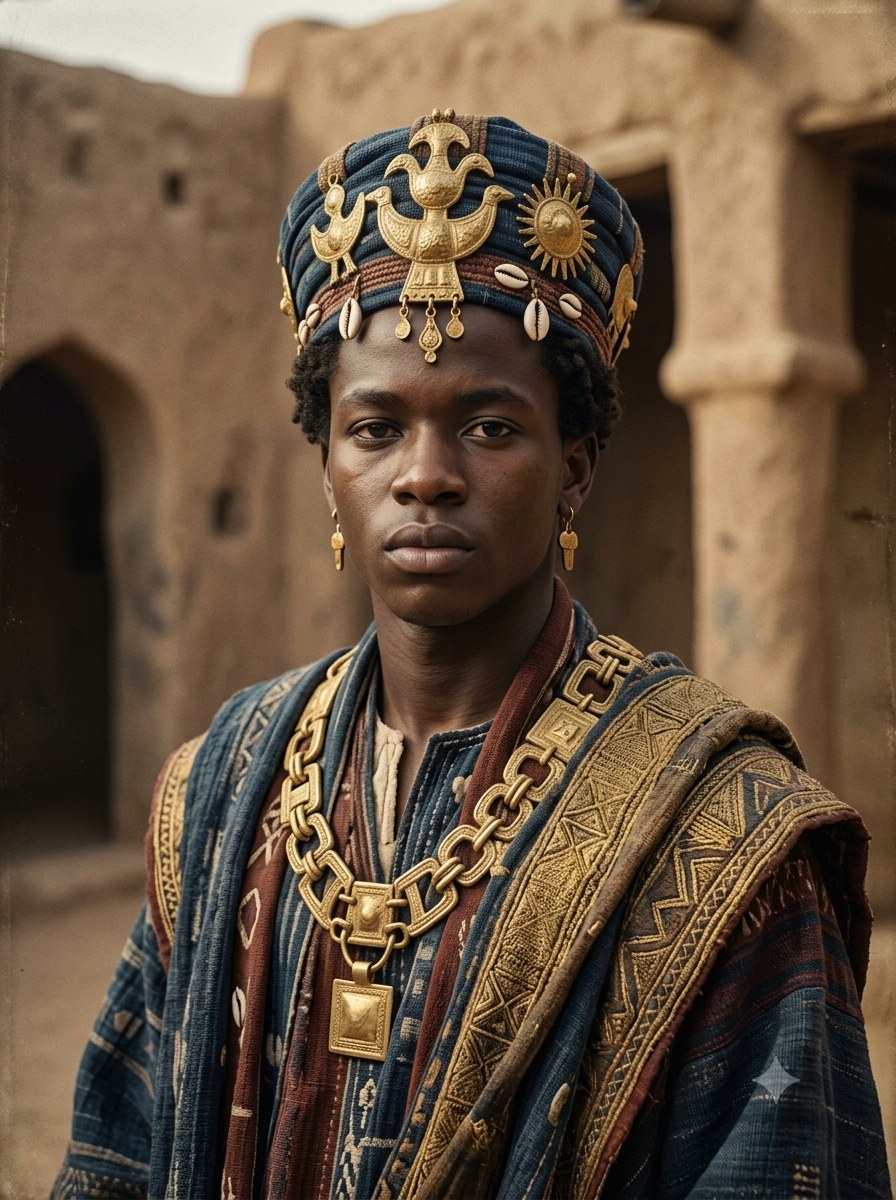
AI-assisted Portrait of Maghan I
The Heir Between Giants
Maghan I has the misfortune of being remembered almost entirely for who he was not. He was not his father, Mansa Musa, whose 1324 pilgrimage to Mecca scattered so much gold across Cairo that the metal's value is said to have slumped for years. And he was not his uncle, Mansa Suleyman, the capable administrator who would steady the realm after him. Maghan sits in the gap between the two—a four-year reign (roughly 1337 to 1341) that the sources treat as a slackening, a loosening of the grip, a pause before the empire was set right again.
The honest difficulty is that almost nothing of the man himself survives. What we have comes filtered through later Arabic chroniclers—chiefly the fourteenth-century historian Ibn Khaldun—and the verdict is uniformly dim: a weak ruler under whom Mali's authority frayed, and to whose reign some accounts attribute a raid on Timbuktu by the Mossi from the south. Whether the failures were truly his or simply landed in his lap, the record does not let us say. He is a silhouette, not a portrait.
Any reading of his character must therefore be offered lightly. But the one trait the sources agree on—that he did not command, that the throne seemed to slip through his hands—is itself a kind of evidence. A man defined by the absence of force may simply have been a man for whom force was never the native language.
If the typing holds at all, Maghan reads as an ISFP seated on a throne built for a commander: a private, inward man (Fi) asked to project the dominance the role demanded, and quietly unequal to it.
The Man Who Did Not Want the Room
Fi — dominant
Dominant Fi is an inward compass. It orients by private feeling and personal value, not by the expectations radiating off a crowd, and it has little instinct for the outward projection of authority. In a courtier this can read as integrity. In a mansa — the supreme war-leader and arbiter of a vast Sahelian empire — it reads as fatal reticence.
The throne Maghan inherited was not a ceremonial seat. It demanded a ruler who could fill a room, marshal vassals, and make the whole apparatus feel his presence. The sources suggest Maghan did none of this; the empire's grip loosened on his watch. That is exactly the failure a Fi-dominant would be most prone to in such a role — not corruption, not cruelty, but a temperamental inability to perform dominance he did not feel. He may have been perfectly decent and entirely unsuited, the two facts pointing the same direction.
Present, Not Strategic
Se — auxiliary
Auxiliary Se anchors the ISFP in the immediate and the concrete. It lives in the present tense — responsive, sensory, attuned to what is in front of it rather than to the long campaign. Paired with dominant Fi, it makes for a man more inclined to inhabit his moment than to engineer the next one.
For a ruler, that is the wrong instinct at the wrong scale. Mali in the 1330s did not need a sovereign who was merely present; it needed one who could think in decades, hold a frontier against the Mossi, and project power across distances he would never travel. The reported sack of Timbuktu is precisely the kind of event a present-focused temperament fails to forestall — a threat that had to be anticipated and deterred long before it arrived at the walls. Here again the record is too thin to convict Maghan personally; but if he was the man the chroniclers describe, the failure to look ahead is of a piece with the type.
The Foresight He Lacked
Ni — tertiary
Tertiary Ni is the faculty of long-range vision — the capacity to read where events are tending and to govern toward a horizon. In the ISFP it sits low in the stack, available but undeveloped, easily crowded out by the present-tense pull of Se. A throne is the one place where that weakness becomes unmissable, because rule is nothing if not the management of consequences that have not yet happened.
What the chroniclers describe — an empire that slipped its moorings in only four years — is the shape of an absent Ni. Mali did not collapse under Maghan; it drifted, which is the more telling failure. Drift is what happens when no one at the center is steering toward a destination, when each problem is met as it comes rather than headed off. His uncle Suleyman, by contrast, governed with exactly the patient, forward-looking grip Maghan seems to have lacked — and the empire answered to it.
The Command He Could Not Summon
Te — inferior
Te is the executive function — the drive to organize people, enforce structure, and impose order on the world by direct command. In the ISFP it is the inferior, the weakest and least trusted instrument in the stack. And it is, precisely, what a mansa most needed: the throne was a Te office, demanding a commander who could administer an empire and bend its many parts to a single will.
Set Maghan beside his father and his uncle and the deficit comes into focus. Both Musa and Suleyman, whatever their inner types, could operate the machinery of command. Maghan, by this reading, could not — the office asked him to lead from his weakest function, and the empire registered the shortfall as drift. It is the oldest tragedy of inherited power: a throne does not care whether its occupant is built to sit in it.
Why ISFP Over ISTP
Why not ISTP?
The ISTP shares the inward, present-tense quality but routes it through Ti and Te rather than Fi — making for a cool, capable, hands-on operator who, even when reluctant to lead, can solve a concrete problem with detached competence. Had Maghan been that man, the chroniclers would likely have recorded a quietly effective ruler, not a slackening of the realm. What little survives points the other way: a gentle, unassertive figure overwhelmed by a role that wanted force, which is the Fi-led reading, not the Ti-led one.
The whole case rests on a single, fragile observation — that Maghan could not summon command — and even that comes secondhand. So the verdict is tentative by necessity. But the distinction worth holding is between incapacity and unfittedness. An ISTP failing on the throne would have failed by indifference or detachment; the ISFP fails by temperament, asked to project a dominance that runs against the grain of who he is. Maghan's record reads less like a man who could not do the job than a man the job was never shaped for.
Connected Figures
Further Reading
- Ancient Ghana and Mali — Nehemia LevtzionThe standard scholarly reconstruction of Mali's mansas from the Arabic sources — the essential frame for placing Maghan's brief reign between Musa and Suleyman.
- African Dominion: A New History of Empire in Early and Medieval West Africa — Michael A. GomezA sweeping modern history of Mali and its neighbors that re-reads the dynasty's politics and situates the succession struggles around Maghan's reign.
