 Historical Figure MBTI
#434 · 4-9-26 · The Mali Empire
Soumaoro Kanté
Sorcerer-King of Sosso · Sundiata's Nemesis
fl. early 1200s
7 min read
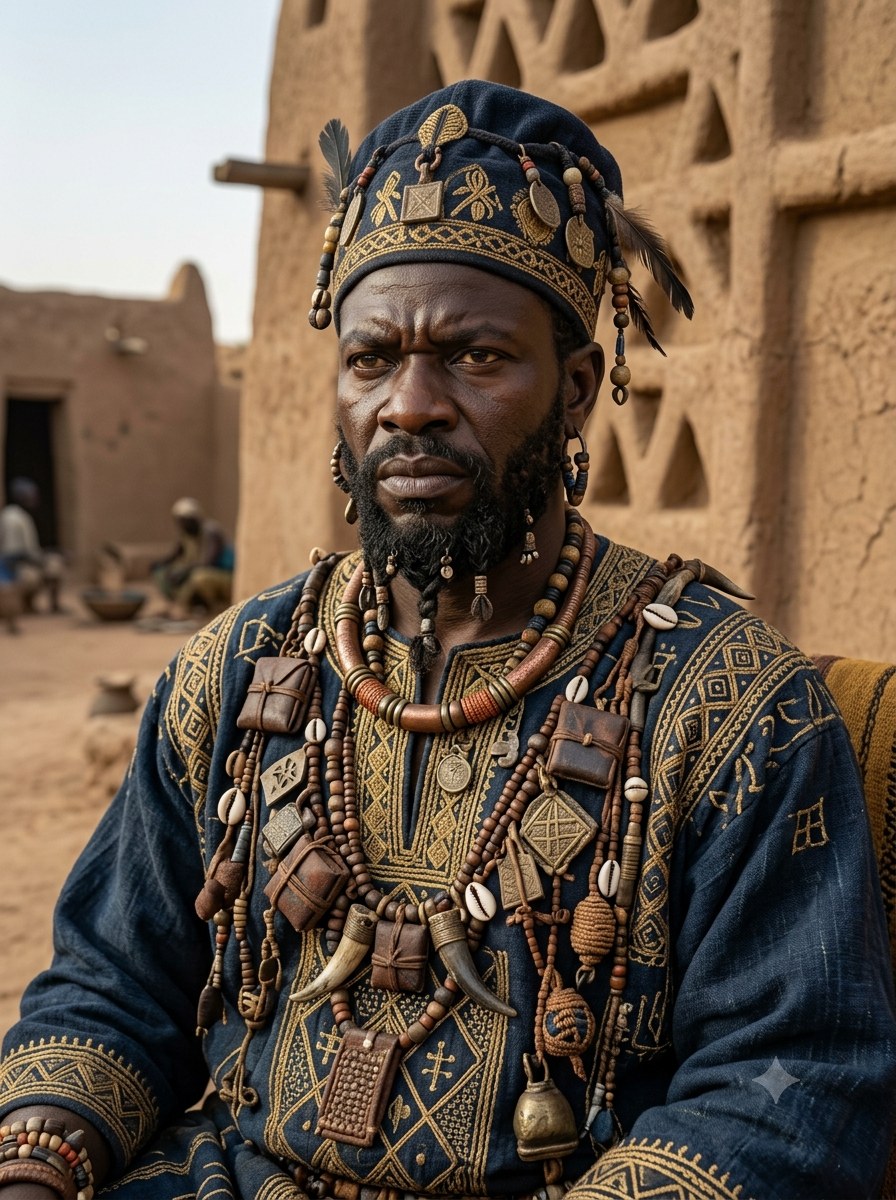
AI-assisted Portrait of Soumaoro Kanté
The Sorcerer-King Who Ruled by Terror
Soumaoro Kanté comes down to us not from a chronicle but from a song. He is the great antagonist of the Epic of Sundiata—the founding story of the Mali Empire, carried for centuries in the memory of West African griots before it was ever written down. To meet him at all is to meet him through the voice of his enemies, and the griots made him magnificent in his menace: the blacksmith-king of Sosso, a sorcerer said to be invulnerable to iron, who conquered the scattered Mandinka clans and ruled them by fear. Sorting the historical man from the legendary one is, frankly, impossible. What survives is a portrait—a tyrant built of raw force and dark craft—and that portrait is coherent enough to read.
The history beneath the song is thin but real. In the early thirteenth century the kingdom of Sosso rose to dominate the upper Niger after the collapse of ancient Ghana, and its king pressed the surrounding peoples hard. Then, around 1235, he was beaten at the Battle of Kirina by Sundiata Keita, the exiled prince who would weld those same clans into Mali. Sosso power ended on that field, and an empire rose on its ruin. The epic dresses the defeat in magic—Soumaoro's invulnerability is finally broken by a single secret—but the shape of the event is the same either way: a strongman who could conquer everything except the one threat he never saw coming.
Soumaoro is the ESTP rendered as myth—dominant Se as the hammer-blow of conquest, Ti as the sorcerer's hidden craft, and an inferior Ni that leaves the all-powerful tyrant blind to the single weakness that undoes him.
The Hammer and the Conquest
Se — dominant
Everything about Soumaoro is physical, immediate, present-tense. He is remembered first as a blacksmith—and in the Mande world the smith is no ordinary craftsman but a figure of feared power, a master of iron and of the forces locked inside it. That is dominant Se made literal: power you can hold in your hand, heat and metal and the strength to bend them. He did not inherit an empire by lineage or build one by patient statecraft. He took it, clan by clan, by being the strongest man on the field and making sure everyone knew it.
Se rules through force and through fear in the moment, and the epic insists on exactly this. Soumaoro's subjects obey because the alternative is annihilation now, not because they are bound by law or loyalty. He answers challenges with overwhelming, tangible violence; his authority is the authority of the man who can crush you today. This is the warrior-king in his purest form—reading the situation in front of him, striking first and hardest, dominating physical space. There is no patience in it and no long horizon, only the relentless application of present power.
It is also why his power could not outlive him. Se conquers brilliantly and holds nothing. Soumaoro built a reign of terror, not an institution—a structure that depended entirely on his own overwhelming presence to stay standing. Remove the man and the whole edifice collapses, which is precisely what happened at Kirina.
The Sorcerer's Hidden Craft
Ti — auxiliary
Soumaoro is not merely strong; he is cunning, and that is where auxiliary Ti enters the portrait. The epic gives him a secret chamber of fetishes—a private workshop of occult power, the source of his fabled invulnerability to iron weapons. Strip away the supernatural framing and what remains is a recognizable cognitive shape: a closed, internal system of cause and effect, mastered in private and guarded as the engine of his dominance. The sorcerer is the man who understands the hidden mechanics that no one else does.
Paired with dominant Se, Ti makes him a thinking warrior rather than a mere brute. His force is guided by craft—the smith's precise knowledge of his materials, the strategist's grasp of what makes his enemies break. It is the auxiliary doing what an auxiliary does: serving the dominant, sharpening raw power into something targeted and effective. But it is Ti turned inward and secret, hoarded rather than shared—knowledge as a personal weapon, not a structure to be passed on.
Rule by Atmosphere of Dread
Fe — tertiary
Tertiary Fe in an ESTP is not warmth—it is an instinct for the emotional temperature of a room, bent toward control. Soumaoro understands the climate of fear and cultivates it deliberately. The chamber of fetishes, the reputation for invulnerability, the spectacle of a king who cannot be killed: these are not just weapons but performances, calibrated to shape how an entire people feels about him. He governs the collective mood, and the mood he chooses is dread.
This is Fe in its lower, self-serving register—social awareness deployed to dominate rather than to bond. He reads the room in order to own it. Yet the same tertiary function marks the limit of his rule: he commands fear but never loyalty, presence but never genuine allegiance. A leader who binds people only through terror has no reservoir of devotion to draw on when the spell of his strength finally breaks—and across the field at Kirina stood a rival who inspired exactly the loyalty Soumaoro could never command.
The One Weakness He Never Foresaw
Ni — inferior
The legend of Soumaoro's fall is, read psychologically, a parable about inferior Ni. He is invulnerable to every ordinary weapon—and yet he carries a single hidden vulnerability, a secret undoing he himself does not fully grasp. In the epic the answer is famously specific: his power can be broken only by a spur taken from a white rooster, fixed to an arrow. Sundiata discovers the secret, and the strike that nothing should have landed lands.
That is the inferior function in its most literal storytelling form. Dominant Se lives so completely in the present and the tangible that the long view, the buried pattern, the singular hidden flaw all sit in the blind spot. Soumaoro can see and crush any threat in front of him; what he cannot do is foresee the one improbable thing that will end him. His strength is total in the moment and total nowhere else. The all-powerful tyrant is undone not by a stronger man but by a secret—by the future arriving from an angle he never thought to guard.
Whether or not any white rooster ever existed, the story preserves a real truth about the type: the Se-dominant strongman is most dangerous to himself precisely where he feels most invincible. The hammer that broke every clan could not see the arrow already drawn.
Why ESTP Over ESTJ
Why not ESTJ?
The ESTJ is the institution-builder—the strongman who conquers and then organizes, laying down law, administration, and a structure meant to outlast him. Soumaoro does none of that. He rules by raw force and present-tense fear (Se), not by system; he dominates the clans but never welds them into a durable order. The proof is in the ruin: ESTJ power tends to survive its founder, while Soumaoro's collapsed the moment he fell. He was a conqueror, not an administrator—and Sosso died with him.
The distinction is the heart of his story. Both types can seize power, but they hold it differently: the ESTJ's Te builds the lasting machine, while the ESTP's Se wields the overwhelming blow. Soumaoro is force without architecture—magnificent and terrifying in the moment, structurally empty the instant the moment passes. That is exactly why the rival who beat him is remembered so differently. Where Soumaoro left only the memory of dread, Sundiata built an empire that endured for centuries—the very thing the Se strongman, for all his power, could never do.
Connected Figures
Further Reading
- Sundiata: An Epic of Old Mali — D. T. NianeThe standard prose rendering of the epic, drawn from a griot's recitation — the essential source for Soumaoro as the legend remembers him.
- African Dominion: A New History of Empire in Early and Medieval West Africa — Michael A. GomezSituates Sosso, Sundiata, and the rise of Mali within the broader political history of the medieval Sahel.
- The Epic of Sunjata and the Griot Tradition — Scholarship on the Mande oral epicStudies of how the Sundiata story was composed, transmitted, and shaped by griots — and what that means for reading figures like Soumaoro as history blended with myth.
