 Historical Figure MBTI
#1308 · 9-29-26 · Heian Japan
Akazome Emon
Court Poet · Attendant in a Literary Household
fl. late 10th–early 11th century; exact dates unknown
5 min read
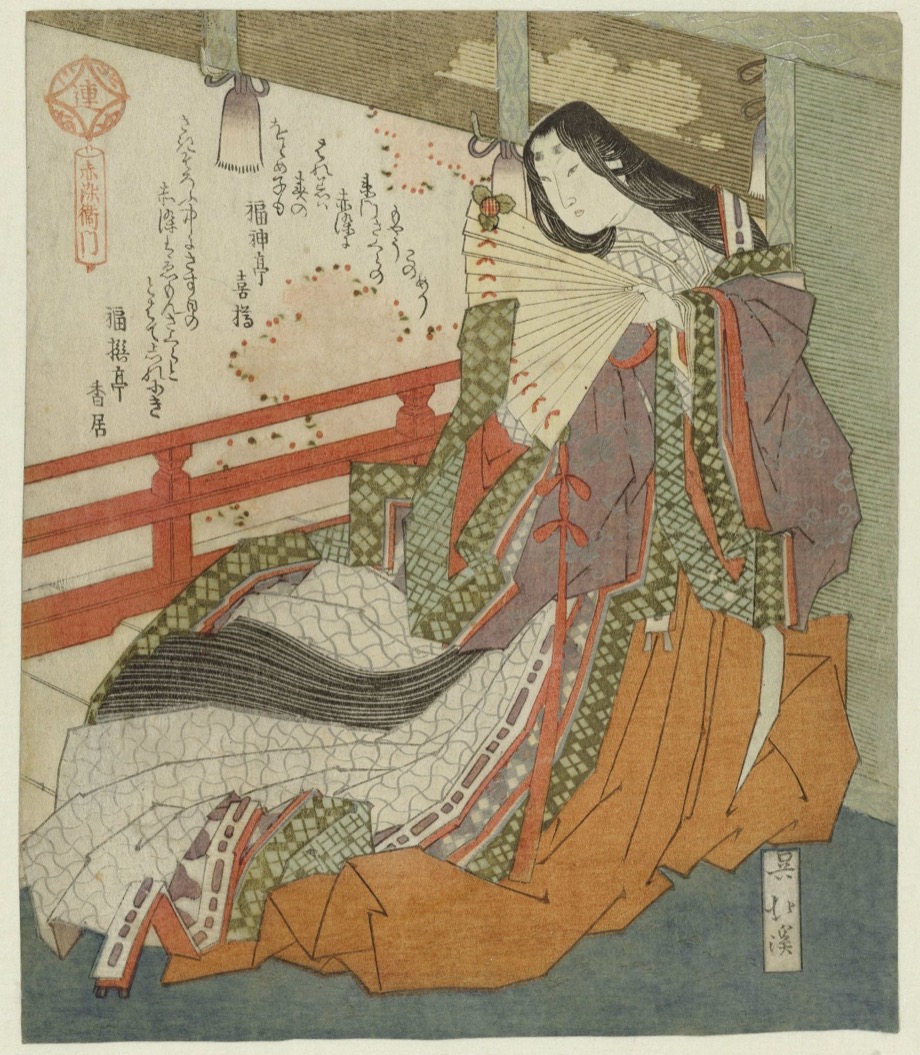
Portrait of Akazome Emon — c. 1827 (later depiction)
The poem need not announce its maker
Akazome Emon impressed a critic who was not easily impressed. In her diary, Murasaki Shikibu distinguishes Akazome’s satisfying verse from the work of people who display every composition and congratulate themselves too readily. The praise concerns judgment as well as accomplishment: poems are allowed to speak without a noisy campaign for the poet. It is a narrow contemporary glimpse, but a valuable one.
Akazome served Minamoto no Rinshi and her daughter Fujiwara no Shōshi, married the scholar Ōe no Masahira, and sustained a long poetic career. Exact birth and death dates remain uncertain. Her work reached imperial anthologies, formal contests, and a personal collection. The familiar picture of an exemplary wife is only one part of a literary reputation and should not determine the whole portrait.
The proposed ISFJ reading is low confidence. It rests on the limited evidence for measured composition and attention to the occasion, rather than on marriage, motherhood, or obedience. A poet can make traditional forms inventive, and restraint can be a professional strategy. The surviving record permits a hypothesis about her judgment; it cannot certify an inward preference.
Akazome Emon suggests ISFJ: dominant Introverted Sensing appears in a measured discrimination within the inherited poetic art.
Introverted Sensing — discrimination within an inherited art
Murasaki’s judgment describes selective production: Akazome does not seem compelled to send verse into circulation at every opportunity. This suggests a standard against which a particular composition must be weighed. The possible Introverted Sensing connection lies in that discrimination within an established practice, where familiarity with forms and prior examples supports a judgment about what is appropriate now.
The evidence is still mediated. Murasaki is constructing a critical hierarchy among women writers, and the qualities she praises tell us something about her own ideals. A reader cannot turn her approval into an objective inventory of Akazome’s habits. Nor is the use of inherited poetic language distinctive enough by itself to establish any type. It was the common professional equipment of this literary world.
The poem later selected as number fifty-nine of the Hyakunin Isshu gives waiting a temporal shape. A promised visitor fails to arrive, and the speaker watches the moon decline instead of sleeping. The familiar celestial image becomes a measure of time spent trusting another person. Its force depends on restraint: an entire accusation can be carried by a report of what the speaker has watched.
The poem is associated with speaking on another woman’s behalf, traditionally her sister. That possibility matters for biography. A convincing voice of disappointment is not necessarily a record of Akazome’s own lover failing to appear. Her accomplishment may include inhabiting someone else’s situation with precision. The poem shows command of a social and literary occasion before it shows us a private experience.
Extraverted Feeling — words fitted to their recipient
A later account in Fukurozōshi credits her with helping Masahira compose a petition for Fujiwara no Kintō. The advice is to attend to the recipient’s pride in ancestry and the contrast with his present circumstances. Read cautiously as an anecdote, it gives Akazome a kind of practical literary intelligence: wording works when it understands the person who must receive it.
That is a plausible auxiliary Extraverted Feeling clue, but the later date of the account limits its evidentiary force. It may preserve a remembered skill or develop an exemplary story about a gifted wife. The scene should not be narrated as a securely observed consultation, with invented gestures or thoughts. Its significance lies in the particular form of competence her reputation came to embody.
Formal court poems also did work for other people. A celebration, a screen painting, or a contest required a poet to judge the subject, the audience, and the language available to both. Akazome’s sustained participation makes her more than a quiet domestic counterpart to Izumi Shikibu. Her measured reputation coexisted with public literary activity. Restraint did not remove ambition or professional standing.
The history that cannot become automatic evidence
Akazome has traditionally been associated with the earlier portion of Eiga Monogatari, the history of flourishing aristocratic fortunes centered on Fujiwara no Michinaga’s world. The attribution is debated. It is tempting to use the work’s attention to household ceremony and relationships as a large additional personality record, but doing so would make an uncertain authorship carry an uncertain psychological conclusion.
The safer distinction preserves both kinds of achievement. Her attributed poems and contemporary reputation establish an accomplished poet. The possible historical authorship belongs to the scholarly discussion of the chronicle’s production. It can be mentioned without claiming every narrative choice as her personal decision. Similar care applies to later stories in which her prayerful verse heals a son: the story documents literary and religious reception, not a verified miracle.
Why ISFJ Over INFJ
Why not INFJ?
INFJ could account for deliberate composition and a reputation for perceptive judgment. The slight ISFJ preference comes from the available emphasis on fitting particular occasions and maintaining a discriminating standard within familiar practices. There is little secure evidence of a sustained interpretive vision organizing many domains of her life. That absence reflects a sparse record, so the alternative remains credible.
Neither literary decorum nor later praise of family devotion settles the distinction. The strongest testimony is another writer’s judgment, supplemented by selected poems and later anecdotes. This supports a cautious editorial reading rather than a recovered diagnosis of character.
Connected Figures
Further Reading
- The Diary of Murasaki Shikibu — Murasaki Shikibu; translated by Richard BowringA contemporary, interested observer judges the poets and conduct of Shōshi’s court.
- Pictures of the Heart: The Hyakunin Isshu in Word and Image — Joshua S. MostowReads canonical poems alongside the commentary and images that shaped their reception.
- A Tale of Flowering Fortunes: Annals of Japanese Aristocratic Life in the Heian Period — Translated by William H. McCullough and Helen Craig McCulloughThe chronicle traditionally associated with Akazome, whose authorship requires qualification.
