 Historical Figure MBTI
#1307 · 9-29-26 · Heian Japan
Izumi Shikibu
Waka Poet · Writer of Intimacy and Impermanence
c. 976–after 1025; exact dates unknown
6 min read
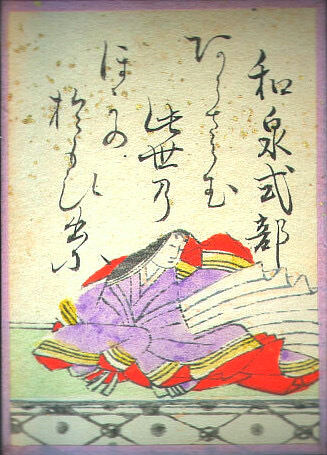
Portrait of Izumi Shikibu — Edo period (1603–1868) (later depiction)
A feeling is not settled by its reputation
Izumi Shikibu’s poetry repeatedly makes an absent person present through the pressure of wanting. A meeting, a memory, or a last opportunity can become more consequential than the judgments gathering outside the room. That concentration gives her writing its immediacy. It also makes a modern portrait unusually hazardous: the intimate speaker is compelling enough to be mistaken for an unmediated view of the historical woman.
Her personal name and exact life dates are unknown. She married Tachibana no Michisada, became the mother of Koshikibu no Naishi, and was associated with the princes Tametaka and Atsumichi. Later she served Fujiwara no Shōshi and married Fujiwara no Yasumasa. These connections give her life a historical outline. They do not turn every poem attributed to her into a dated confession or every scene in the Izumi Shikibu Diary into independently verified conduct.
A tentative INFP reading rests on the recurrent authority given to inward attachment, together with an inventive ability to make feeling answer the changing language of another person. The confidence is low. Poetry is an art, and its requirements can imitate a psychological preference. The interpretation becomes useful only when it remains smaller than the evidence and acknowledges that a different reading, or leaving her unclassified, is defensible.
Izumi Shikibu suggests INFP: dominant Introverted Feeling gives inward attachment an authority that public reputation cannot settle.
Introverted Feeling — the claim an attachment makes
Her poem selected as number fifty-six of the Hyakunin Isshu imagines a life approaching its end and asks for one further meeting to carry beyond this world. Its arrangement gives the attachment a value that mortality cannot simply cancel. It does not argue that the beloved is socially appropriate or that the wish will be granted. The desire matters because it belongs to the speaker and persists at the boundary of life.
This is the strongest limited basis for a dominant Introverted Feeling interpretation: an experience is weighed from within, before it is measured against public approval. That does not mean the poet ignored other people or possessed a modern doctrine of individual freedom. Court relationships carried obligations, inequalities, and consequences. The poem makes a personal claim within that world; it does not establish that the historical woman routinely rejected every convention.
The diary opens after the death of Tametaka, when his brother Atsumichi approaches through a messenger and a flowering branch. Grief and a new invitation occupy the same exchange. The woman’s response does not simply erase the earlier relationship. It makes remembered loss part of the terms on which a possible new attachment can be understood. The scene’s emotional continuity is more revealing than a summary that labels her merely fickle.
Here the distinction between literary evidence and personality evidence matters most. The diary organizes scenes and poems into a relationship narrative. Its authorial history and degree of revision have been debated; even a substantially autobiographical work can arrange experience for an audience. The inward valuation is securely a feature of the text. Its correspondence with an enduring preference in Izumi herself remains an inference.
Extraverted Intuition — an answer can redirect the occasion
Poetic exchange is an active encounter in this writing. A seasonal image, an allusion, or an apparent complaint offers more than one possible answer. The respondent can accept the other person’s terms, revise them, or show that the same image carries a meaning its sender has overlooked. Izumi’s reputation for quick composition belongs to this responsive art. The poem is small, but its implications can change the conversation.
In the diary’s opening, the gift of blossoms recalls the deceased prince through an established poetic association. The response turns toward a bird’s voice and the possibility of hearing from the living brother. The exchange neither abandons memory nor remains enclosed by it. One image opens another relation. That capacity to move among implications offers a plausible auxiliary Extraverted Intuition reading, provided literary fluency is not treated as a psychological test.
A closed door later becomes a disputed sign. The prince reads it as rejection; the woman’s reply challenges his interpretation of her inward state. An object does not possess one final emotional meaning simply because one participant declares it. The scene gives the exchange its energy by making an apparently decisive fact answerable to another explanation. The text keeps interpretation in motion.
These turns require knowledge of a shared repertoire as well as invention. An improvisation may be spontaneous in delivery while relying on years of familiarity with verse. Murasaki Shikibu recognized both Izumi’s attractive verbal agility and her acquaintance with earlier literature, even while withholding her highest approval. The contemporary judgment is valuable, but its critical preferences and social judgments must remain visible.
Memory and consequence do not disappear
Loss returns throughout the attributed poetry. Memory is not merely information about what happened; it changes the present occasion. A sensory cue can recall another person, and a new relationship can be haunted by an earlier one. In a full INFP framework this might suggest supporting Introverted Sensing. Yet remembering a lover is so fundamental to the literary genre that it provides little independent discrimination between types.
External consequences also enter the record. Moving into Atsumichi’s household placed the relationship among other people’s claims, including those of his consort. Serving Shōshi placed Izumi within an institution whose literary distinction enhanced a powerful family’s prestige. Neither a household nor a court was simply a setting for private emotion. Her writing survives partly because those institutions preserved and valued accomplished verse.
It would therefore be misleading to invent an inferior Extraverted Thinking crisis from scandal or bereavement. We lack a sustained record of how she organized work, assessed practical alternatives, or behaved under different kinds of pressure. The proposed stack names a reading of the strongest recurring emphasis, not four equally documented compartments of a recovered mind. The weaker claims deserve to stay weak.
Why INFP Over ENFP
Why not ENFP?
ENFP is plausible because the exchanges display rapid associative movement and responsive invention. INFP receives a slight preference because those possibilities repeatedly serve a concentrated inward attachment rather than a broad exploration of people and ventures. This difference may belong to the selected literary material more than to the woman. The evidence cannot make the alternative disappear.
Murasaki’s mixed assessment also resists a simple verdict. She admired the writing while criticizing conduct, and later readers often enlarged that criticism into a complete personality. Neither the critic’s disapproval nor the poet’s intimate speakers should be allowed to decide the type alone. The result is a low-confidence interpretation that leaves room for substantial uncertainty.
Connected Figures
Further Reading
- The Izumi Shikibu Diary: A Romance of the Heian Court — Izumi Shikibu; translated with an introduction by Edwin A. CranstonA scholarly translation and study of the relationship narrative and its textual problems.
- Diaries of Court Ladies of Old Japan — Translated by Annie Shepley Omori and Kochi DoiAn accessible early translation, whose dated introduction and chronology require caution.
- The Diary of Murasaki Shikibu — Murasaki Shikibu; translated by Richard BowringA contemporary, interested observer judges the poets and conduct of Shōshi’s court.
- Pictures of the Heart: The Hyakunin Isshu in Word and Image — Joshua S. MostowReads canonical poems alongside the commentary and images that shaped their reception.
