 Historical Figure MBTI
#1306 · 9-28-26 · Heian Japan
Fujiwara no Korechika
Court Minister · Imperial Kinsman · Exiled Rival
974–1010
5 min read
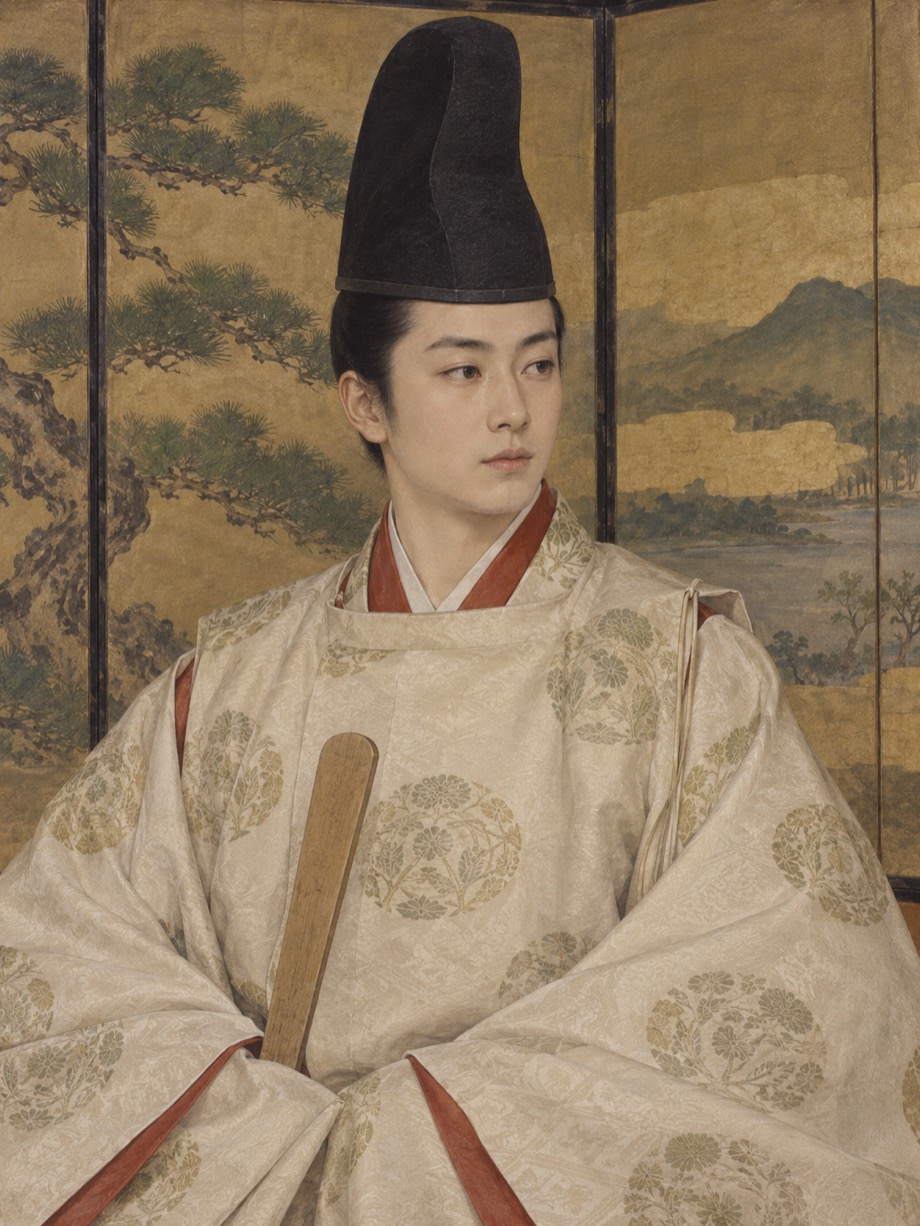
AI-assisted Portrait of Fujiwara no Korechika
The defeated man in more than one story
Fujiwara no Korechika can appear as two quite different figures. In the literary memory of Teishi’s household, he helps supply the material from which a celebrated book will emerge. In accounts organized around Michinaga’s ascendancy, he becomes the rival whose failure clears the way. Neither role is fictitious merely because it serves a narrative. Neither is a sufficient account of the man. The difference asks readers to examine what each telling needs from his presence.
Korechika was Teishi’s brother and Michitaka’s son. His advancement placed him near the center of the imperial court before the family’s reversal in the 990s. He remains Untyped: episodes of learning, rivalry, and disgrace do not provide a balanced enough record to distinguish stable personal preferences. Defeat does not itself diagnose impulsiveness, and participation in a learned household does not establish an inward intellectual temperament.
Paper at the beginning of a book
In The Pillow Book’s account of its beginnings, Korechika brings paper connected with the emperor’s copying of a Chinese historical work. Teishi asks what use the material should have, and Shōnagon’s answer supplies the pillow suggestion through wordplay. Fukumori’s analysis treats this scene as an origin story with implications for the book’s relation to patronage and collective cultural activity. Korechika belongs to that story as a participant in the household’s circulation of writing materials.
The episode makes a useful correction to the portrait of a merely disgraced politician. A court official’s relations could include gifts, learning, and the encouragement of a literary circle. Paper was not an abstract symbol: access to it helped make a substantial written work possible. Yet the scene does not tell us that Korechika foresaw The Pillow Book’s eventual form or controlled its composition. A material contribution and an author’s later account of it must not become an invented commission.
It is also important to recognize whose memory gives the scene its warmth. Shōnagon served his sister. Her portrayal of the household has reasons to preserve its cultivated distinction after its political position weakened. That loyalty does not invalidate the record; it identifies the social relationship through which the record survives. Korechika’s place in this narrative offers evidence of association and participation, with much less evidence about the motives he would have assigned to either.
An inheritance that did not become a succession
Michitaka’s death in 995 destabilized the position his children had enjoyed. Korechika’s prospects met the competing claims and resources of his uncle Michinaga. In 996 Korechika and his brother Takaie were removed from the capital through accusations and exile. This reversal damaged Teishi’s household as well as the brothers’ careers. Political authority within the family was not a possession that passed automatically from father to son.
The scandal has often supplied a ready character sketch: an arrogant young aristocrat brings about his own fall while a superior rival waits. Such a sketch is more definite than the selected evidence warrants. Accounts of wrongdoing circulated within a struggle over access, appointments, and imperial relationships. The charges must be understood as historically consequential accusations, while the surviving narratives’ allocation of blame requires separate scrutiny. There is no need to invent innocence in order to resist treating every retrospective explanation as neutral.
Nor should the eventual outcome be used to read the whole contest backward. Michinaga’s later predominance makes earlier uncertainty look like the inevitable exposure of Korechika’s weakness. At the time, family position, influential allies, ministerial office, and the fortunes of an imperial marriage all mattered. A failure to preserve those advantages could arise from several combinations of circumstances and decisions. The historical result does not identify a single cognitive mechanism that made the loser lose.
When learning becomes an explanation for failure
Fukumori’s study of performative Chinese learning examines a later account in the Great Mirror that opposes Korechika’s scholarship to Michinaga’s supposedly more effective native sensibility. The contrast is not a modern assessment conducted with equal evidence about both men. It is part of a retrospective literary account of why one figure succeeded and another failed. Learning itself becomes morally and politically charged according to the outcome the narrator seeks to explain.
That story is particularly dangerous material for personality typing. A modern reader could translate it into a contrast between impractical intellect and realistic management, then attach convenient type labels to the rivals. The resulting neatness would come from the later story’s design. It would also reproduce its evaluation before asking whether the evidence independently supports it. Scholarship can coexist with practical judgment, and a victorious politician’s success does not prove the absence of learning.
The Pillow Book’s more favorable glimpse and the Great Mirror’s comparative judgment should therefore remain in conversation. Each supplies a different use of Korechika’s remembered presence. The first helps explain a cultivated household and a book’s beginnings; the second helps explain an ascent to power. Neither account provides the breadth of repeated, independently observed personal behavior needed for a confident type. Their disagreement is historically informative without being psychologically decisive.
Connected Figures
Further Reading
- The Pillow Book — Sei Shōnagon; translated by Meredith McKinneyRead the lists alongside the court narratives, attending to the difference between remembered occasions and the narrator’s presentation of them.
- Sei Shōnagon the Essay / Ese-ist: Delineating Differences in Makura no sōshi — Naomi FukumoriExamines the book’s origin story, its ordering of differences, and the possible collective purposes behind its apparently private miscellany.
- Chinese Learning as Performative Power in Makura no sōshi and Murasaki Shikibu nikki — Naomi FukumoriExplains how classical knowledge could become a social performance within women’s court households, rather than a simple measure of solitary scholarship.
- Ōkagami: The Great Mirror — Translated and studied by Helen Craig McCulloughA later account centered on Michinaga’s rise; useful for studying retrospective judgments, not a neutral psychological assessment of his defeated rivals.
